
The AMC 10 is a mathematics competition designed by the Mathematical Association of America (MAA) for students in grade 10 and below, aiming to assess students' mathematical thinking and problem-solving abilities. This article will provide a detailed analysis of the AMC 10's target grades, exam characteristics, and strategies for choosing the right approach based on different academic backgrounds.

I. Which Grade Levels Is AMC 10 Suitable For?
1. Students transitioning to international schools after the high school entrance exam (Zhongkao)
International curriculum systems such as IGCSE/A-Level/AP/IB: These curricula emphasize mathematical thinking and interdisciplinary applications. The AMC 10 covers modules including algebra, geometry, number theory, and combinatorics, helping students build a logical framework in advance and adapt to the demands of the international curriculum.
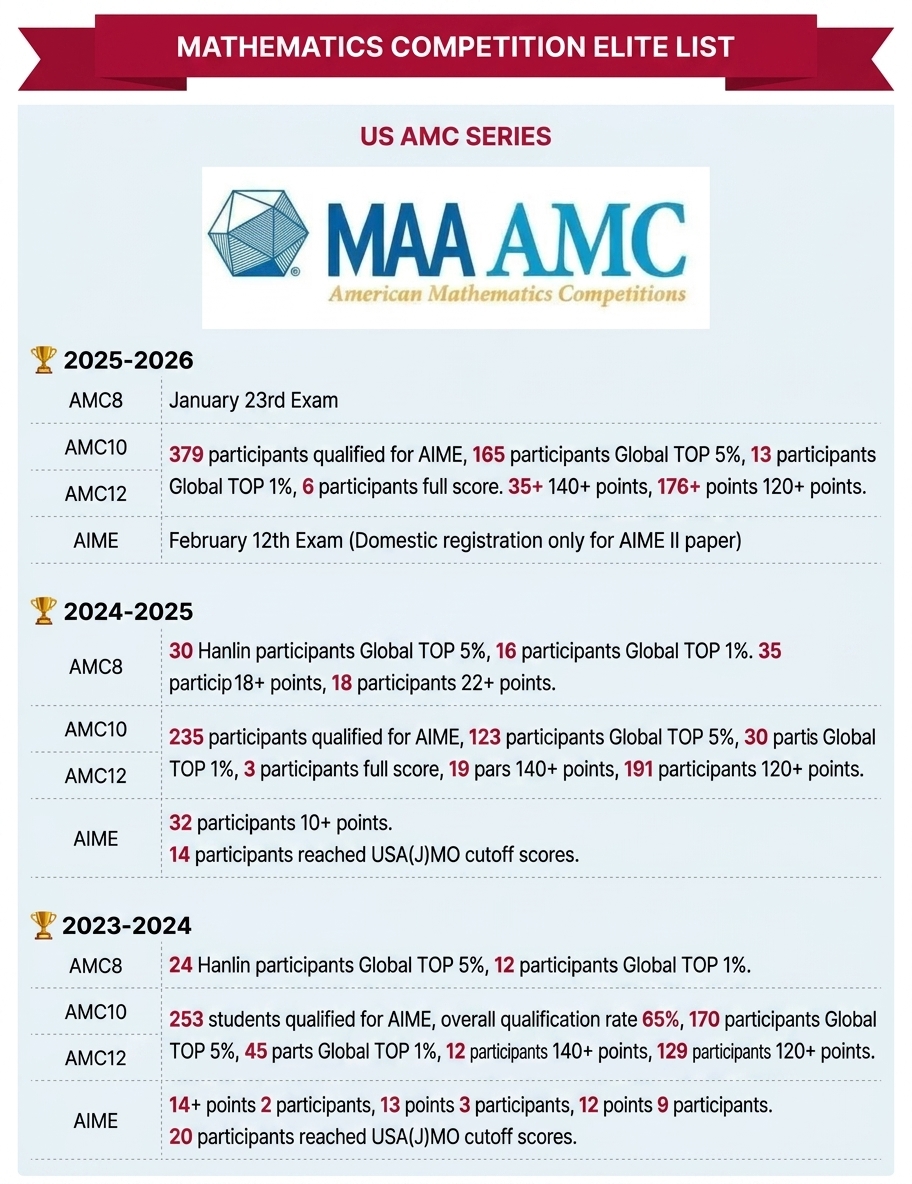
Proof of "hard skills" in application materials: Awards in the AMC 10 math competition, especially the top 1% or 5%, can serve as strong evidence in application materials, enhancing admission competitiveness.
Example: The entrance exam of Guanghua Cambridge International School directly includes original AMC 10 questions; the entrance exam outline of WLSA also explicitly requires mastery of AMC 10 core topics such as polynomial factorization and quadratic function extremum.
2. Students aiming for China's "Top 4" prestigious high schools
Key high schools place great emphasis on mathematical ability when selecting top students: The AMC 10 is more difficult than standard school exams and can quickly identify students with outstanding mathematical literacy.
Advantages in independent enrollment and special class selection: The problem design of the AMC 10 aligns well with competition thinking, helping students stand out in independent enrollment and special class selections. At the same time, the rigorous reasoning habits developed have transferable value for other subjects.
Example: Shanghai's "Top 4" and Shenzhen's "Top 4" prestigious high schools refer to AMC 10 scores in their independent enrollment processes.
3. Students currently enrolled in international schools planning to advance to AIME
One pathway to AIME: The AMC 10 is a crucial way to qualify for the AIME. Therefore, most students choose to begin preparing for the AMC 10 in grade 8 and strive to reach the AIME qualification cutoff.
Extend preparation time, improve problem-solving speed and accuracy: Starting preparation in grade 8 extends the preparation period, allows for systematic training to enhance problem-solving speed and accuracy, accumulates experience for subsequent higher-level competitions, and avoids hasty preparation in upper grades due to academic pressure.
II. What Level of Chinese Mathematics Does AMC 10 Correspond To?
1. Knowledge Scope Comparison
AMC 10 exam content: Covers elementary algebra, basic geometry, elementary number theory, and probability problems. It does not include trigonometry, advanced algebra, or advanced geometry.
Corresponding Chinese mathematics level: 70% junior high school math + 30% mandatory high school math content. Specifically, the algebra portion corresponds roughly to Chinese grade 9 to grade 10 level, while the geometry portion is close to grade 8 to grade 9 plane geometry.
Key differences: AMC 10 emphasizes number theory and combinatorics, whereas the Chinese curriculum only touches on "properties of integers" briefly. AMC 10 requires systematic mastery of concepts like congruences and divisibility, and places greater emphasis on case analysis and constructive abilities.
2. Thinking Logic Comparison
Chinese mathematics education: Emphasizes standardized steps, problem classification, and calculation accuracy.
AMC 10: Values multi-perspective approaches, methodological innovation, and time efficiency, requiring students to possess strong creative thinking and the ability to flexibly apply knowledge.
3. Correspondence Between Score Ranges and Chinese Mathematics Levels
Around 100 points (approx. global top 25%): Equivalent to the level of an outstanding mathematics student in a key Chinese high school, with a solid grasp of in-school knowledge and the ability to solve complex comprehensive problems.
Around 120 points (approx. global top 5%): Equivalent to the level of a provincial third prize in Chinese math competitions, possessing competition thinking and the ability to solve unconventional problems.
Above 135 points (approx. global top 1%): Equivalent to the level of a provincial first prize in Chinese math competitions, with systematic competition training and strong creative problem-solving abilities.
III. Differences Between AMC 10 and Chinese Math Competitions
1. Question Types and Difficulty
AMC 10: 25 multiple-choice questions, full score 150, to be completed in 75 minutes. The problems are flexibly designed, emphasizing the integrated application of multiple knowledge points and testing students' creative thinking and problem-solving skills.
Chinese math competitions: Usually consist of fill-in-the-blank and proof-based questions, with relatively fixed problem types, focusing on formula application and calculation accuracy.
2. Scoring Standards
AMC 10: 6 points for a correct answer, 1.5 points for an unanswered question, 0 points for an incorrect answer. This scoring system encourages reasonable guessing, adding to the interest and challenge of the competition.
Chinese math competitions: Typically deduct points for incorrect answers and give no points for unanswered questions, placing greater emphasis on accuracy and stability.
Scan the QR code to join the AMC 10 exclusive learning community, where you can access a wealth of preparation materials and trial courses!
Scan for free 2010-2025 AMC 10 past papers + solutions + book list + formulas, and trial course details!
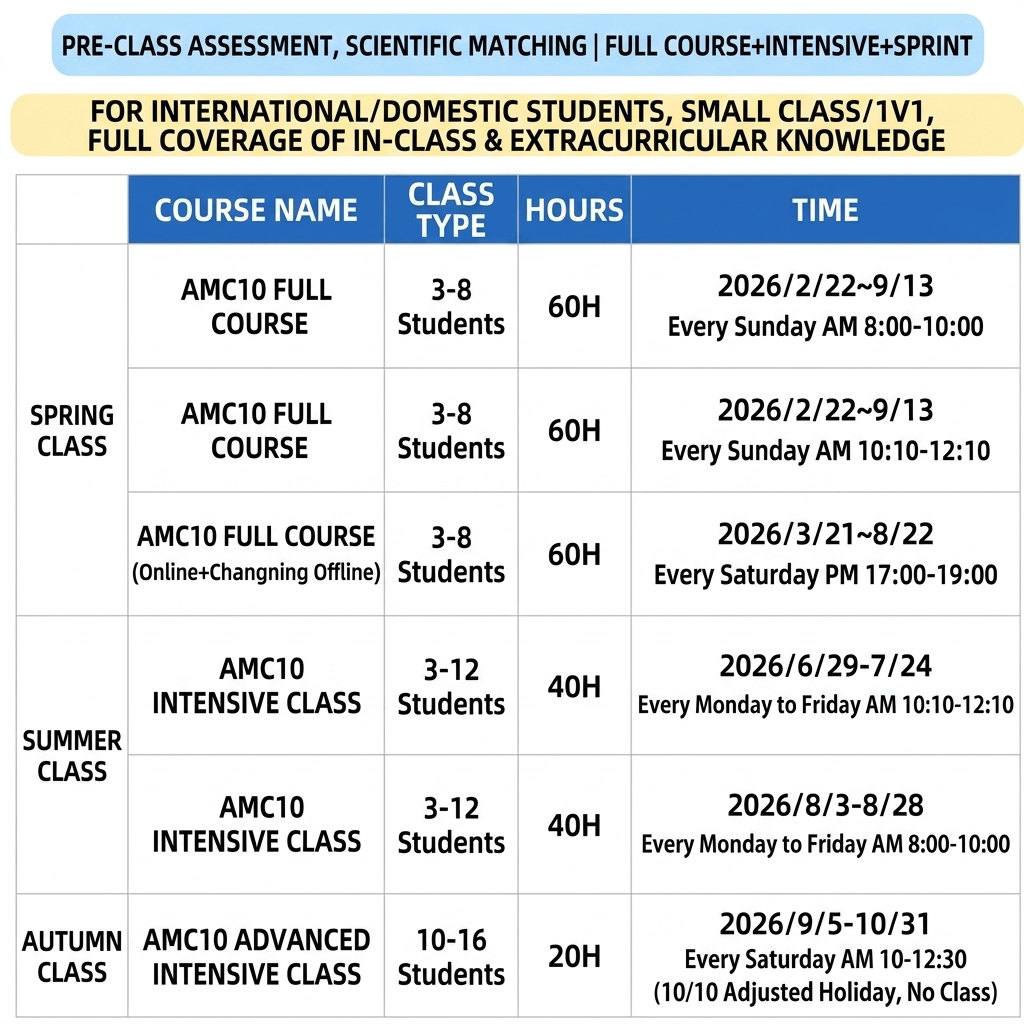
AMC 10 Tutoring Courses
Our instructors are graduates of top universities worldwide, providing precise curriculum planning and full-course learning tracking to ensure you improve and win awards!
|
Class Type
|
Hours
|
Class Size
|
Start Date
|
|---|---|---|---|
|
Winter Break Class
|
30H
|
3–8 students
|
Consult teacher for details
|
|
Systematic Course
|
20H
|
1v1 / 3–8 student class
|
Consult teacher for details
|
|
Problem-Solving Class
|
20H
|
1v1 / 3–8 student class
|
Consult teacher for details
|