
The AMC10 Math Competition not only assesses students' breadth of mathematical knowledge but also tests their problem-solving speed and depth of thinking. Through scientific planning and systematic preparation, even average students can achieve excellent results in this high-level competition.
I. Main Differences Between AMC10 Version A and Version B
1. Different Exam Dates
Version A: November 6, 2025 (Thursday) 17:00-18:15 (75 minutes)
Version B: November 14, 2025 (Friday) 17:00-18:15 (75 minutes)
Typically, the AMC10 Version A exam is held about one week earlier than Version B.
2. Slight Differences in Knowledge Point Proportions
Although both versions cover roughly the same knowledge points—Algebra, Geometry, Combinatorics, and Number Theory—their emphases differ. Version A focuses more on mathematical applications and computational problem-solving, while Version B places greater emphasis on a balanced assessment across various mathematical areas.
3. Different Cutoff Scores
The cutoff scores for advancing to AIME do not differ much between Version A and Version B. However, for the top 1% cutoff, there may be significant fluctuations between the two versions.

II. How to Choose Between Version A and Version B?
Take Both Versions: If time permits, it is recommended that students take both the A and B versions. This not only increases the chances of winning an award but also allows you to better prepare for the second exam using the experience gained from the first.
Can Only Take One Exam: It is recommended to register for Version B. This way, after Version A is completed, you can use the actual past paper to familiarize yourself with the question types, thereby increasing your chances of achieving a high score on Version B.
III. How Long Does an Average Student Need to Prepare for AMC10 to Win an Award?
Based on different foundational levels, average students can refer to the following timeline to prepare for AMC10 and gradually improve to reach their award goals.
January to May (Foundation Period)
For students with no prior experience or a weaker foundation, this is a critical period to systematically master the core knowledge points of AMC10. Lower-grade students, in particular, need to supplement and solidify their foundational knowledge.
Goal: Solve over 1,000 foundational problems and establish a mistake notebook.
June to August (Intensive Period)
After mastering the basics, you need to flexibly apply this knowledge to solve complex problems. Achieve this by working through a large number of problems, promptly organizing mistakes, and repeatedly tackling weak areas.
Goal: Work through past papers from 2018 to 2025, summarize problem-solving models, and conquer intermediate-level questions.
September to November (Sprint Period)
This is the final sprint phase. Focus on breaking through key and difficult points, reviewing and organizing knowledge, and repeatedly training on mistakes. Additionally, do not neglect mock exams and time management training.
Goal: Conduct 1-2 full mock exams per week and optimize time allocation.
IV. Preparation Tips
Foundation Period: Systematically learn the four major modules, solve over 1,000 foundational problems, and establish a mistake notebook.
Intensive Period: Work through recent years' past papers, summarize problem-solving models, and conquer intermediate-level questions.
Sprint Period: In the two weeks before the exam, review mistakes, focus on techniques for the final challenging questions, and adjust your answering pace.
V. Competition Module-Specific Breakthrough Tips
Algebra: Master polynomial transformations, Vieta's formulas, mean inequalities, etc. Improve speed in calculation and symbolic derivation.
Geometry: Deeply understand the Power of a Point theorem, similar triangles, solid geometry sections and volume calculations, etc. Practice constructing auxiliary lines.
Number Theory: Strengthen understanding of modular arithmetic and congruences. Master factorization and recursive thinking. Avoid missing cases when using casework.
Combinatorics: Proficiently use the Inclusion–Exclusion Principle and probability modeling. Use extremal principles and recursion to solve complex counting problems.
VI. Answering Strategies
Easy First, Hard Later: Don't dwell on difficult questions; ensure you score points on easy and intermediate-level questions.
Organize Scratch Paper by Sections: Keep steps clear for easy review. For geometry problems, draw diagrams to aid thinking. For number theory problems, first try small numbers to find patterns.
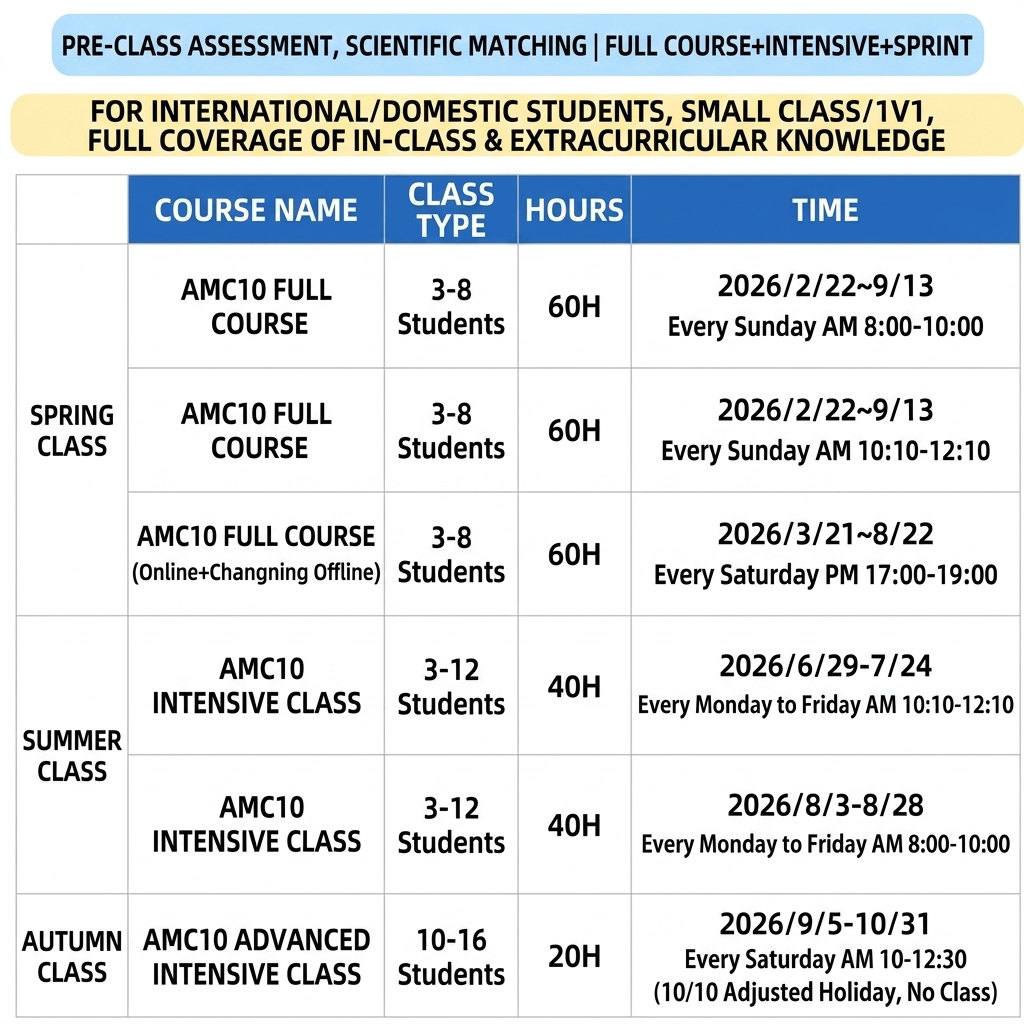
AMC10 Tutoring Courses
Our instructors are graduates of top universities worldwide, providing precise curriculum planning and full-course learning tracking to ensure you improve and win awards!
|
Class Type
|
Hours
|
Class Size
|
Start Date
|
|---|---|---|---|
|
Winter Break Class
|
30H
|
3–8 students
|
Consult teacher for details
|
|
Systematic Course
|
20H
|
1v1 / 3–8 student class
|
Consult teacher for details
|
|
Problem-Solving Class
|
20H
|
1v1 / 3–8 student class
|
Consult teacher for details
|
For more information about AMC10/12 competition courses, please contact us.