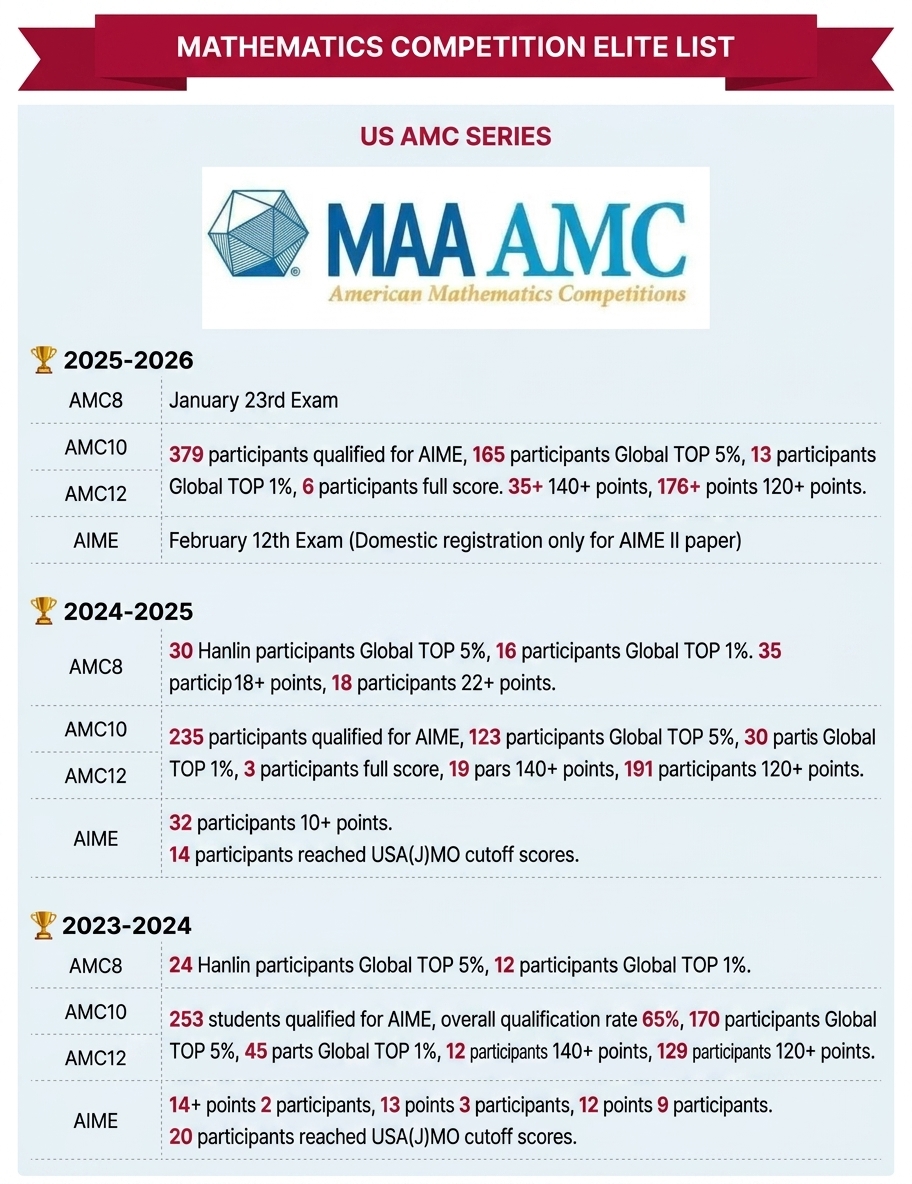
With the release of the 2025 AMC10 cutoff scores, we can observe a trend of increasing difficulty year by year. The threshold for advancing has risen, and the competition has become more intense. This article will provide a detailed analysis of the 2025 AMC10 cutoff trends, the differences between the A and B versions, and offer preparation strategies for 2026 to help you stand out in the fierce competition.

I. Analysis of the 2025 AMC10 Cutoff Scores
Trends in Cutoff Scores over the Last 5 Years
Key Findings:
Significant increase in advancement cutoff: From 93-96 points in 2021 to 105-108 points in 2025.
Intensified competition in high-scoring zones: The cutoffs for the top 5% and top 1% have also risen correspondingly, reaching historic highs in 2025.
Analysis of Underlying Reasons:
Surge in number of participants: The number of test-takers, especially in China, continues to grow globally, leading to more intense competition.
Changes in question style: Shift from "calculation-oriented" to "thinking-oriented and flexible," requiring students to have stronger logical reasoning abilities.
Increased weight of AIME: The value of advancing to the AIME has increased, attracting more outstanding students to participate.
II. AMC10 A vs B: How to Choose?
01 Differences in Focus and Difficulty
AMC10 A
Basic scores are key: Questions are mostly "direct applications of core knowledge points," without obscure or strange questions.
Characteristics: The first 15 questions are basic questions (accounting for 60% of the total score), suitable for candidates who want to "secure basic points and aim for medium scores." Questions 16-20 are medium difficulty. Questions 21-25 are only a few advanced questions.
AMC10 B
Advanced questions determine the gap: The questions focus more on "higher-order thinking and comprehensive problem-solving strategies," with a higher proportion of difficult questions (19-25) requiring unconventional methods to solve.
Characteristics: The proportion of basic questions is reduced, and medium and difficult questions are closely linked. Suitable for candidates with "a solid foundation who want to reach the top 5% / top 1%."
02 Differences in Cutoff Scores
The difficulty levels of the A and B versions are similar, but some questions on the B version are more challenging. Historical data shows that the advancement cutoff for the B version is generally higher than that of the A version, but the overall fluctuation is minimal.
03 How to Choose?
Exam Schedule: The A version is usually one week earlier than the B version (expected to be November 6 and November 14, 2026).
Difficulty and Focus: The A version focuses more on the application of mathematics in real-world scenarios and computational problem-solving. The B version emphasizes a balanced examination of various fields, with some questions being more flexible and requiring higher mathematical literacy.
Strategic Recommendations: If conditions permit, it is recommended to take both exams and use the highest score. If you can only take one, you can first refer to the A version's past papers to familiarize yourself with the question types before making a decision.
III. 2026 AMC10 Preparation Strategies
1. Foundation Phase (6 months in advance)
Core Goal: Focus on Algebra (main scoring area) + Number Theory (advantageous for gaining points), thoroughly understand medium-level geometry problems, and grasp basic combinatorics question types.
Specific Steps: Work through questions 1-22 of past 10 years' exams by module, summarizing quick problem-solving techniques for each module (e.g., substitution method in algebra, auxiliary lines in geometry, congruence simplification in number theory). Aim for ≤5% errors per module, ensuring immediate familiarity with the approach for medium-level questions (11-20).
2. Advanced Phase (3 months in advance)
Core Goal: Full-length timed mock exams (75 minutes), practicing time allocation and answer strategies.
Ideal Pace:
Questions 1-10 ≤18 minutes (all correct)
Questions 11-20 ≤32 minutes (≤1 wrong)
Questions 21-25 ≤20 minutes (aim for 2-3 correct)
Last 5 minutes for review.
Study Plan: Complete 3 sets of past A/B exams from the last 5 years each week, review mistakes on the same day, and fill frequent gaps.
3. Sprint Phase (1 month before the exam)
Core Goal: Let go of obscure and strange questions, return to high-frequency topics and core formulas.
Specific Steps: Review the mistake notebook + high-frequency questions from the last 3 years, memorize quick calculation formulas for geometry/number theory, practice classic question types 21-25. Establish consistent answering habits, circle keywords in questions to avoid reading comprehension or calculation errors.
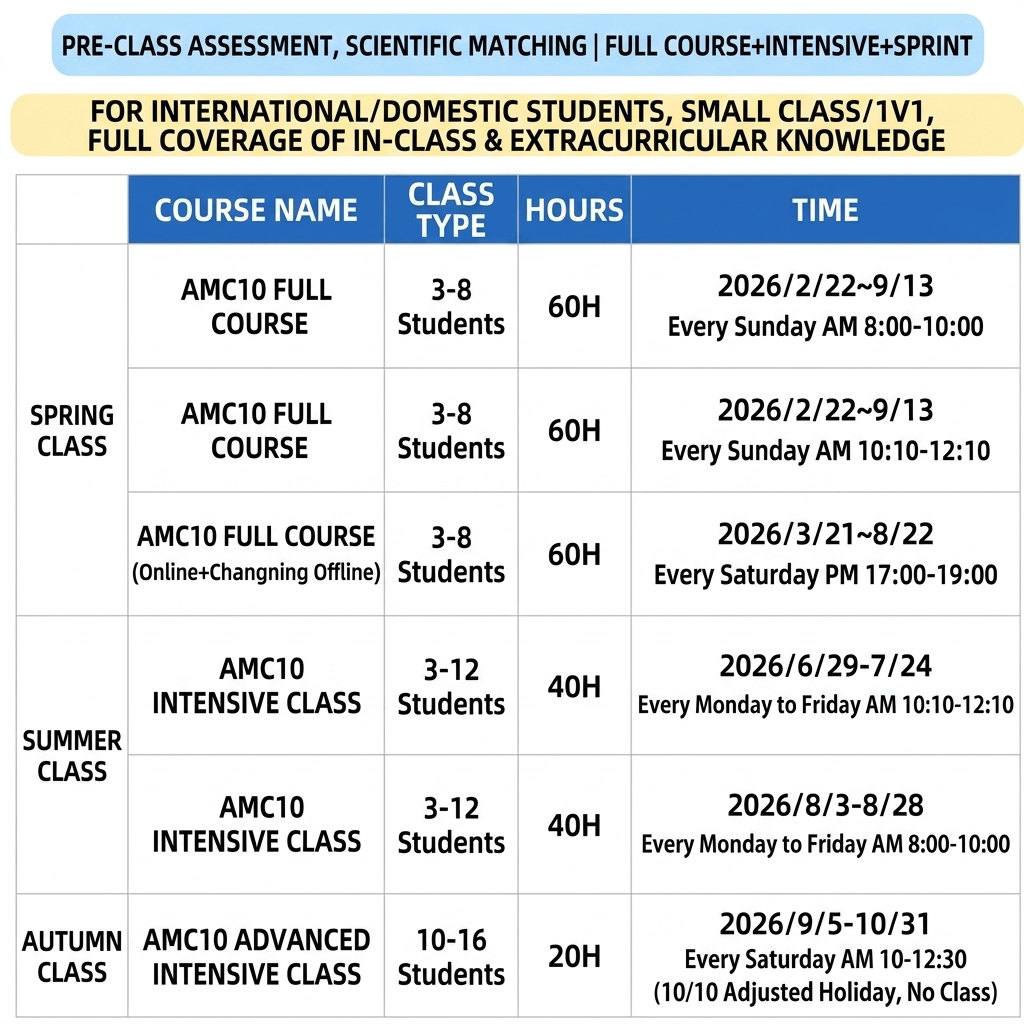
AMC10 Preparation Courses
Our instructors are graduates from top global universities. With precise curriculum planning and comprehensive learning tracking, we ensure your score improvement and award-winning success!
| Class Type | Hours | Class Size | Start Date |
|---|---|---|---|
| Winter Break Class | 30H | 3–8 students | Consult teacher for details |
| Systematic Course | 20H | 1v1 / 3–8 students | Consult teacher for details |
| Problem-Solving Class | 20H | 1v1 / 3–8 students | Consult teacher for details |