
Many parents and students mistakenly believe: "AMC10 is a high school competition, it's too early for middle school students" or "Students in the domestic track don't need to take international competitions."
But the truth is quite the opposite—middle school is the golden window for preparing for AMC10! Especially for students transitioning from the domestic track to an international one, AMC10 is not only proof of mathematical ability but also a "key" that unlocks barriers to academic advancement.
This article will comprehensively analyze, from three dimensions—academic improvement, educational value, and award pathways—why middle school students (especially those in grades 8–9) are now in the best position to start preparing for AMC10.

I. Dual Improvement in Grades and Thinking: Competition ≠ Detached from Curriculum, It's an "Advanced Upgrade"
Highly Overlapping Knowledge: Preparing for the competition is also reviewing
The four core modules of AMC10 (Algebra, Geometry, Number Theory, Combinatorics) almost fully cover the key content of middle school mathematics:
Algebra: Equations, Inequalities, Functions, Sequences → Corresponds to high school entrance exam (Zhongkao) problem-solving questions
Geometry: Triangle congruence/similarity, properties of circles, Pythagorean theorem → Core of Zhongkao geometry
Number Theory: Factors and multiples, congruence, divisibility → Expands on the "Integers" chapter
Combinatorics: Counting principles, probability → Connects to high school elective content
Key Differences:
In-school problem: "Find the solution to this equation."
AMC10 problem: "Under certain conditions, how many integer solutions does this equation have?"
It's not beyond the syllabus; it's about depth + flexibility upgrade.
Cognitive Skills Nurtured Reflect Back on In-School Learning
Through AMC10 training, students will learn to:
Break down complex problem statements and quickly identify core concepts;
Build a knowledge network instead of memorizing formulas in isolation;
Improve time-constrained problem-solving skills to confidently tackle challenging Zhongkao problems;
Develop a habit of summarizing patterns, enhancing overall scientific literacy.
II. Maximizing Academic Advancement Value: A "Game-Changer" for Students Transitioning from Domestic Track
For students planning to transfer from middle school to international high school (such as IB, A-Level, AP programs), AMC10 offers irreplaceable strategic value:
Advantage 1: Solid Foundation, Low Preparation Cost
Domestic track students have strong calculation skills and a solid foundation, far exceeding their peers in pure international programs;
They only need to supplement competition thinking and problem-solving patterns (like the Inclusion–Exclusion Principle, permutations and combinations), no need to start from scratch;
With 3–6 months of systematic training, they can reach the AIME qualification level.
Advantage 2: Breaking Stereotypes, Highlighting STEM Strengths
International high school admissions officers often have two major concerns about domestic track students:
"They only know how to drill problems and lack logical thinking"
"They rely on teachers and have weak independent learning skills"
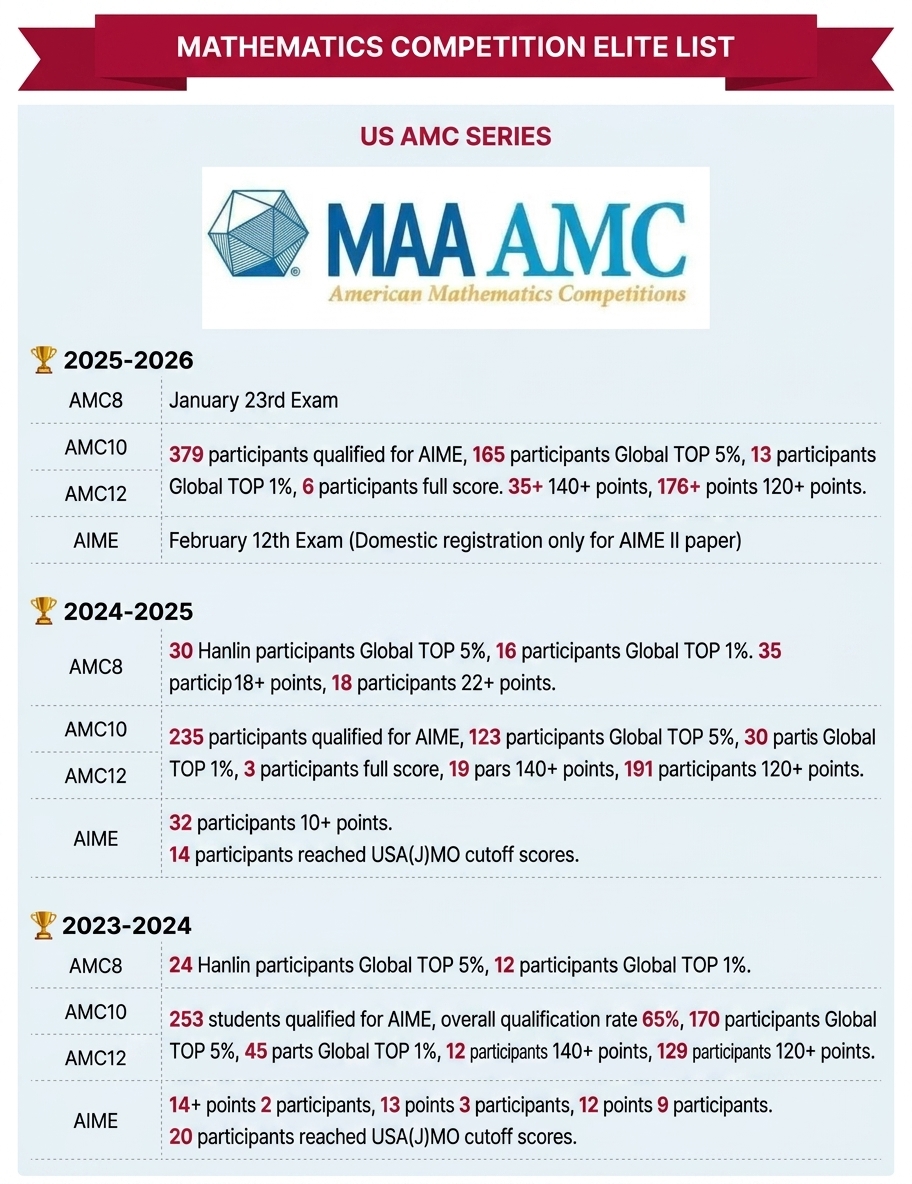
An AMC10 Top 5% or AIME qualification certificate directly proves that you possess the mathematical reasoning skills required for an international curriculum and that you can independently tackle challenging problems, adapting to the inquiry-based learning of IB/A-Level.
Advantage 3: Filling the Background Gap, Boosting Application Competitiveness
Compared to transfer applicants who only have "in-school grades + IELTS/TOEFL," those with AMC10 awards will:
Receive priority attention in resume screening;
Showcase growth mindset and resilience through their competition preparation experience during interviews;
Be more likely to earn scholarships or admission to top-tier classes.
III. How Can Middle School Students Scientifically Set AMC10 Award Goals?
| Goal Level | Required Correct Answers | Accuracy | Preparation Focus |
|---|---|---|---|
| Qualify for AIME | ≥17 questions | ≈68% | Secure points on Q1–20, grab 1–2 on Q21–25 |
| Top 5% (Honor Roll) | ≥20 questions | ≈80% | ≤1 wrong in medium-difficulty Q11–20, 2 correct in Q21–25 |
| Top 1% (DHR) | ≥22 questions | ≈88% | ≤3 minutes per question on Q1–15, efficiently tackle Q16–25 |
Pacing Suggestions (75 minutes)
Questions 1–15: ≤40 minutes (<3 minutes per question, aim for all correct)
Questions 16–20: ≤22 minutes (aim for minimal mistakes)
Questions 21–25: ≤13 minutes (grab 2 questions, leave the rest blank wisely)
Scoring Strategy Reminder:
IV. Actionable Advice for Parents of Middle School Students
Don't wait to "finish learning high school knowledge" before starting. 80% of AMC10 content is already covered in middle school; what's missing is just the training in mathematical thinking.
Prioritize AMC10 to validate abilities, not AMC8. If your child consistently scores 90+ in school math, AMC8 is no longer challenging; AMC10 is better at unleashing their potential.
Incorporate AMC10 into academic planning. 8th grade: first attempt, target Credit/Distinction; 9th grade: aim for AIME qualification, build a highlight for applications; 10th grade: if not qualified, shift to AMC12 as a safety net.
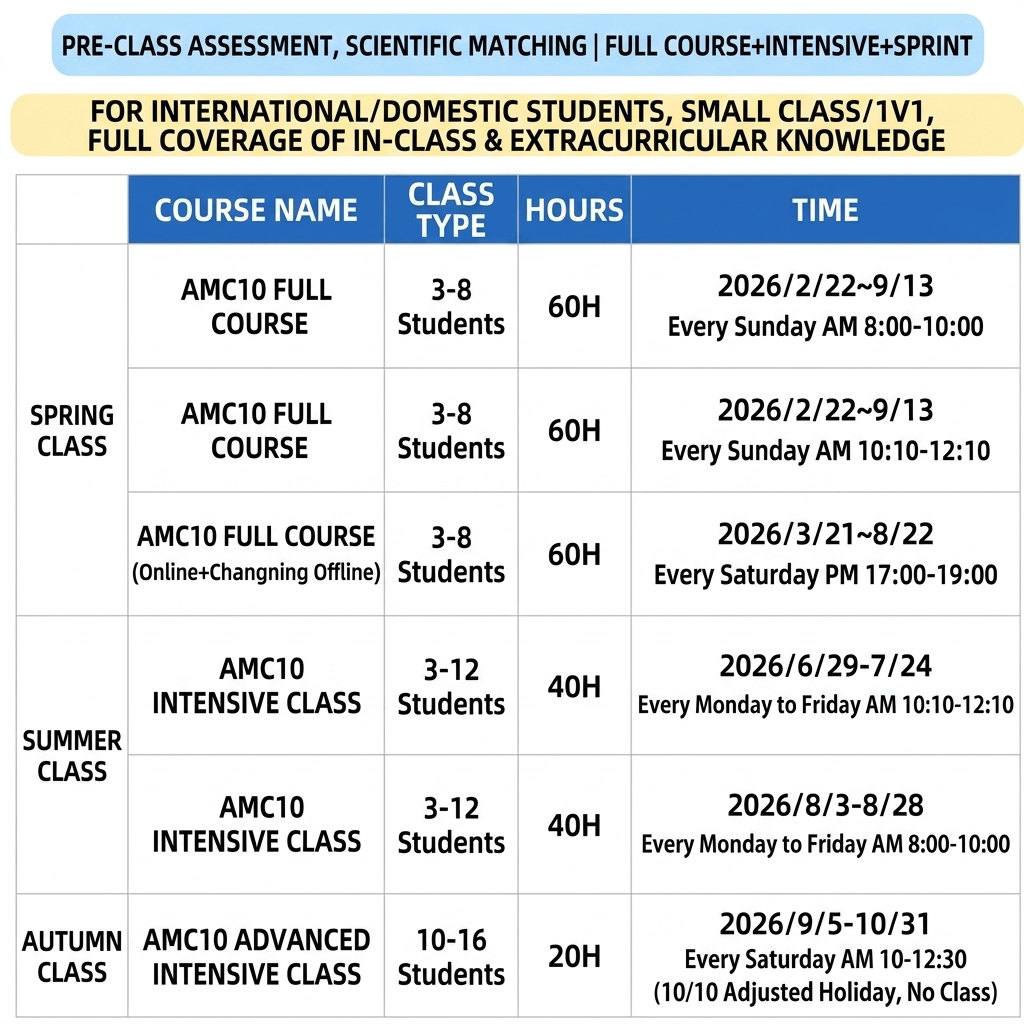
AMC10 Preparation Courses
Our instructors are graduates from top global universities. With precise curriculum planning and comprehensive learning tracking, we ensure your score improvement and award-winning success!
| Class Type | Hours | Class Size | Start Date |
|---|---|---|---|
| Winter Break Class | 30H | 3–8 students | Consult teacher for details |
| Systematic Course | 20H | 1v1 / 3–8 students | Consult teacher for details |
| Problem-Solving Class | 20H | 1v1 / 3–8 students | Consult teacher for details |