
Many parents mistakenly believe: "AMC12 is just AMC10 with two more years of content, slightly more difficult."
But the truth is quite the opposite—AMC10 and AMC12 have fundamental differences in knowledge systems, difficulty structures, advancement logic, and strategic value. Choosing the wrong competition not only wastes preparation time but may also undermine a student's confidence. This article will thoroughly clarify, from five dimensions—knowledge points, difficulty, value, cutoff scores, and participation strategy—which competition your child should take: AMC10 or AMC12?

I. Core Knowledge Point Comparison: More Than Just "Two More Years" – It's a Different Track
| Topic Area | AMC10 | AMC12 |
|---|---|---|
| Algebra | Linear/quadratic equations, inequalities, function basics | Advanced inequalities (Cauchy, AM-GM), higher-degree equations, function composition and inverses |
| Geometry | Plane geometry, similarity, circle basics | Solid geometry, analytic geometry, complex plane geometry, trigonometric identities |
| Number Theory | Factors and multiples, congruences, modular arithmetic basics | Euler's theorem, Fermat's little theorem, higher-degree congruences, Chinese remainder theorem |
| Combinatorics | Addition/multiplication principle, basic probability | Generating functions, recurrence relations, advanced expectation, conditional probability |
| Additional Core Topics | ❌ Not tested | ✅ Trigonometry ✅ Logarithms and exponential functions ✅ Complex numbers and complex plane |
Key Difference: AMC10 stops at "elementary mathematics," while AMC12 enters the complete high school mathematics system and paves the way for AIME/USA(J)MO.
II. Difficulty Comparison: Which Is More "Competitive"?
On the surface: AMC12 > AMC10
The final problems of AMC12 (Questions 21–25) often involve pre-college content, such as complex number rotations, nested trigonometric identities, and advanced recurrences, earning it the title "genius filter."
Actual advancement difficulty: AMC10 > AMC12
| Competition | 2025 AIME Cutoff Score | Characteristics of Participants |
|---|---|---|
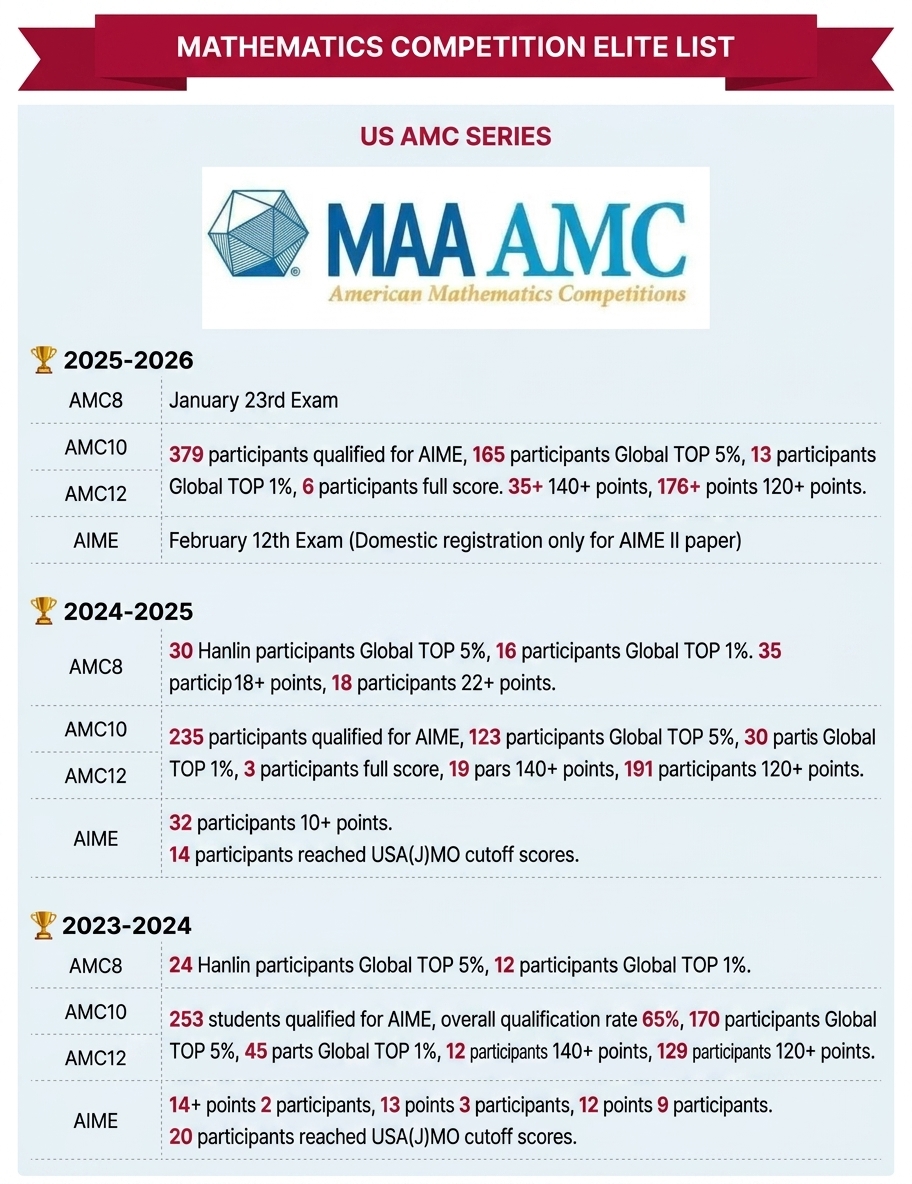
| AMC10 | Version A: 105 / Version B: 99 | Many 8th–9th grade "trial" students lower the average, but top competitors are extremely strong, pushing the cutoff higher. |
| AMC12 | Version A: 96 / Version B: 100.5 | Primarily 11th–12th graders with complete knowledge, but with higher tolerance for errors (perfect score 150, 96 points ≈ 16 correct answers + leaving some blank). |
The truth: AMC10 is a "high-score rat race"—the top 1% threshold is extremely high; AMC12 is a "standard-based selection"—as long as you have full knowledge coverage, steady preparation makes it easier to advance to AIME.
III. Value Comparison: Real Worth from an Admissions Perspective
| Target University/Major | Recommended Path | Reason |
|---|---|---|
| Top 30 US universities (non-elite STEM) | AMC10 top 1% or AMC12 top 5% | Both serve as proof of mathematical ability. |
| Ivy League / MIT / Caltech / Stanford | Must take AMC12 + High AIME score | AMC12 scores are directly linked to USA(J)MO selection and are a "hard currency" for top STEM schools. |
| Quantitative majors like CS/Engineering/Physics/Economics | Prioritize AMC12 | Advanced math tools (trigonometry, complex numbers, logarithms) are foundational for these fields, and AMC12 better demonstrates underlying ability. |
IV. How to Choose Scientifically? A Guide for Three Typical Scenarios
Scenario 1: The child is still building a foundation (Grades 8–10, new to competitions)
Recommendation: AMC10
Reason: Fewer knowledge gaps, avoids frustration from "not having learned trigonometry/complex numbers"; focus on training stability in the first 20 questions, build confidence; the goal is not to win awards but to build a framework for competition thinking.
Note for parents: At this stage, focus on "experience + accumulation," not on scores.
Scenario 2: The child is stuck at an AMC10 bottleneck (consistently solving 12–16 questions, struggling to advance)
Recommendation: Switch to AMC12
Reason: The last 5 questions of AMC10 require exceptional talent and extensive time to master; whereas the first 20 questions of AMC12 are more "routine" for high school students with complete knowledge; with the same ability, it's easier to qualify for AIME with AMC12 (96 points vs. 105 points).
Scenario 3: The goal is a clear AIME score (applying to Ivy League/strong STEM programs)
Recommendation: Prepare directly for AMC12
Reason: AMC12 is the only path to USA(J)MO; even 10th graders who have already studied trigonometry, logarithms, and complex numbers can certainly challenge AMC12; admissions officers value a trajectory of continuous advancement (e.g., 9th grade AMC10 → 10th grade AMC12 → 11th grade AIME 10+).
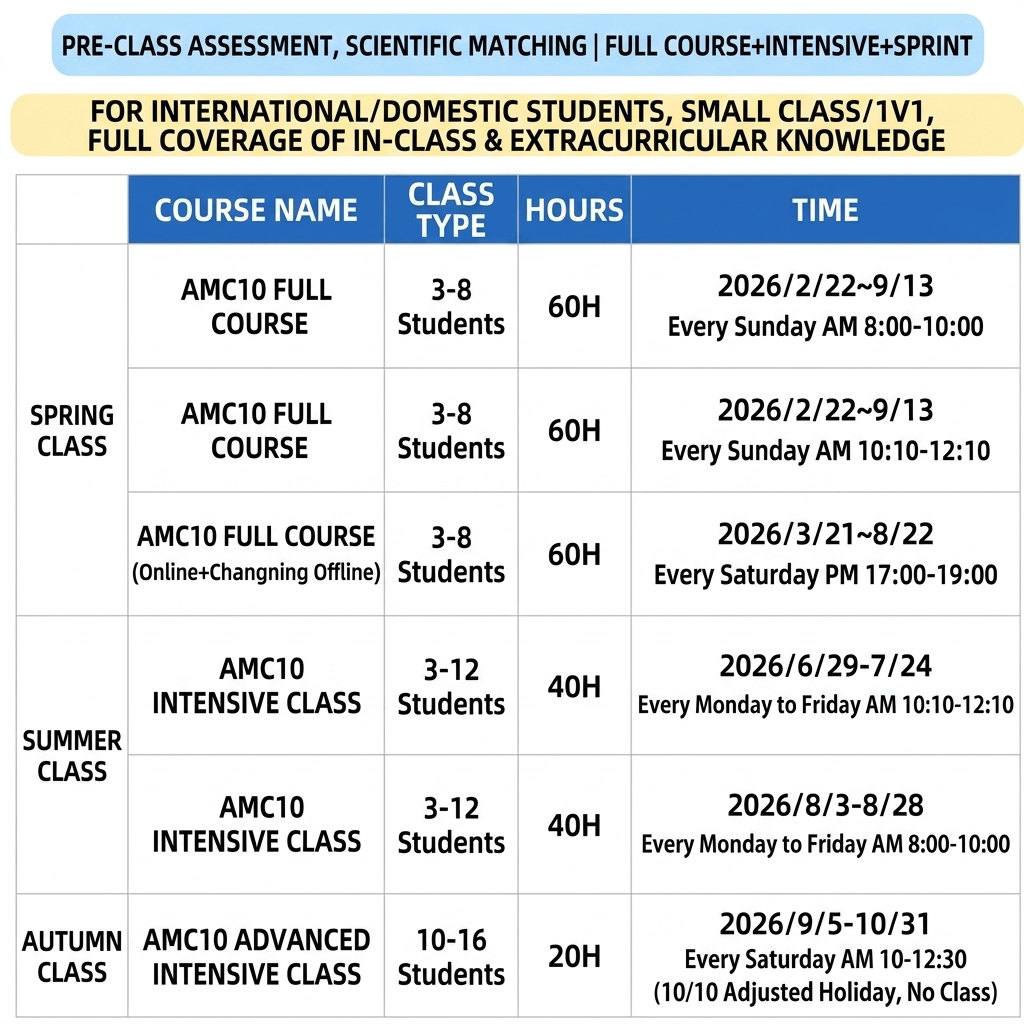
AMC10 Preparation Courses
Our instructors are graduates from top global universities. With precise curriculum planning and comprehensive learning tracking, we ensure your score improvement and award-winning success!
| Class Type | Hours | Class Size | Start Date |
|---|---|---|---|
| Winter Break Class | 30H | 3–8 students | Consult teacher for details |
| Systematic Course | 20H | 1v1 / 3–8 students | Consult teacher for details |
| Problem-Solving Class | 20H | 1v1 / 3–8 students | Consult teacher for details |