
The AMC, sponsored by the Mathematical Association of America (MAA), is the world's most influential middle school mathematics competition system. Among them, AMC8 and AMC10 are the starting points for most Chinese students to engage with international math competitions. However, there are significant differences between the two in terms of target audience, difficulty, content, and objectives. Choosing the wrong track may yield half the results with twice the effort; choosing the right path allows for efficient score improvement and steady progression. Below is a systematic comparison of AMC8 and AMC10 from five dimensions, along with scientific transition strategies and competition participation advice.

I. Core Differences Comparison Table
| Dimension | AMC8 | AMC10 |
|---|---|---|
| Target Audience | Grade 8 and below, ≤14.5 years old | Grade 10 and below, ≤17.5 years old |
| Exam Date | January each year | November each year (A/B versions) |
| Exam Duration | 40 minutes | 75 minutes |
| Questions & Format | 25 multiple-choice questions | 25 multiple-choice questions |
| Scoring Criteria | +1 point for correct answer, 0 for incorrect/blank, max 25 points | +6 points for correct answer, +1.5 points for blank, 0 for incorrect, max 150 points |
| Difficulty Level | ≈ Grade 5 Chinese Elementary School Math Olympiad level (some questions reach Grade 7) | ≈ Chinese Junior High School Math League level (covers Grade 9 to Grade 10) |
| Core Competencies Tested | Calculation accuracy, basic application, attention to detail | Depth of mathematical thinking, breadth of knowledge, flexible modeling ability |
II. Content Scope and Depth Comparison
AMC8 Focus Areas
Basic Calculations: Integer operations, fractions, decimals, percentages, ratios
Elementary Geometry: Pythagorean theorem, area/perimeter, angles, simple solid figures
Counting and Probability: Basic permutations and combinations, classical probability
Word Problems: Modeling everyday situations such as distance, work, concentration
Data Interpretation: Chart reading, mean, median
Limited Extensions: Simple linear equations, coordinate systems, quadratic function graph recognition
Characteristics: Emphasizes fundamentals, speed, and attention to detail. The first 15 questions are mostly extensions of in-school content, while the last 10 questions begin to show differentiation in thinking.
AMC10 Focus Areas
Advanced Algebra: Quadratic equations, inequalities, function properties, sequences
Advanced Geometry: Similar triangles, circle properties, coordinate geometry, trigonometric identities (excluding trigonometry)
Introduction to Number Theory: Prime factorization, modular arithmetic, GCD/LCM
Probability and Statistics: Conditional probability, expected value, combinatorial counting (including Inclusion–Exclusion Principle)
Logic and Strategy: Game theory, optimization, recurrence relations
Note: Does not test advanced high school topics such as trigonometry, calculus, complex numbers, or vectors, but places extremely high demands on logical reasoning and the integration of multiple knowledge points.
III. How to Transition Smoothly from AMC8 to AMC10?
The transition from AMC8 to AMC10 is not an "upgrade" but a "leap." It requires completing three major transformations during winter or summer break:
1. Broaden Knowledge Base – Supplement Core Middle School Modules
Key areas to supplement:
Quadratic functions and graphical analysis
Geometric properties of circles (chords, tangents, inscribed angles)
Basic number theory (congruence, concept of Fermat's Little Theorem)
Advanced combinatorial counting (permutations vs. combinations, case analysis)
2. Upgrade Thinking – From "Calculating Correctly" to "Thinking Thoroughly"
AMC8: Know the formula → Substitute and calculate
AMC10: Understand the essence of the problem → Build a model → Choose the optimal solution
Example: AMC10 often tests strategies such as "simplification using symmetry," "extreme case analysis," and "reverse construction."
3. Practice with Past Papers – Familiarize Yourself with the Style of A/B Versions
AMC10 offers Version A and Version B each year. The difficulty fluctuates slightly, but the question types are consistent.
Recommendation: Complete 2 sets each from the A and B versions of the past 5 years, and summarize high-frequency test points (e.g., Question 23 of the 2024 B version tested recursive sequences + modular arithmetic).
IV. AMC8 or AMC10? Precise Selection by Grade Level
| Grade Level | Recommendation | Reason |
|---|---|---|
| Grade 6 and below | Focus on AMC8 | AMC10 involves a large amount of algebra and geometry proofs, which younger students lack the knowledge foundation for, potentially hurting their confidence. The AMC8 top 1% (Honor Roll) already carries significant weight. |
| Grades 7–8 | Decide based on circumstances:
|
Grades 7–8 are a critical window period. If a student can consistently score 20+ points on AMC8, they can attempt AMC10; otherwise, it is recommended to solidify the foundation first. |
| Grades 9–10 | Must take AMC10 | Exceeds the age limit for AMC8, and AMC10 scores directly affect eligibility for AIME invitation (top 2.5%), serving as an important credential for applying to STEM programs at US universities. |
Decision Tool:
Conduct an AMC8/10 placement test (25 questions, timed simulation) and make a decision based on the score:
AMC8 test ≥20 points → Can challenge AMC10
AMC10 test ≤80 points → Recommended to strengthen foundation before competing
V. Value of Participation: More Than Just a Competition – A Springboard for Academic Advancement
AMC8:
Suitable for upper elementary students to build math confidence
Reference for international school admission/placement
Lays the foundation in calculation and thinking for AMC10
AMC10:
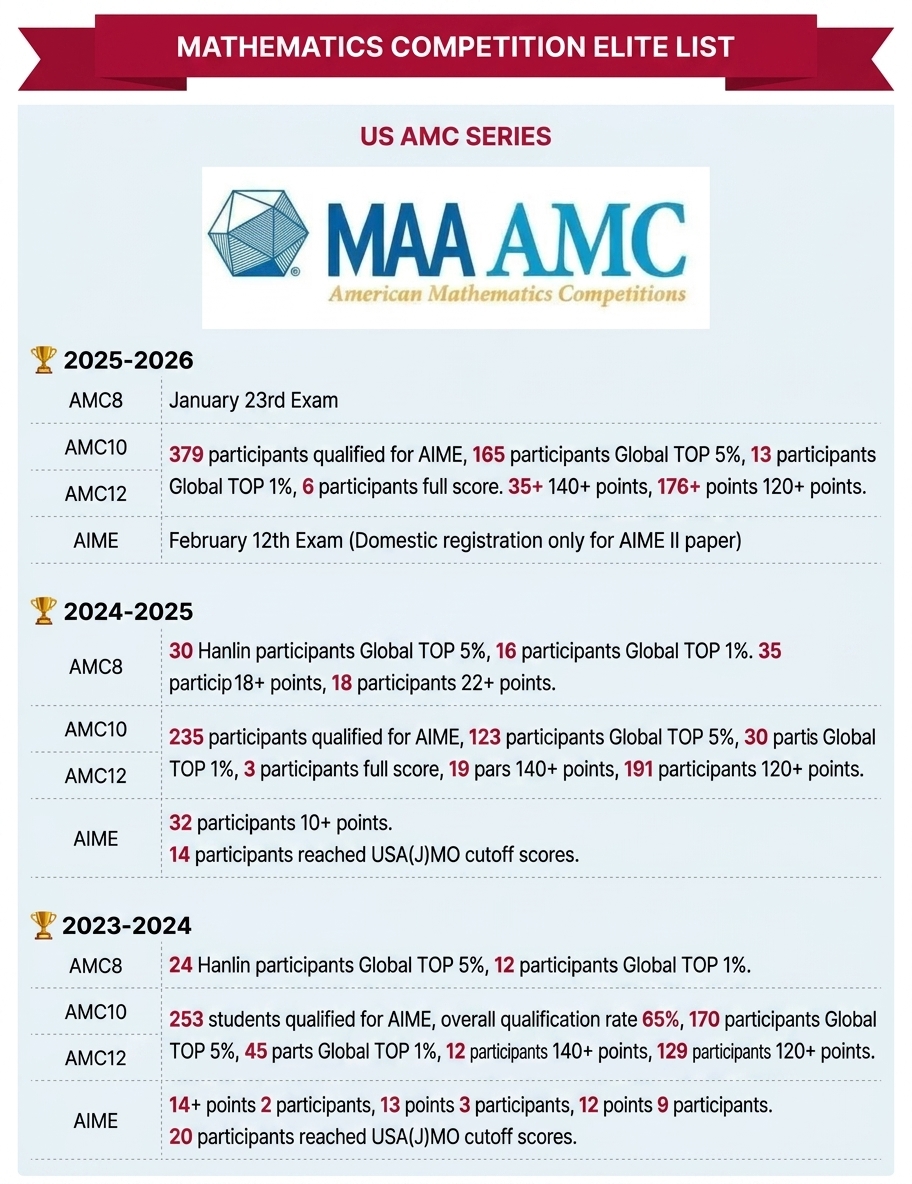
Global Top 2.5% receive AIME invitation – the first step toward USAMO
Recognized proof of STEM ability by Oxford, Cambridge, Ivy League, G5, and Top 30 US universities
Reference for scholarships at top Canadian universities such as Waterloo, University of Toronto, and UBC
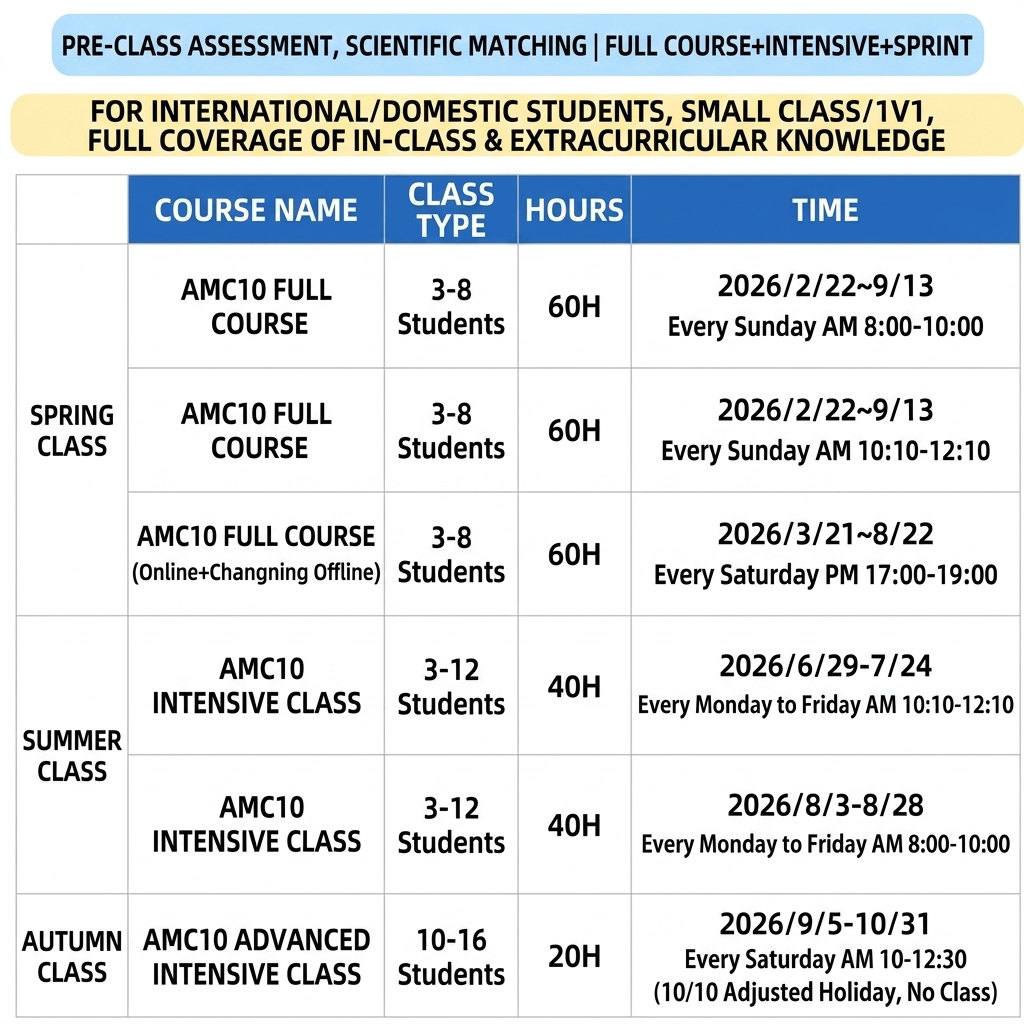
AMC10 Preparation Courses
Our instructors are graduates from top global universities. With precise curriculum planning and comprehensive learning tracking, we ensure your score improvement and award-winning success!
| Class Type | Hours | Class Size | Start Date |
|---|---|---|---|
| Winter Break Class | 30H | 3–8 students | Consult teacher for details |
| Systematic Course | 20H | 1v1 / 3–8 students | Consult teacher for details |
| Problem-Solving Class | 20H | 1v1 / 3–8 students | Consult teacher for details |