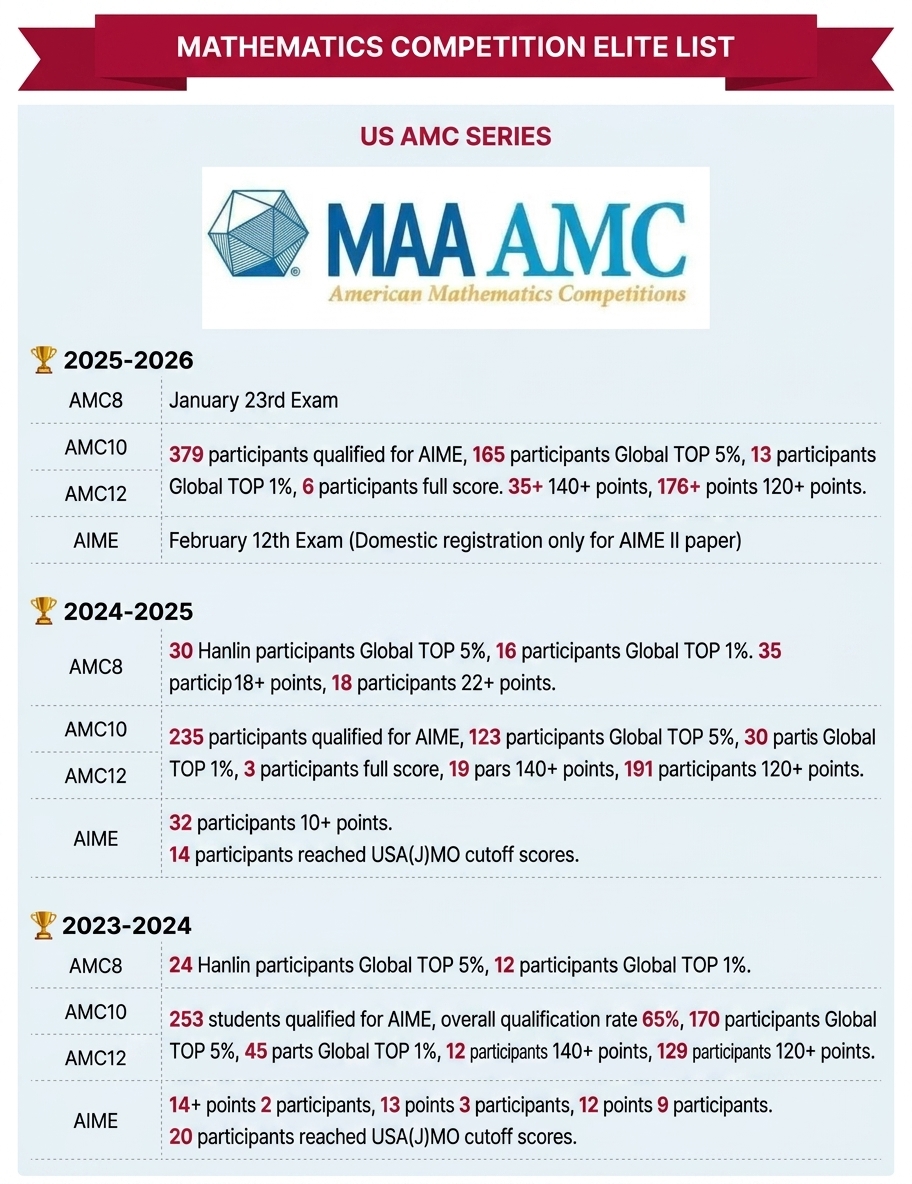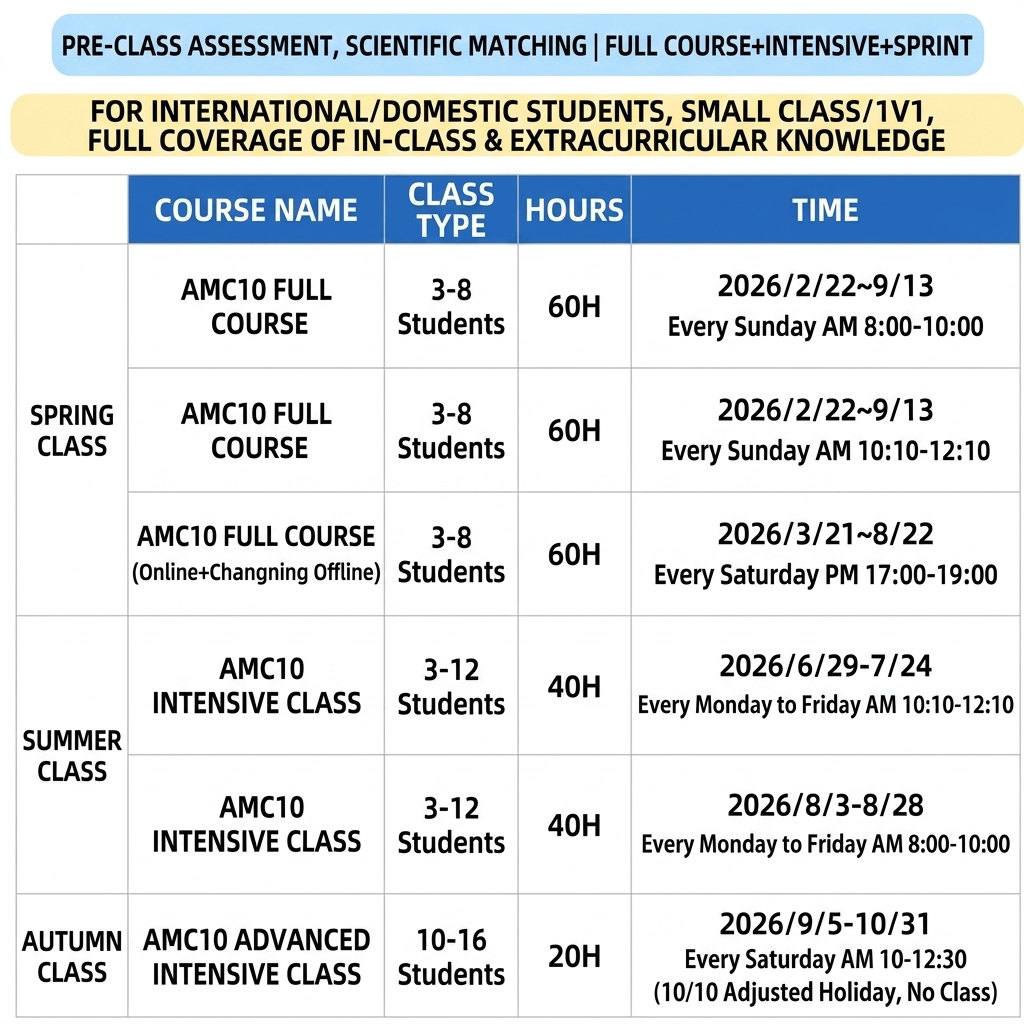

As one of the most influential high school mathematics competitions globally, the AMC10 has an official eligibility criterion of grade 10 or below (or under 17.5 years old on the day of the exam). However, "being eligible to register" does not mean "it is suitable to take the exam." According to years of teaching data and student award-winning cases, blindly following the trend only wastes time. The period from 8th to 10th grade is the "golden track" for this competition.

I. Best Timing for the AMC10: A Comprehensive Breakdown by Grade Level
Students at different grade levels are at different stages of cognitive development; developing a matching strategy is the key to success.
| Grade Level | Recommendation Index | Core Strategy & Positioning |
|---|---|---|
| 9th-10th Grade (Sophomore/Junior) |
⭐ Golden Period | The Best Value for Effort: Go All Out. At this stage, students' knowledge base (algebra, geometry) and logical thinking ability align perfectly with the difficulty curve of the AMC10. Preparation yields the fastest progress, making it the optimal time to achieve high scores and qualify for the AIME. For 10th graders, this is the last opportunity before college applications, and they must give it their all. |
| 8th Grade (Freshman) |
⭐ Potential Period | Get Ahead Early: Lay the Groundwork for the Future. Ideal for students with a solid math foundation, Olympiad background, or consistently top in-school grades. The goal at this stage is not necessarily to win the highest award, but to familiarize oneself with question types through practical experience, develop competition thinking, and build momentum for a breakthrough in 9th grade. |
| 7th Grade & Below | ⚠ Foundation Period | Consolidate the Basics: Avoid Pushing Too Hard. There is a significant gap in in-school knowledge, especially nearly zero exposure to number theory, combinatorics, and advanced geometry. Forcing preparation for the AMC10 can easily lead to frustration and damage self-confidence. It is recommended to first conquer the AMC8, build a solid foundation, and then progress upward. |
II. Pitfall Avoidance Guide: Four Common Misconceptions in AMC10 Preparation
Many students work very hard but get stuck with scores between 80 and 100. This is often because they have fallen into the following misconceptions:
1. Forcing "School Thinking" onto "Competition Problems"
Phenomenon: Only able to solve problems step-by-step by setting up equations; gets stuck when encountering variations of problems; spends too much time on the first 15 questions, giving up on questions 16 and beyond.
Solution: Build a competition knowledge framework (Algebra → Geometry → Number Theory → Combinatorics). Learn to use "quick-kill" techniques such as substitution method, elimination method, extreme value principle, and symmetry analysis, instead of brute-force calculating.
2. Blindly Tackling Difficult Problems, Neglecting the Foundation
Phenomenon: Obsessively studying advanced number theory or out-of-scope problems, but losing points on simple geometry questions.
Solution: The foundation leads to victory. Focus on mastering high-frequency test points like factorization, completing the square, similar triangles, the Pythagorean theorem, divisibility rules, and the inclusion-exclusion principle. First, ensure extremely high accuracy on the first 15 questions, completing them within 20 minutes, before tackling the harder ones.
3. Only Practicing Problems Without Reviewing, Repeating the Same Mistakes
Phenomenon: Engaging in rote problem-solving that feels productive but repeating the same type of error; unable to solve problems when numbers or contexts are changed.
Solution: A mistake notebook is not for copying problems. It must include three elements: error analysis (conceptual misunderstanding/calculation error/overlooked condition), deduction of the correct approach, and identification features of similar problems. Categorize problems by module and extract solution models.
4. Practicing Without Time Limits, Crashing on Exam Day
Phenomenon: High accuracy during practice, but unable to finish on the actual exam; spending too much time on the first 10 questions, leaving no time for the last 5 challenge problems.
Solution: Treat practice like the real exam. Strictly time your practice sessions and develop the habit of making quick decisions. Learn to strategically skip questions—if you have no idea after 2 minutes, skip it immediately to reserve time for later difficult problems.
III. Selection Guide: How to Choose a Reliable AMC10 Prep Course?
The market is full of mixed-quality institutions. Parents should focus on the following four dimensions when choosing a course to avoid pitfalls:
| Evaluation Dimension | Core Focus Points | Pitfall Avoidance Advice |
|---|---|---|
| Teaching Faculty (Prestigious Background + Practical Experience) |
Does the teacher hold a degree from a top university like Tsinghua, Peking, Fudan, or an Ivy League? Do they have a high-scoring record in the AMC/AIME? The number of cohorts they have taught is crucial—being able to solve problems oneself does not guarantee effective teaching. | Avoid university students who merely "lecture from a script." Choose full-time teachers with a mature teaching and research system. |
| Curriculum System (Tiered Instruction + Scientific Planning) |
Are there differentiated course levels based on foundation (e.g., Fundamentals, Comprehensive, Sprint)? Does the curriculum cover all four major modules: Algebra, Geometry, Number Theory, and Combinatorics? | Beware of "hodgepodge" teaching. A good curriculum should progress layer by layer, like peeling an onion. |
| Service & Feedback (Full-Process Management) |
Is there a placement test before enrollment? Are homework assignments graded? Is feedback on learning progress timely? | Institutions that only offer classes without follow-up coaching usually see significantly diminished results. |
| Teaching Mode (Attention Determines Efficiency) |
Is it a small class (6-10 students), 1-on-1, or a large class of dozens? | Small classes and 1-on-1, though slightly higher in price, allow instructors to attend to each student's reactions, resulting in strong interaction and far greater preparation efficiency than a large class where students can easily get lost. |