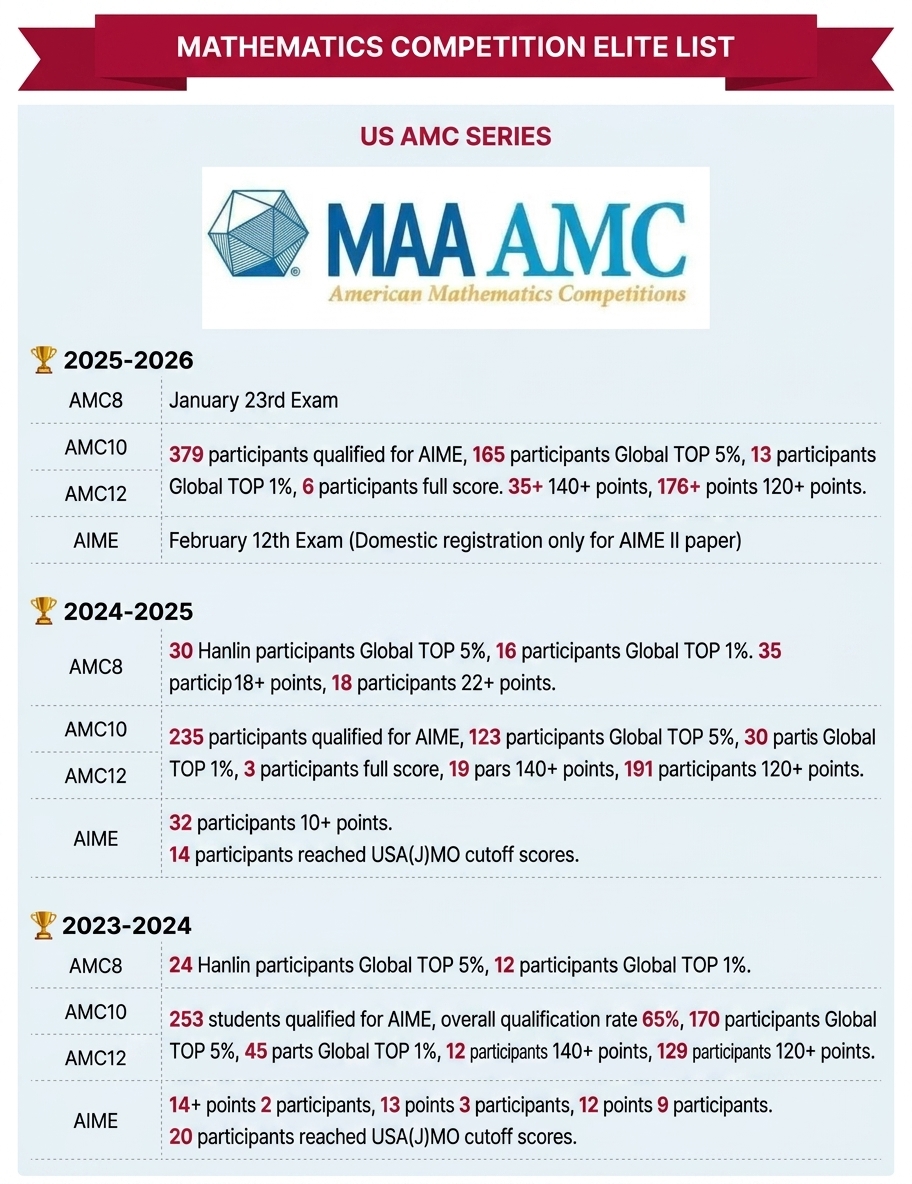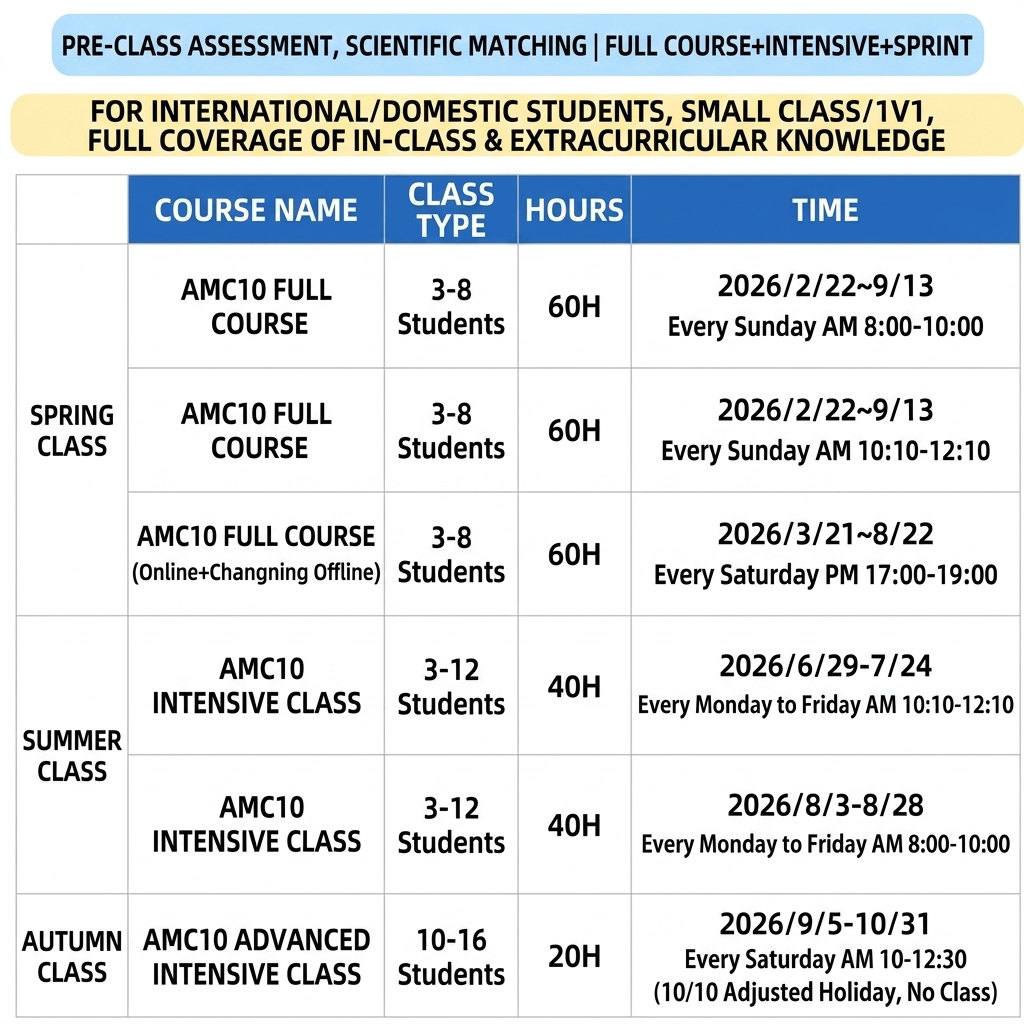

When planning the path for international mathematics competitions, the AMC10 is often the key watershed for students transitioning from foundational to advanced levels. Many parents often have questions: Which grade level is the AMC10 suitable for? What level of mathematics in China does it correspond to? To apply for top schools, what level of awards are needed? The following is an in-depth analysis for you.

I. Target Audience of AMC10 and Difficulty Benchmarking
The AMC10 is officially intended for students in Grade 10 (Grade 10) and below, but among the actual participants, students in Grades 8-9 with a solid mathematical foundation account for a considerable proportion. From the perspective of the knowledge system, the scope of the AMC10 corresponds to the domestic mathematics syllabus from Grade 9 to Grade 10. However, its proposition logic is completely different from domestic regular exams. It does not simply test the proficiency of knowledge points, but rather focuses more on flexible logical reasoning and cross-module comprehensive application. The overall difficulty lies between the domestic high school entrance examination (Zhongkao) and the college entrance examination (Gaokao), roughly equivalent to the level of the National Junior High School Mathematics League. For students who are accustomed to the "step-by-step" approach of school mathematics, the AMC10 is quite a challenge in terms of thinking flexibility and knowledge breadth.
II. The Four Core Knowledge Modules of AMC10
The knowledge points of the AMC10 cover a wide range. The core can be summarized into the following four modules, and a clear knowledge framework needs to be established during preparation:
Algebra
This is the module with the largest proportion. In addition to conventional linear and quadratic equations and inequalities, the focus is on polynomial operations, complex functions (absolute value, recursion, exponential and logarithmic), sequences (arithmetic, geometric, and recursive relations), and basic complex numbers. In addition, advanced techniques like the AM-GM inequality are also common test points.
Geometry
The scope of the exam extends from plane geometry to solid geometry and analytic geometry. The core includes theorems of plane geometry such as triangle congruence and similarity, power of a point theorem, Menelaus' theorem, and Ceva's theorem. It also involves the equations of lines and circles, volume and surface area calculations in solid geometry, and the properties of the "four centers" of a triangle (centroid, orthocenter, incenter, and circumcenter).
Number Theory
This is a relatively weak area for students in the domestic Chinese education system. The focus is on divisibility, remainders, prime numbers, congruence and modular arithmetic, prime factorization, greatest common divisor, and least common multiple. Parity analysis, properties of perfect squares, and basic Diophantine equations are also high-frequency test points.
Counting & Probability
This module has the most varied types of questions and is highly challenging. The core covers permutation and combination (addition/multiplication principle, inclusion-exclusion principle), various probability calculations (geometric probability, conditional probability), the binomial theorem, the pigeonhole principle, and recursion and induction.
III. Core Goal: Which AMC10 Awards Are Most Favored by Top Schools?
The AMC10 has a total score of 150 points (25 multiple-choice questions, 6 points for a correct answer, 1.5 points for leaving a question blank, 0 points for an incorrect answer). In the fierce competition, the value of different awards varies significantly:
Distinguished Honor Roll (Top 1%): This is the most valuable top honor in the AMC10, usually requiring a score of 120 points or higher. Achieving this award means that the student has entered the ranks of the world's top math students. It is regarded as the "gold standard" in the eyes of admissions officers at top universities like MIT and Stanford.
Honor Roll (Top 5%): Awarded to the top 5% of participants worldwide, typically requiring a score of around 100 points. This is a highly competitive award that strongly proves the student's excellent potential and solid foundation in mathematics, serving as an important plus in applications to US Top 30 universities.
AIME Qualification: This is the core strategic goal for most AMC10 examinees. Outstanding students ranking in the top 2.5% to 5% globally will be invited to participate in the AIME (American Invitational Mathematics Examination). The difficulty of the AIME is far higher than that of the AMC10. As long as you successfully qualify, this achievement itself is bright enough and is a necessary path to higher-level mathematical honors.
Achievement Roll: Specifically established for young participants in Grade 8 and below. It is awarded as long as the score reaches 90 points or above. For junior high school students, this is an excellent academic encouragement and can also demonstrate mathematical talent in advance during the transition from junior to senior high school or when applying to US high schools.