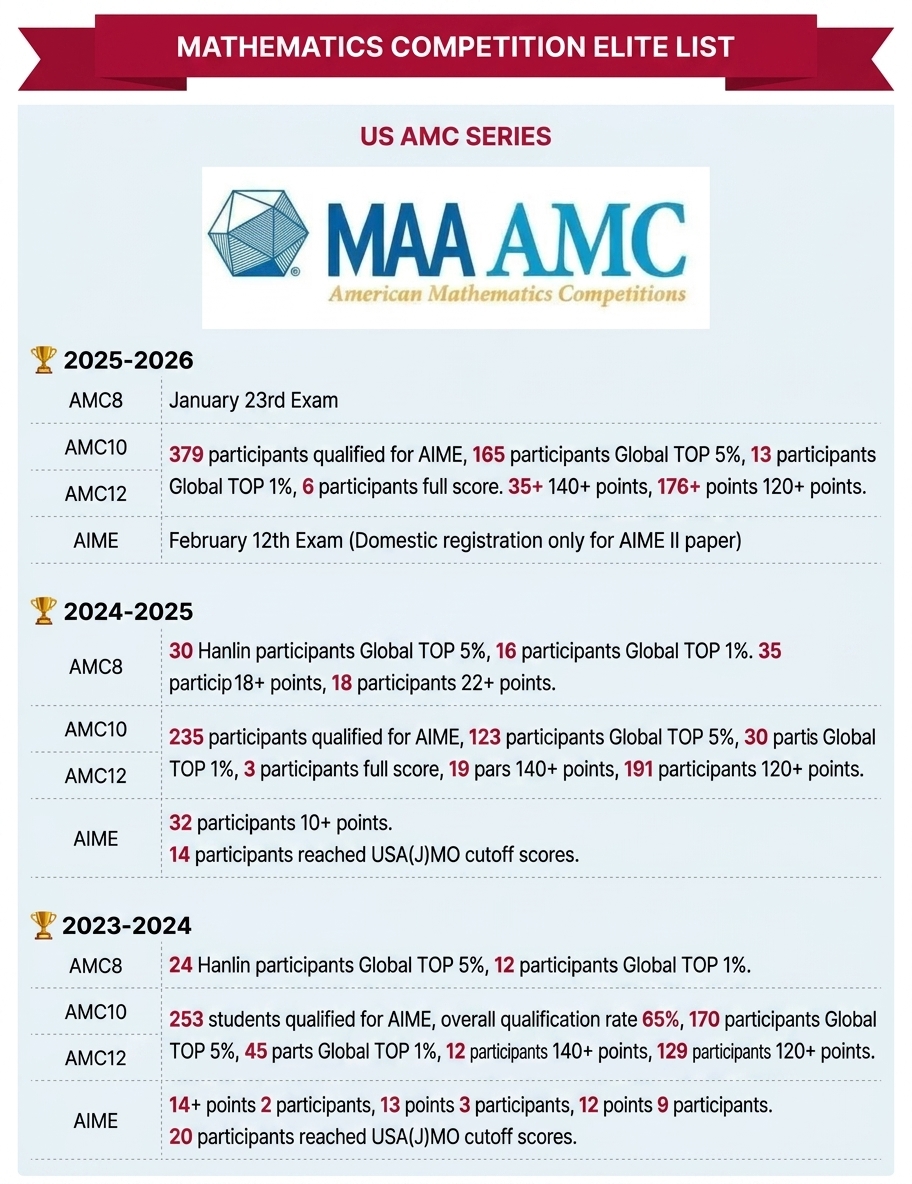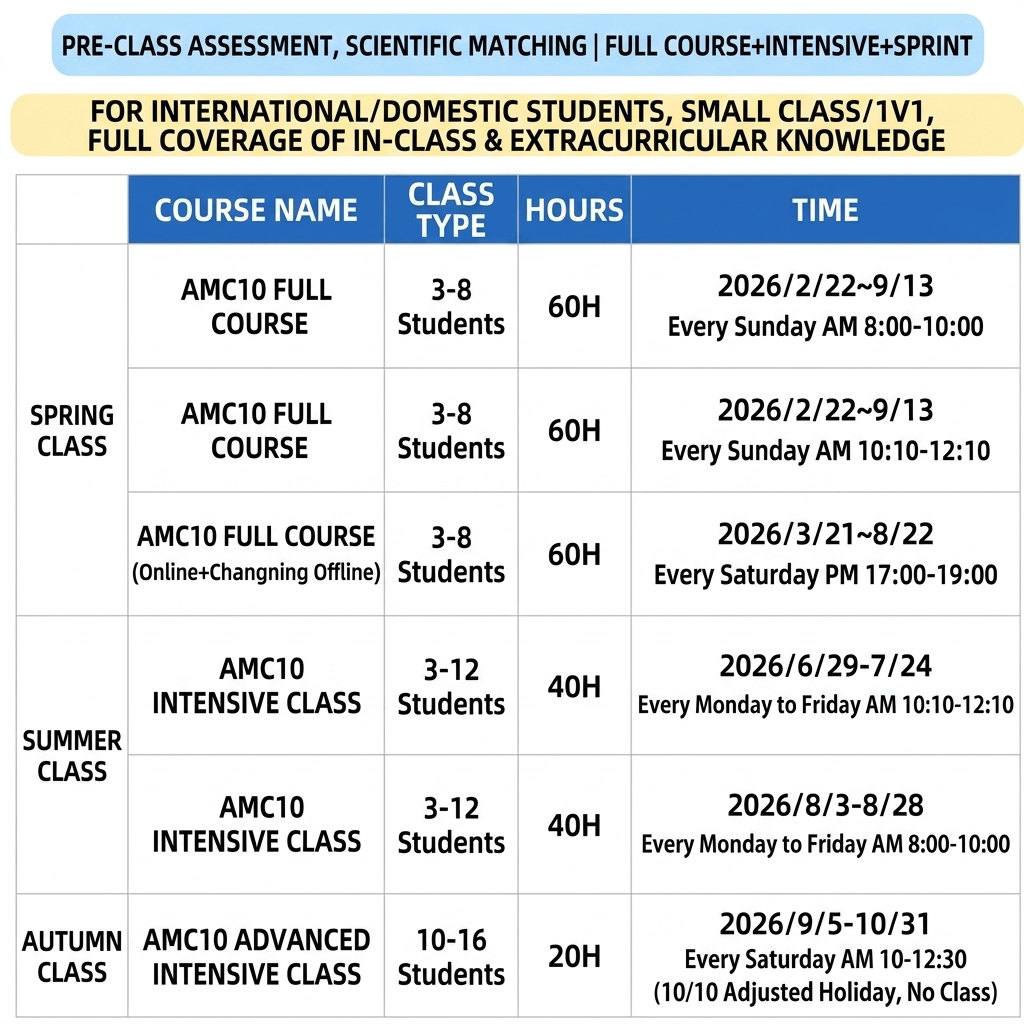

The AMC10 is officially open to students in grade 10 or below (and under 17.5 years of age on the day of the competition). However, when considering preparation strategy and the main body of participants, students in grades 8 and 9 equivalent to domestic are considered the "golden group" for taking the AMC10.

I. Why Are Grades 8-9 the 'Golden Years' for AMC10?
For students in grades 8-9, participating in the AMC10 comes with natural advantages:
Just the right knowledge base: Students at this stage have typically completed the core content of middle school algebra and geometry, but have not yet entered the heavy academic pressure of high school, leaving them with relatively flexible time.
Most effective transition: The difficulty of the AMC10 falls between that of the middle school math league and high school math league. Preparing during these years allows students to consolidate their in-school knowledge while expanding their thinking through competition, laying a foundation for AMC12 or AIME in high school.
II. Grade-Level Strategy Differences for AMC10 Preparation
| Grade Level | Core Focus | Recommendations & Goals |
|---|---|---|
| Grades 7-8 | Build foundation + Cultivate interest | Recommendation: If AMC8 scores are strong (e.g., 20+), attempt to engage with AMC10 content. Focus on becoming familiar with the competition rhythm and supplementing number theory, combinatorics, and other topics not covered in school. Goal: Aim for the Global Achievement Roll (grade 8 or below and score ≥ 90) or become familiar with question types — avoid rushing for results. |
| Grades 8-9 | Systematic learning + Aim for top 5% | Recommendation: This is the golden period for preparation. You need to systematically study the four major modules (Algebra, Geometry, Number Theory, Combinatorics) and begin timed practice with past papers. Goal: Consistently achieve Honor Roll (top 5%, approx. 105-110 points) and attempt to reach the AIME qualifying threshold. |
| Grades 9-10 | High score sprint + AIME qualification | Recommendation: This is the final opportunity to take AMC10. Your knowledge system should be complete. Focus on conquering the final challenging problems (questions 21-25) and optimizing time allocation. Goal: Aim for Distinguished Honor Roll (top 1%, approx. 120-130+ points) and ensure AIME qualification. |
III. How Big Is the Gap from AMC8 to AMC10?
Many students who score high on the AMC8 may feel out of their depth when first encountering the AMC10. The main reasons are:
Large knowledge gap: Compared to AMC8, AMC10 introduces quadratic functions, polynomials, arithmetic/geometric sequences, introductory geometric proofs, and other pre-high school concepts.
Higher-level thinking required: AMC10 no longer tests isolated knowledge points, but emphasizes the combined application of multiple topics and logical reasoning. For example, a single problem might involve both geometric figures and algebraic calculations.
Practical performance gap: Many students who scored 20+ on AMC8 may only answer about 10 questions correctly on their first attempt at AMC10 past papers. Therefore, setting aside 6 to 12 months of systematic preparation is essential.
IV. Reference: The Value of AMC10 Awards
AMC10 awards are highly recognized worldwide, with top 1% results serving as a strong credential for applying to top-tier universities:
Distinguished Honor Roll (DHR, Top 1%): In 2025, the cutoff for version A reached 136.5, and for version B it was 133.5. This represents top-tier mathematical problem-solving ability globally.
Honor Roll (HR, Top 5%): The cutoff typically ranges from 100 to 110 points, serving as a significant indicator of strong mathematical literacy.
AIME Qualification: Typically the top 2.5% of participants qualify, with cutoff scores generally fluctuating between 95 and 105 points.