

Many parents, upon hearing that the AMC10 is an international math competition that requires learning ahead of the curriculum, instinctively think: "It must be incredibly difficult—my average child could never handle it." In reality, this is not quite the case—the AMC10 is far less intimidating than imagined, but it is by no means an opponent to be taken lightly.
I. Breaking the Misconception: Where Does the AMC10's Difficulty Lie?
First, let's be clear: the AMC10 does not involve any advanced mathematics. All test points fall within the scope of the domestic middle school mathematics curriculum. It does not test calculus, linear algebra, or even most high school elective topics.
So where does its "difficulty" truly lie? The real challenge is that the problem-solving approach is entirely different from school exams. School math problems mostly test direct formula application—after practicing a problem type three to five times, a student can solve it with their eyes closed. But AMC10 problems are far more flexible, especially the later ones, which integrate knowledge points from multiple modules and hide many subtle traps, testing a student's logical reasoning ability and quick problem-solving skills.
Moreover, the AMC10 consists of 25 questions to be completed in just 75 minutes, averaging only 3 minutes per question. This places considerable demands on both speed and accuracy—it's not just about "knowing how to solve it," but about "being able to solve it quickly and correctly."
II. The 2026 Season Is Approaching—Summer Is the Final Golden Window
The exam dates for the 2026 AMC10 season have been confirmed:
Paper A: November 5, 2026 (Thursday), 17:00–18:15
Paper B: November 13, 2026 (Friday), 17:00–18:15
Registration deadlines: October 26 for Paper A, November 3 for Paper B.
With less than five months remaining until the exam, summer is the only golden preparation period of the year with no academic distractions, allowing for focused, intensive training. If you're still hesitating, thinking "let's wait until school starts," it may already be too late.
We are an officially authorized AMC test center and can provide free registration assistance! Scan the QR code to inquire about the 2026 AMC10 registration details ⇓
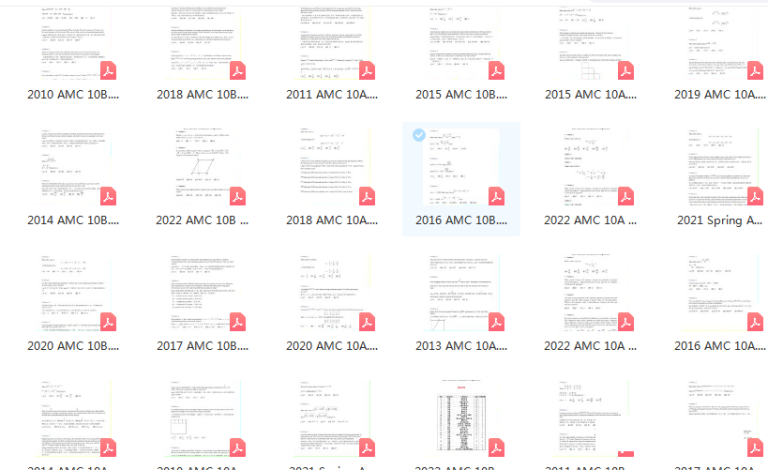
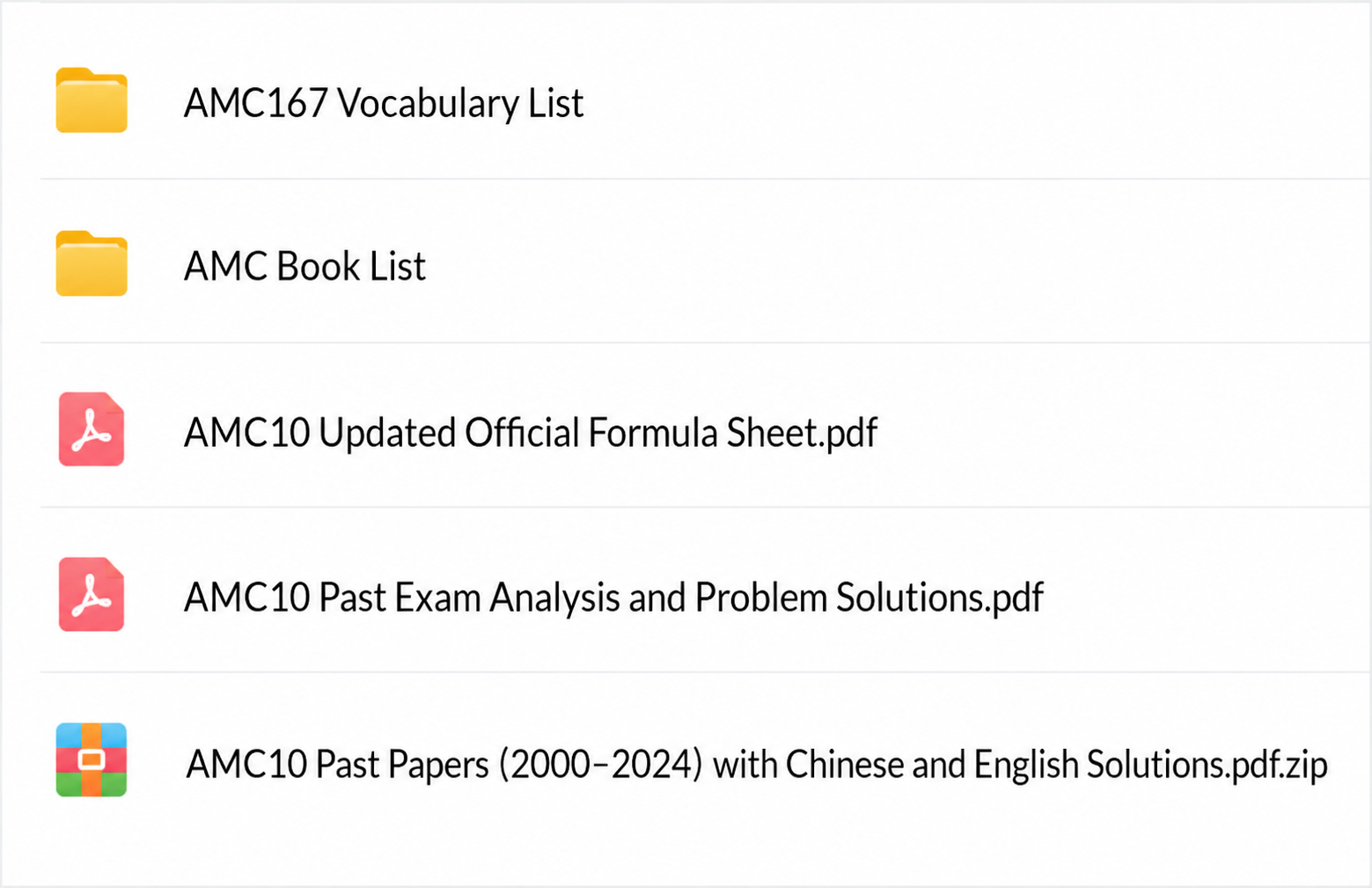
Scan the QR code for free access to AMC10 past papers (2010–2025) + solutions + book lists + formula sheets, and trial course information![reference:29]

III. Why "Cramming" Doesn't Work—Three Hard Realities
① Soaring Participation Numbers, Rising Cutoff Scores
AMC10 participation in the China region has grown from 2,000 in 2007 to over 50,000 today—a 25-fold increase over 16 years—and continues to grow at 20%–25% annually. In 2025, the AIME qualifying cutoff for Paper A surged to 105 points (up 3 points), and Paper B to 99 points (up 12 points); the Global Top 1% (DHR) remained stable above 130 points. Competition in 2026 will only intensify—short-term cramming is no longer effective.
② A Vast Knowledge System—Four Modules Require Systematic Building
The AMC10 covers four major modules: Algebra (35%–40%), Geometry (25%–30%), Number Theory (20%–25%), and Combinatorics (10%–15%). Among these, Number Theory and Combinatorics are the areas most neglected in the domestic school curriculum, yet they account for a significant proportion of the AMC10.
A harsh reality is that a student who scores perfectly in school math may, without systematic training, only be able to correctly answer the first 15 questions on the AMC10. Summer is the only time for immersive, topic-focused preparation—miss it, and you'll have to wait another year.
③ In-Person Test Seats Are Scarce—Securing a Spot Means Securing Your Opportunity
The 2026 AMC10 season has fully reverted to in-person paper-based exams. A test seat equals eligibility—no make-up exams, no extensions. In popular cities, core test center seats are already hard to come by. Early planning and early seat reservation are just as important as systematic preparation.
IV. How Should Students at Different Grade Levels Prepare for the AMC10?
Grade 7: Build a Solid Competition Foundation
Having just entered middle school, jumping directly into AMC10 preparation may be too challenging. It is recommended to start with a Pre-AMC10 course to fill in any gaps in middle school math knowledge, then gradually transition to AMC10 competition content. For 7th graders, it is advisable to allow 1 to 1.5 years of preparation time and avoid rushing for quick results.
Grade 8: A Critical Transition Period
8th grade is a turning point. If a student excels in school math, they can directly enter an AMC10 foundation class; if their foundation is average, it is better to start with a Pre-AMC10 bridging course. 8th graders are advised to spend 8 to 12 months systematically preparing for the 2027 AMC10, allowing ample time for knowledge absorption and practice.
Grades 9–10: The Golden Sprint Period
This is the last opportunity to participate in the AMC10—students must give it their all! It is recommended to directly join an AMC10 intensive sprint class, focusing on targeted breakthroughs in weak modules, with practice and mock exams before the competition, aiming for the top 5% or even the top 1%. Every point gained could be the difference between qualifying for AIME and standing out in college applications.
The drums of the 2026 season have already sounded. Every summer day is an irreplaceable preparation resource. Instead of worrying about "whether my child can do it," start making a plan, secure your test seat, and begin systematic learning now.