
AMC 10 is hosted by the Mathematical Association of America (MAA). It is open to students in grade 10 and below who are no older than 17.5 years old on the day of the exam. It is one of the most influential middle and high school mathematics competitions in the world.

I. A Comprehensive Analysis of High-Frequency Test Points Across AMC 10's Four Core Modules
AMC 10 content is highly concentrated in four major modules: Algebra, Geometry, Number Theory, and Combinatorics & Probability. Among these, Algebra and Geometry account for more than 60%, while Number Theory and Combinatorics account for about 40%. Below is a breakdown of the core test points and difficulties for each module:
1. Algebra Module (Approx. 30%-35%)
The Algebra module is the main source of foundational points. It appears frequently in the early-to-middle section of the paper and is also involved in the final challenging problems.
Core Test Points: Sequences and summation (arithmetic/geometric sequence general terms, recursive sequences), quadratic functions and equations (root formula, discriminant, parabola vertex and intersections), polynomials (factoring, Vieta's formulas, remainder theorem), inequalities (including absolute value, AM-GM inequality), function graph transformations, exponential and logarithmic functions.
Difficulty Focus: Ability to simplify problems, solving polynomial and quadratic function integer root problems, techniques for piecewise discussion of absolute value and floor functions.
Common Errors: Reading and modeling word problems, solving absolute value functions, exponential and logarithmic calculations.
2. Geometry Module (Approx. 25%-30%)
In recent years, the number of geometry questions and the difficulty of comprehensive problems have increased, often tested in combination with algebra.
Core Test Points:
Plane Geometry: Triangles (congruence/similarity criteria, properties of the five centers, Pythagorean theorem), circles (inscribed angle theorem, tangent properties, power of a point theorem, concyclic points), polygons, geometric transformations (translation, rotation, symmetry).
Solid Geometry: Surface area and volume calculation, spatial geometric nets, Euler's formula, three-view drawings and cross-section problems.
Analytic Geometry: Equations of lines and circles, distance from a point to a line, coordinate system position transformations.
Difficulty Focus: Area calculation of irregular figures (dissection method, equal-area substitution, Pick's theorem and shoelace theorem), application of comprehensive circle theorems, spatial imagination and auxiliary line construction.
Common Errors: Finding equal angles in congruent/similar triangles, figure cutting and supplementing, converting plane geometry text to diagrams.
3. Number Theory Module (Approx. 20%-25%)
Number theory is content that is hardly systematically taught in domestic schools, and it is also the area where domestic students most easily lose points. Test points span from intermediate to final challenging problems.
Core Test Points: Factors and multiples (prime factorization, greatest common divisor and least common multiple), divisibility theory, congruence and modular arithmetic (Fermat's little theorem, simple applications of the Chinese remainder theorem), digit and place value principles, base conversion, parity analysis, modulo and floor operations, defining new operations.
Difficulty Focus: Multi-constraint Diophantine equations, double-modulus congruences, divisibility determination techniques (such as divisibility rules for special numbers like 7, 11, 13).
Common Errors: Prime factorization, last-digit problems, solving congruence equations.
4. Combinatorics & Probability Module (Approx. 15%-20%)
Questions in this module are flexible and have no fixed formulas. They test on-the-spot logical thinking the most and are the watershed that distinguishes top students.
Core Test Points: Permutations and combinations (addition/multiplication principle, inclusion-exclusion principle, binding method, gap method), probability calculation (classical probability model, geometric probability, conditional probability, expectation), recursive counting (Fibonacci sequence, Catalan numbers), graph theory basics (handshake theorem, coloring problems), pigeonhole principle and extreme principle.
Difficulty Focus: Case-by-case discussion of complex combinatorial problems, conditional probability analysis, recursive relationship modeling.
Common Errors: Distinguishing permutations from combinations, avoiding double counting, confusing discrete probability with geometric probability.
II. Core Differences Between AMC 10 and Domestic Math
The biggest difference between AMC 10 and domestic school math lies in thinking orientation rather than knowledge depth:
School Math: Focuses on fixed question types, formula application, and repetitive practice. It tests proficiency; as long as you are careful, you can get a high score.
AMC 10: Questions have no fixed templates, are full of traps, and have deep logical layers. It emphasizes rapid modeling, reverse reasoning from answer choices, and cross-module integrated application. It does not rely on complex calculations but heavily tests derivation, case-by-case discussion, and reverse modeling abilities.
In addition, AMC 10 uses a 75-minute, 25-question timed pressure test format, averaging only 3 minutes per question. The demand for time allocation and exam pacing is far higher than domestic competitions. In terms of scoring, a correct answer earns 6 points, an unanswered question earns 1.5 points, and a wrong answer does not deduct points. This means that reasonably leaving questions blank rather than blind guessing is the core of score control strategy.
III. 2026 AMC 10 Preparation Plan (Countdown Sprint Version)
Based on the current date (September 20, 2026), there are only about 45 days left until the A-version exam. Preparation has entered the intensive sprint stage. Below are phased preparation suggestions:
Phase 1: Intensive Practice Period (September - Mid-October)
Practice past papers from the last 5-10 years, categorized by the four major modules: Algebra, Geometry, Number Theory, and Combinatorics.
Focus on conquering the two major blind spots in domestic schools: Number Theory and Combinatorics. Prioritize mastering high-frequency difficult points such as congruence equations, modular arithmetic, inclusion-exclusion principle, and recursive counting.
Establish an error log, labeling three types of mistakes: "knowledge blind spot / calculation error / missing approach." Review regularly.
Practice 10-15 basic questions daily to ensure the accuracy rate for the first 15 questions is ≥80%.
Phase 2: Sprint Mock Exam Period (Mid-October - Before Exam)
Conduct 2-3 full mock exams per week, strictly following the 75-minute time limit and simulating an offline exam environment.
Train time allocation strategy: control the first 10 questions within 15 minutes, questions 11-20 in about 35 minutes, and reserve 25 minutes for the last 5 challenging questions.
Master the "easy first, difficult later" answering method. When stuck, decisively mark and skip. Reasonably use the leave-blank strategy (1.5 points for a blank question is better than blind guessing).
In the 2 weeks before the exam, focus on reviewing the error log, sorting out high-frequency traps and solution templates, and adjusting mindset.
Score Range Target Reference
| Goal | Score Range |
|---|---|
| Qualify for AIME | Stably above 100-110 points (top 2.5%) |
| Global Top 5% (Distinguished Honor Roll) | A version approx. 112.5 points, B version approx. 105 points (2025 data) |
| Global Top 1% | A version approx. 136.5 points, B version approx. 133.5 points (2025 data) |
We are an AMC authorized test center and can provide free registration assistance! Scan the QR code to inquire about 2026 season AMC 10 registration matters ⇓
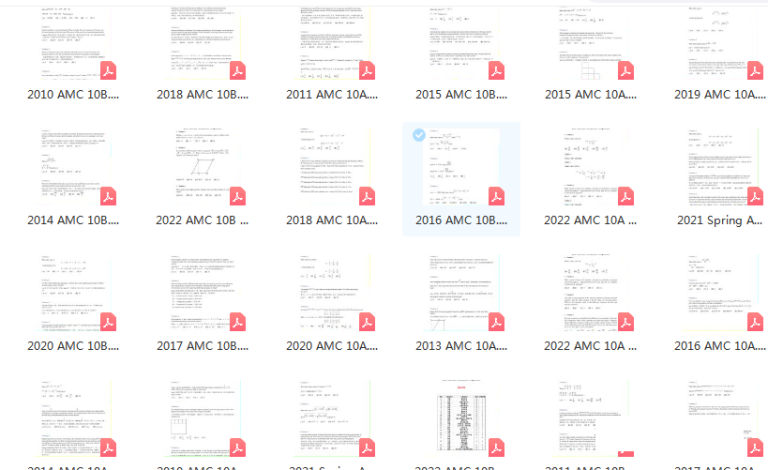
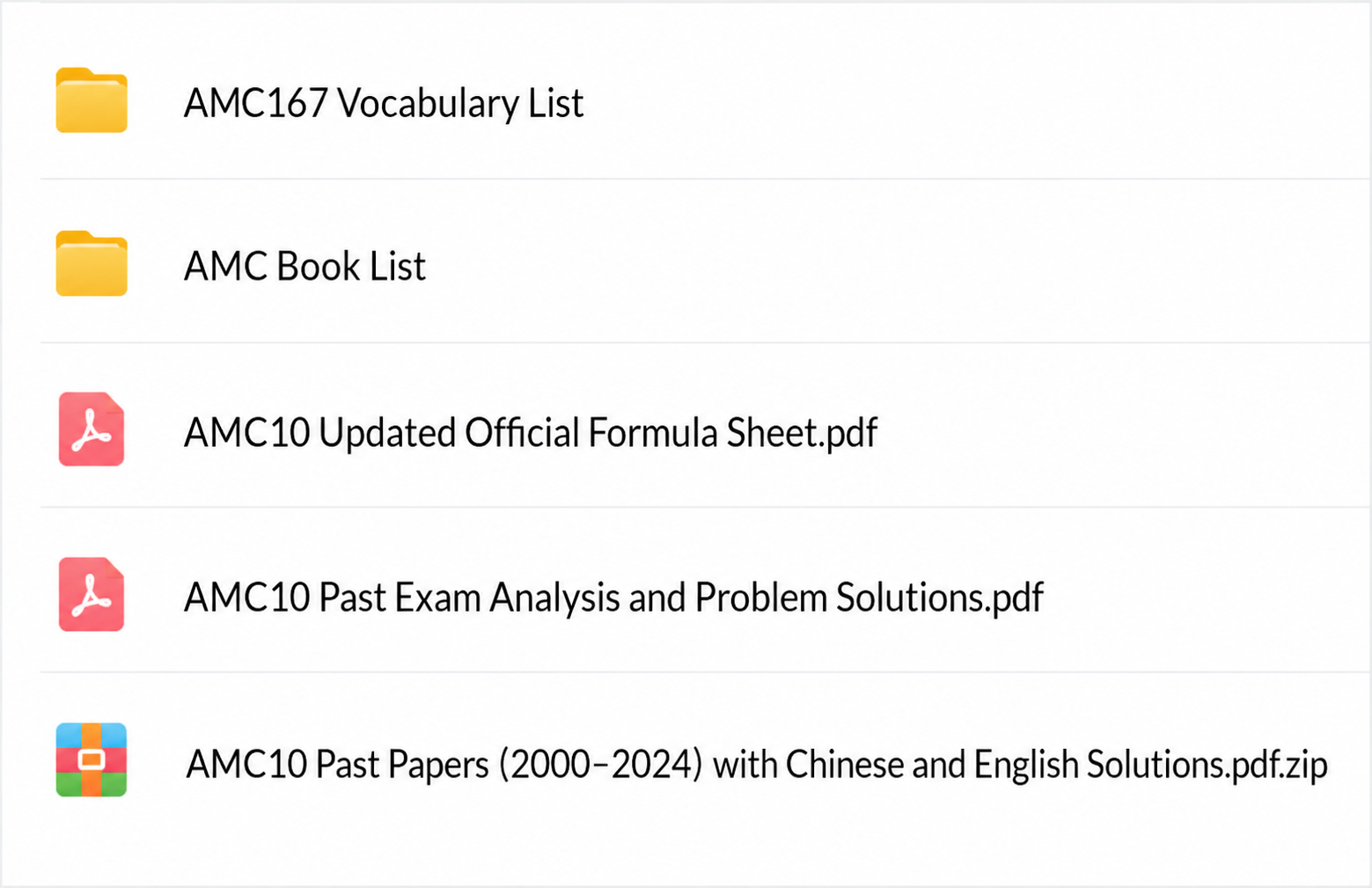
Scan the QR code to receive free AMC 10 past papers from 2010-2025 + solutions + book list + formulas, and to learn about course details!