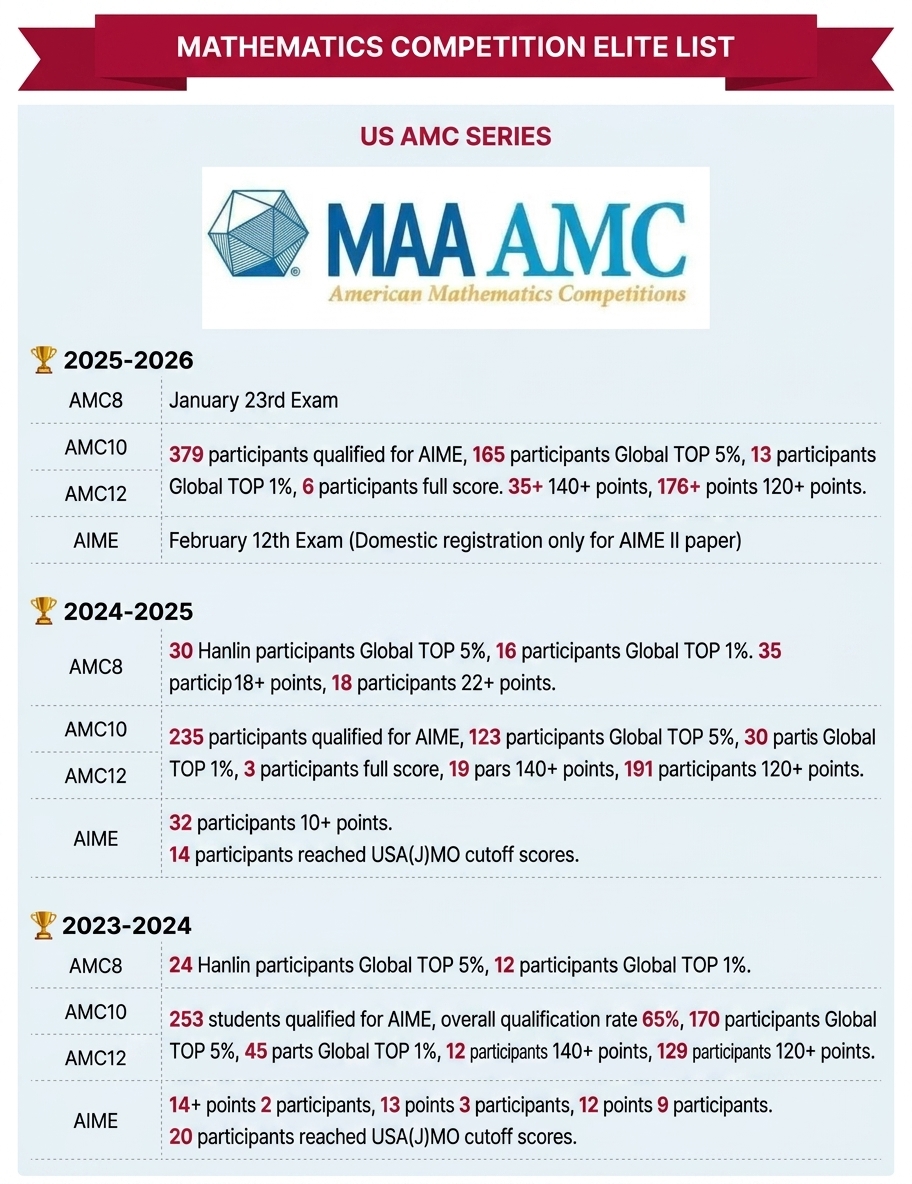

AMC10 (American Mathematics Competition 10) is organized by the Mathematical Association of America (MAA). Founded in 1950, it is one of the most influential secondary school mathematics competitions worldwide.
I. Introduction to AMC10 Rules
Eligibility: Students in grade 10 or below globally, aged ≤ 17.5 on the day of the exam.
Exam Schedule: Held annually in November, with Version A and Version B (different content, similar difficulty). Participants may choose to take one or both versions.
Exam Format: 25 multiple-choice questions, 75 minutes. Bilingual Chinese-English test papers (some test centers provide Chinese translation). Available both online and at physical test centers.

II. Scoring and Awards (2025 Reference)
| Award | Requirement | 2025 Cutoff Score (Example) |
|---|---|---|
| Distinguished Honor Roll | Global Top 1% | Version A: 136.5, Version B: 133.5 |
| Honor Roll | Global Top 5% | Version A: 112.5, Version B: 105 |
| Achievement Roll | Grade 8 or below + Score ≥ 90 | — |
| AIME Qualification | Reach the qualifying score | Version A: 105, Version B: 99 |
Scoring logic: 6 points for each correct answer, 1.5 points for each unanswered question, 0 points for each incorrect answer → Maximum score: 150 points. Correctly answering 17–18 questions ≈ Top 5%; correctly answering 22+ questions ≈ Top 1%.
III. Can Average Students Learn AMC10? Absolutely!
AMC10 ≠ exclusive to geniuses! It tests mathematical thinking + adaptability + time management, not just depth of knowledge.
Value for average students:
- Enhances in-school learning: Modules such as algebra, geometry, and probability heavily overlap with IGCSE/IB/A-Level curricula.
- Improves logical thinking: Breaks the habit of "template-based" problem-solving and cultivates multi-angle problem-solving abilities.
- Builds academic confidence: Through systematic training, a score of 90–110 is entirely achievable, enough to stand out in college applications.
Recommendation: If your child consistently achieves B+/A level in school math, AMC10 is definitely worth a try. Start with a diagnostic test using past papers before deciding on systematic preparation.
IV. Why Do Top Students Often Stumble in AMC10?
Many top-performing students fail to achieve satisfactory results in their first attempt. The main reasons are as follows:
Reason 1: Rigid Thinking, Inability to Adapt to Flexible Question Types
Domestic training style: "Identify problem type → Apply template" (e.g., geometry always requires auxiliary lines, equations always require elimination).
AMC10 problem design: Deliberately breaks conventions! For example:
- A "geometry problem" might be solved more efficiently using number theory congruence.
- An "algebra problem" might be solved intuitively by constructing a function graph.
Coping strategy: Train the ability to identify the essence of a problem — ask "What idea does this problem test?" rather than "What type of problem is this?"
Reason 2: Time Pressure + Reading Traps
Extremely fast pace: Average ≤ 3 minutes per question, with the last 5 questions often requiring 10+ minutes each.
Complex problem statements: Real-life scenarios (e.g., game rules, map paths) + long text + hidden conditions.
Common mistakes:
- Overlooking keywords such as "positive integer" or "distinct".
- Misreading units (miles vs km) or graph axes.
- Being overly cautious on easy questions, leaving insufficient time for difficult ones.
Coping strategies:
- Timed mock exams: At least 1 full set of past papers per week, strictly timed to 75 minutes.
- Marking method during reading: Circle key conditions, units, and limiting words.
- Learn to skip: If no idea after 5 minutes on questions 21–25, decisively move on to protect accuracy on the first 20 questions.
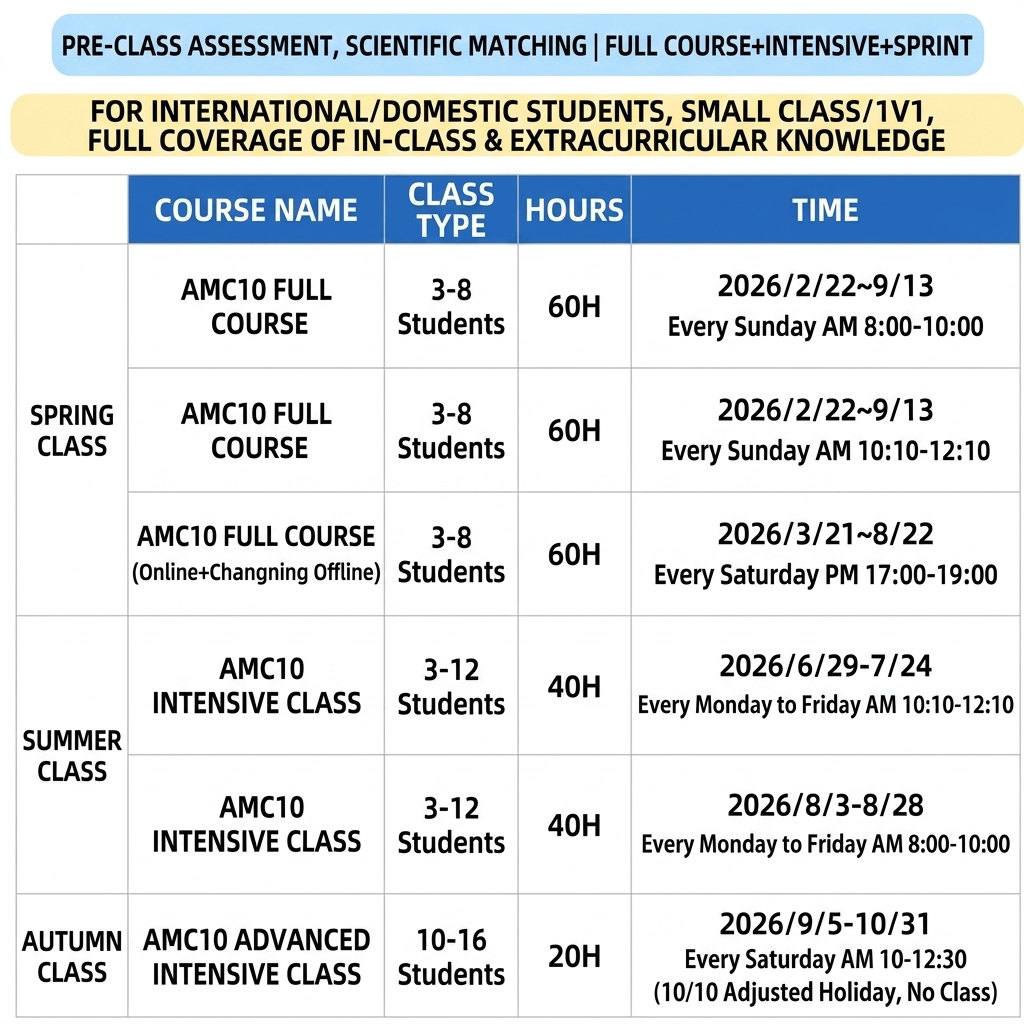
AMC10 Preparation Courses
Our instructors are graduates from top global universities. With precise curriculum planning and comprehensive learning tracking, we ensure your score improvement and award-winning success!
| Class Type | Hours | Class Size | Start Date |
|---|---|---|---|
| Winter Break Class | 30H | 3–8 students | Consult teacher for details |
| Systematic Course | 20H | 1v1 / 3–8 students | Consult teacher for details |
| Problem-Solving Class | 20H | 1v1 / 3–8 students | Consult teacher for details |