AMC10 A vs B In-Depth Comparison: How to Choose Between A and B? AMC10 Preparation Guide for Students with Different Levels

The AMC10 holds two exams each year — the A and B versions — which are completely equivalent in terms of college admission recognition, award value, and AIME qualification cutoffs. However, there are significant differences in question style and distribution. Understanding these differences and choosing accordingly is the key to maximizing your chances of advancing.

推荐

I. Core Comparison: AMC10 A vs B

Dimension A (AMC10A) B (AMC10B)
Overall Difficulty No significant difference; the official organizers ensure both versions are balanced in difficulty.
Question Style More conventional: classic question types, strong patterns, heavier computational load. Focuses on fundamental arithmetic skills and attention to detail. More flexible: novel questions, many clever solution approaches, weaker patterns. Emphasizes logical thinking, reverse problem-solving, and interdisciplinary application of knowledge.
Topic Distribution Geometry questions come with sufficient diagrams; plane geometry accounts for a larger proportion. Fewer difficult number theory and combinatorics problems; lower entry barrier. Increased proportion of geometry without diagrams, solid geometry, and analytic geometry. More difficult number theory and combinatorial counting problems; difficulty may spike abruptly in mid-range questions (11–20).
Test Date Early November Mid-November (one week after A)

II. How to Choose Between A and B?

A is more suitable if:

First-time participant or with limited competition experience.

Solid grasp of fundamentals, but slower to adapt to novel question types.

Goal is to perform steadily and secure the scores you are capable of achieving.

B is more suitable if:

Rich competition experience (e.g., has participated in AMC8, MathCounts, etc.).

Quick thinker, good at handling unconventional problems and cross-module comprehensive questions.

Able to stay calm under pressure, good at finding "clever solutions."

Optimal strategy: Sign up for both A and B! The two exams are only one week apart, with highly overlapping preparation content. Use A as a "practice exam" to quickly identify and fill knowledge gaps, then make a second push in B. This is the most effective way to significantly boost your chance of qualifying for AIME.

推荐

III. Preparation Guide for Different Student Levels

The knowledge scope of AMC10 is roughly equivalent to mathematics at or below the first year of Chinese high school (Grade 10), but its requirements for depth, breadth, and flexible application far exceed the standard school curriculum. Based on years of tutoring experience, the following recommendations are made for students with different backgrounds:

1. Students starting from scratch (Recommended preparation time: 3–4 months)

Core task: Fill the knowledge gap from AMC8 to AMC10. Systematically build foundational skills across the four major areas (Algebra, Geometry, Number Theory, Combinatorics).

Recommended path: Enroll in a systematic, long-term AMC10 foundation course to comprehensively cover all test topics and avoid knowledge blind spots.

Goal: Qualify for AIME and aim for the top 5% globally (Honor Roll).

2. Students with prior competition background (Recommended to start preparation 4–6 months in advance)

Core task: Connect and deepen the four major modules, focusing on high-frequency test points and common error-prone areas.

Key action: Create and continuously update an error log. Use error analysis to precisely identify weak areas.

Recommended path: Attend a four-module intensive class, focusing on improving accuracy on questions 11–20 — a critical range that distinguishes average from outstanding performers.

Goal: Aim for the top 1% globally (Distinguished Honor Roll) or secure a top 5% position.

3. Students with solid foundation / prior test-taking experience (Specialized Sprint Phase)

Core task: Break through bottlenecks, improve problem-solving efficiency and stress tolerance.

Key actions:

Build a mathematical English vocabulary bank to ensure quick and accurate comprehension of English problem statements.

Conduct strict timed mock exams to simulate real test pressure.

Recommended path: Participate in an intensive sprint course before the exam, where experienced instructors provide targeted strategies and thinking models for solving the most challenging problems (21–25).

Goal: Perform consistently, secure AIME qualification, and aim for a perfect score.

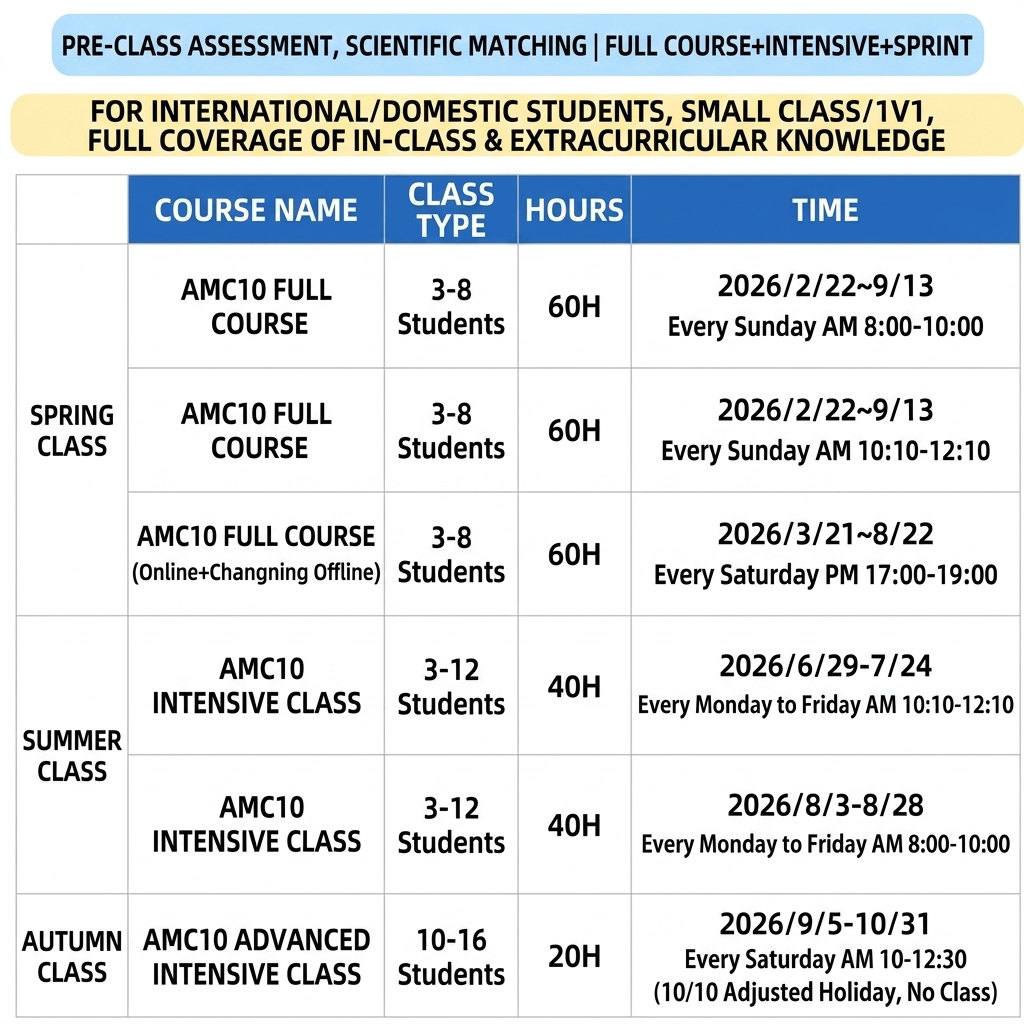
AMC10 Preparation Courses

Our instructors are graduates of top global universities. With precise curriculum planning and full learning support, we escort you to score improvement and awards!

Class Type Hours Class Size Start Date
Four-Module Short-Term Class Varies by module 3-8 students Consult teacher
Systematic Course 20 hours 1v1 / 3-8 students Consult teacher
Problem-Solving Class 20 hours 3-8 students Consult teacher

推荐

How the Difficulty of the Four AMC10 Modules Is Distributed!

The AMC10 is a mathematics competition designed by the Mathematical Association of America (MAA) for students in grade 10 and below, aiming to assess their mathematical thinking and problem-solving abilities. Its knowledge coverage is broad, with a clear hierarchy of difficulty, requiring examinees to solve problems efficiently within a limited time. The following is an analysis of the difficulty and preparation strategies for the four major modules: Algebra, Geometry, Number Theory, and Combinatorics.

推荐

I. Algebra Module (35%-40% of the test)

1. Basic Level (Easy Scoring)

Solving quadratic equations and discriminant analysis

Properties of linear/quadratic function graphs

Simple sequences (arithmetic/geometric)

Percentages and ratio calculations

2. Intermediate Level (Key to Improving Scores)

Absolute value and fractional inequalities

Recurrence relations in sequences

Polynomial factorization (grouping/cross multiplication)

Basic operations with complex numbers

3. Advanced Level (Core for High Scores)

Relationship between polynomial roots and coefficients (advanced Vieta's formulas)

Function iteration and composition

Inequality scaling techniques

Comprehensive application of parametric equations

Preparation Strategies

Basic level: Must achieve perfect scores on all basic questions.

Intermediate level: Master problem-solving templates through extensive practice.

Advanced level: Prioritize accuracy on the first 20 questions; tackle advanced questions based on time availability.

II. Geometry Module (25%-30% of the test)

1. Basic Level (Easy Scoring)

Perimeter and area calculations for triangles and quadrilaterals

Pythagorean theorem

Fundamental properties of similar triangles

Surface area and volume of solid geometry

2. Intermediate Level (Key to Improving Scores)

Properties of circles (inscribed angles, tangents, chord-tangent angles)

Introduction to the five centers of a triangle

Geometric transformations (translation/symmetry)

Coordinate geometry calculations

3. Advanced Level (Core for High Scores)

Comprehensive application of the power of a point theorem

Cross-sections and spatial angle calculations in solid geometry

Geometric construction (auxiliary line techniques)

Advanced trigonometry (sum and difference formulas)

Preparation Strategies

Memorize geometric models: Such as cyclic quadrilateral and similarity models, to improve recognition and application skills.

Practice auxiliary line construction: Master techniques through extensive practice.

Focus on spatial imagination and logical deduction: Cultivate spatial reasoning and logical thinking.

推荐

III. Number Theory Module (20%-25% of the test)

1. Basic Level (Easy Scoring)

Divisibility, factors, and multiples

Prime numbers and composite numbers

Greatest common divisor / least common multiple

Base conversion (decimal to binary/hexadecimal)

2. Intermediate Level (Key to Improving Scores)

Fundamental applications of modular arithmetic

Introduction to Fermat's Little Theorem

Digit properties of numbers

Formula for the number of factors

3. Advanced Level (Core for High Scores)

Solving indefinite equations (Diophantine equations)

Comprehensive Euler's theorem

Number theory constructions and proofs

Complex base conversion operations

Preparation Strategies

Focused breakthrough: Number theory is rarely covered in the domestic curriculum, requiring dedicated study and practice.

Prioritize basic and intermediate questions: These are relatively easy to score and should be reviewed thoroughly.

Advanced questions for AIME aspirants: Students aiming for AIME should delve deeper into challenging number theory problems.

IV. Combinatorics Module (10%-15% of the test)

1. Basic Level (Easy Scoring)

Basic counting (addition/multiplication principles)

Simple probability calculations

Basic set operations

2. Intermediate Level (Key to Improving Scores)

Permutation and combination problems with constraints (e.g., adjacent/non-adjacent)

Recursive counting

Fundamentals of the inclusion–exclusion principle

Advanced classical probability

3. Advanced Level (Core for High Scores)

Complex applications of the inclusion–exclusion principle

Combinatorial constructions and extremal problems

Expected value in probability

Competition-level combinatorial techniques (e.g., advanced pigeonhole principle)

Preparation Strategies

Secure basic level points: Ensure accuracy on all basic questions.

Summarize patterns for intermediate level: Identify common solution patterns through extensive practice.

Flexibility in advanced level: Given time constraints, it may be advisable to skip some advanced questions.

推荐

V. AMC10 Preparation Tips

1. Basic and intermediate questions account for over 80%

Mastering the first 20 questions is key to securing a high score; strive for the highest possible accuracy on these questions.

The core of advancing to AIME is to ensure all intermediate-level questions are correct: performance on these questions directly impacts qualification for AIME.

2. Number theory and combinatorics are key differentiators

Number theory, in particular, is a "signature difficulty" of the AMC10: it is rarely covered in the domestic curriculum and requires targeted reinforcement. Combinatorics questions are highly flexible, so summarizing question patterns is essential.

3. Overall preparation strategy

Systematically learn core concepts: Ensure a solid foundation in all four major modules.

Practice 1000+ basic questions and maintain an error log: Consolidate fundamentals and analyze mistakes.

Intensive past paper training: Familiarize yourself with question types to improve speed and accuracy.

Sprint mock exams: Conduct full-length mock exams weekly to optimize time allocation and pacing.

AMC10 Preparation Courses

Our instructors are graduates from top global universities. With precise curriculum planning and comprehensive learning tracking, we ensure your score improvement and award-winning success!

Class Type Hours Class Size Start Date
Winter Break Class 30H 3–8 students Consult teacher for details
Systematic Course 20H 1v1 / 3–8 students Consult teacher for details
Problem-Solving Class 20H 1v1 / 3–8 students Consult teacher for details

推荐

Online Customer Service
Contact Customer Service