How Can Average Students Break Free from the Olympiad Dilemma? AMC10 Helps an Upset! What Can You Gain from Participating in AMC10?

Many parents often find themselves in this dilemma: their child has stable grades in school mathematics, but once they try to tackle Olympiad problems, they repeatedly hit a wall. Faced with obscure and unusual problems, the child not only becomes mentally exhausted from endless drilling but also sees no improvement in their scores. Is it really true that average students have no place in math competitions? Not at all! Choosing the right path is more important than blindly working hard.

In recent years, more and more families have abandoned traditional Olympiad training and turned to the AMC10 math competition. This shift has helped many average students break through their bottlenecks, become "dark horses" in the competition, and add valuable advantages to their future academic advancement.

推荐

I. AMC10 Math Competition: A Growth Path More Suitable for Average Students

Core Differences Between Domestic Olympiad and AMC10

Challenges of the Olympiad:
Deep dive into single knowledge points: Olympiad problems often revolve around a single knowledge point, digging deep into it. The problem design tends to be obscure and unusual, requiring students to have extremely high talent and long-term knowledge accumulation.
Relies on talent, hard to break through: For most average students, even spending a lot of time on practice problems, it is still difficult to break through bottlenecks, leading to a loss of learning confidence.

Advantages of AMC10:
Emphasizes breadth of knowledge and flexible application: Sponsored by the Mathematical Association of America, the AMC10 places more emphasis on students' understanding of a wide range of knowledge points and their flexible application. The problem design does not go beyond the syllabus, avoiding obscure and unusual questions.
Matches the learning pace of average students: According to statistics, the accuracy rate for the first 10 basic questions of the AMC10 exceeds 60%. As long as students can solidly master junior high school knowledge and extend it slightly, they can steadily earn most of the points, thereby gaining the confidence to win awards.

推荐

II. What Can You Gain from Participating in AMC10?

1. Authoritative Proof of Academic Ability

A differentiator beyond standardized tests: For Chinese students, standardized test scores are generally high. AMC10 scores have become an important indicator to distinguish academic potential. An excellent AMC10 score can strongly prove a student's mathematical ability and level of thinking in their application materials.

2. Cultivation of Advanced Mathematical Thinking and Problem-Solving Skills

Application of creative thinking: The scope of knowledge tested in the AMC10 basically does not exceed the middle school mathematics syllabus, but the problem design is flexible and varied, requiring students to use creative thinking to solve problems. This is different from the "test-taking strategies" of domestic math competitions, placing more emphasis on deep understanding and flexible application of mathematical concepts.

3. Globally Recognized Achievements

Recognition by international universities: In addition to top US institutions, universities in the UK, Canada, Australia, Singapore, and other countries and regions also value AMC10 scores. In Hong Kong, prestigious schools like Diocesan Boys' School and St. Paul's Co-educational College regard the AMC as a touchstone for selecting outstanding students.

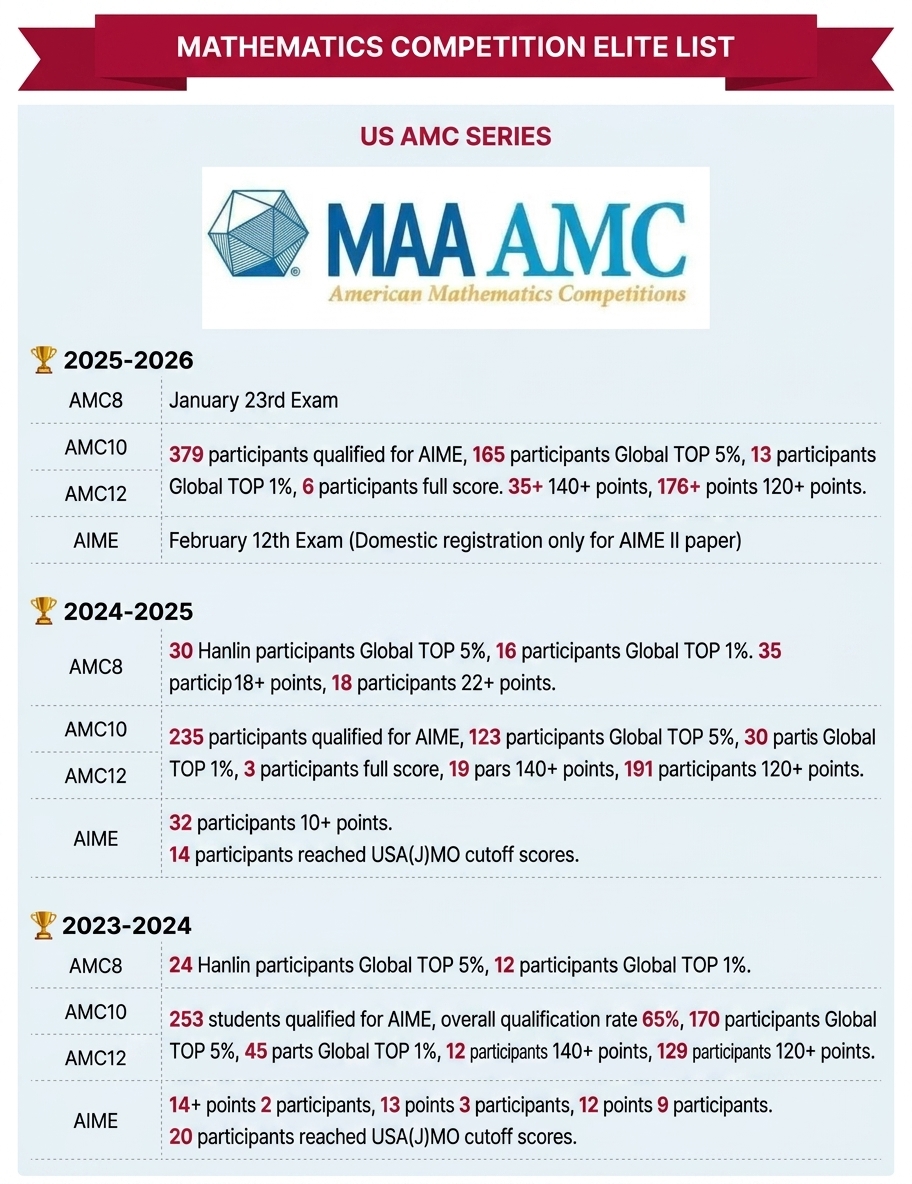
A bridge to higher-level competitions: Students who excel in the AMC10 will have the opportunity to be invited to participate in the American Invitational Mathematics Examination (AIME), an important selection competition for the USA Mathematical Olympiad (USAMO).

4. Gateway to Top Domestic International Schools

In some top-tier international secondary schools in Beijing, Shanghai, Shenzhen, and other places, AMC10 scores have become an implicit standard for student selection. Furthermore, the AMC10 competition not only helps students build academic confidence among their peers but also enhances their self-awareness.

5. Suitable for Students at Different Levels

The AMC10 does not require all students to pursue top-level awards. In fact, students at different levels can find suitable goals for themselves. For example, for 7th-8th graders, obtaining a certificate of achievement is itself a commendable accomplishment.

Systematic learning and training: The process of preparing for the AMC10 helps students build a complete mathematical knowledge system and develop rigorous logical reasoning habits. These abilities will benefit students' academic development in the long term.

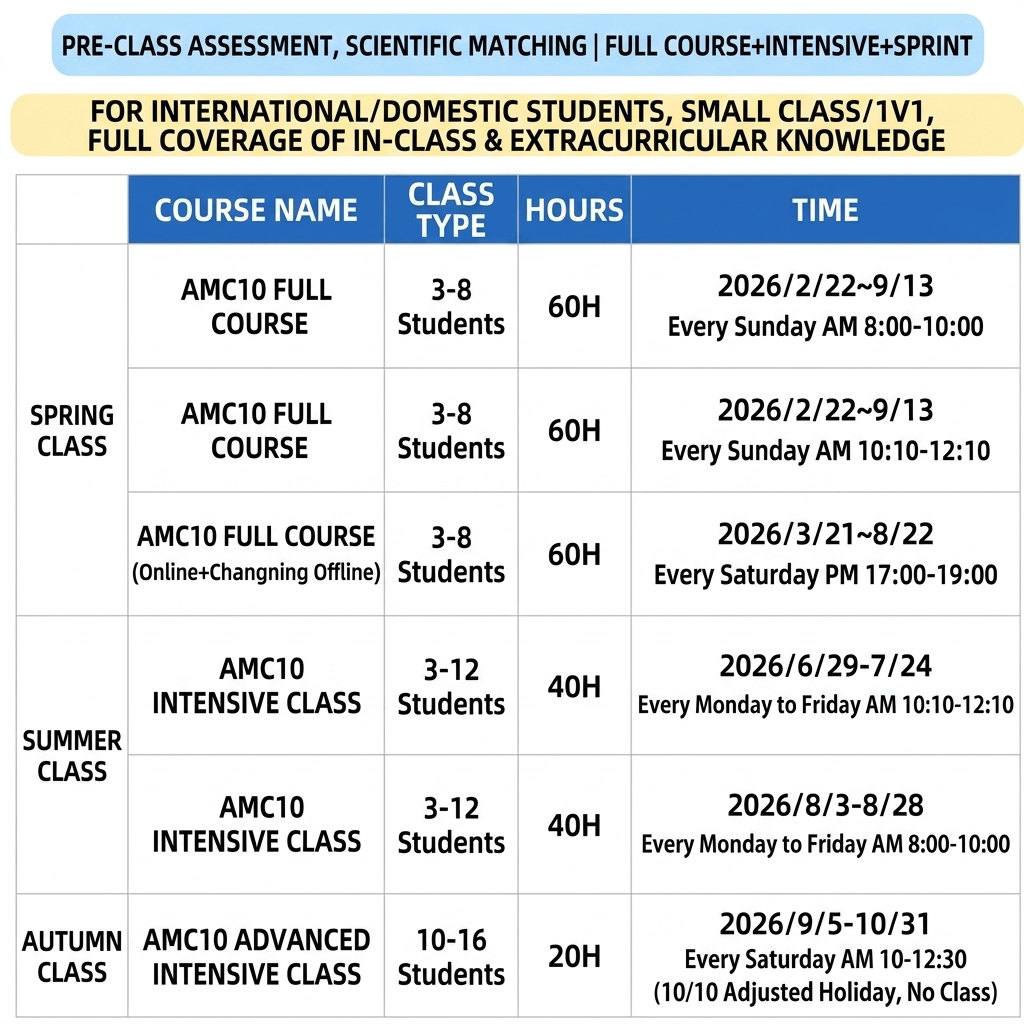
AMC10 Preparation Courses

Our instructors are graduates from top global universities. With precise curriculum planning and comprehensive learning tracking, we ensure your score improvement and award-winning success!

Class Type Hours Class Size Start Date
Winter Break Class 30H 3–8 students Consult teacher for details
Systematic Course 20H 1v1 / 3–8 students Consult teacher for details
Problem-Solving Class 20H 1v1 / 3–8 students Consult teacher for details

推荐

Which Grade Levels Is AMC10 For? What Is the Equivalent Level in Chinese Mathematics? What Are the Differences Between AMC10 and Chinese Math Competitions?

The AMC10 is a mathematics competition designed by the Mathematical Association of America (MAA) for students in grade 10 and below, aiming to assess students' mathematical thinking and problem-solving abilities. This article will provide a detailed analysis of the AMC10's suitable grade levels, exam characteristics, and how to choose appropriate competition strategies based on different learning backgrounds.

推荐

I. Which Grade Levels Is AMC10 Suitable For?

1. Students Transitioning to International Schools After the High School Entrance Exam (Zhongkao)

International curriculum systems such as IGCSE/A-Level/AP/IB: These curricula emphasize mathematical thinking and interdisciplinary applications. The AMC10 covers modules such as algebra, geometry, number theory, and combinatorics, helping students build a logical framework in advance and adapt to the requirements of international curricula.

"Hard proof" of ability in application materials: Awards in the AMC10 mathematics competition, especially top 1% or 5%, can serve as strong evidence in application materials, enhancing admission competitiveness.

Example: The entrance exam of Shanghai Guanghua Cambridge International School directly cited an original AMC10 problem; WLSA's entrance exam syllabus also explicitly requires mastery of polynomial factorization, quadratic function extrema, and other core AMC10 topics.

2. Students Aiming for China's Top Four High Schools

Key secondary schools place great emphasis on mathematical ability when selecting top students: The AMC10 is more difficult than in-school exams and can quickly identify students with outstanding mathematical literacy.

Advantage in independent admissions and special class selection: The problem design of the AMC10 aligns with competition thinking, helping students stand out in independent admissions and special class selection, while the rigorous reasoning habits cultivated have transferable value to other subjects.

Example: Shanghai's top four high schools and Shenzhen's top four high schools refer to AMC10 scores in their independent admissions.

3. Students Enrolled in International Schools and Planning to Advance to AIME

One of the pathways to advance to AIME: The AMC10 is an important route to advance to AIME, so most students choose to start preparing for AMC10 in grade 8 and strive to reach the AIME cutoff.

Extending the preparation cycle to improve problem-solving speed and accuracy: Starting preparation in grade 8 extends the preparation time, allowing students to improve problem-solving speed and accuracy through systematic training, accumulate experience for subsequent advanced competitions, and avoid rushed preparation due to academic pressure in higher grades.

II. What Is the Equivalent Level of AMC10 in Chinese Mathematics?

1. Comparison of Knowledge Scope

AMC10 exam content: Covers elementary algebra, basic geometry, elementary number theory, and probability problems. Does not include trigonometry, advanced algebra, or advanced geometry knowledge.

Corresponding Chinese mathematics level: 70% middle school mathematics + 30% required high school mathematics: Specifically, the algebra part corresponds roughly to the level of Chinese grades 9 to 10 (初三到高一), while the geometry part is close to the plane geometry of grades 8 to 9 (初二到初三).

Key differences: The AMC10 emphasizes number theory and combinatorics, whereas the Chinese curriculum only briefly mentions these in the "properties of integers" section. The AMC10 requires systematic mastery of congruence, divisibility theory, and pays more attention to classification discussion and constructive ability.

2. Comparison of Thinking and Logic

Chinese mathematics education: Emphasizes standardized procedures, problem-type categorization, and computational accuracy.

AMC10: Values multi-angle approaches, methodological innovation, and time efficiency, requiring students to possess strong creative thinking and the ability to apply knowledge flexibly.

3. Correspondence Between Different Score Ranges and Chinese Mathematics Levels

Around 100 points (approximately global top 25%): Equivalent to the level of an outstanding mathematics student in a key Chinese secondary school, with a solid grasp of in-school knowledge and the ability to solve more complex comprehensive problems.

Around 120 points (approximately global top 5%): Equivalent to the level of a provincial mathematics competition third prize winner, possessing competition thinking and the ability to solve unconventional problems.

Above 135 points (approximately global top 1%): Equivalent to the level of a provincial mathematics competition first prize winner, with systematic competition training and strong creative problem-solving abilities.

推荐

III. Differences Between AMC10 and Chinese Math Competitions

1. Question Types and Difficulty

AMC10: A total of 25 multiple-choice questions, with a maximum score of 150 points, to be completed in 75 minutes. The problems are flexibly designed, emphasizing the comprehensive application of multiple knowledge points and testing students' creative thinking and problem-solving skills.

Chinese math competitions: Usually consist mainly of fill-in-the-blank and problem-solving questions, with relatively fixed question types, focusing on formula application and computational accuracy.

2. Scoring Criteria

AMC10: 6 points for a correct answer, 1.5 points for an omitted answer, and 0 points for an incorrect answer. This scoring system encourages reasonable guessing, adding interest and challenge to the competition.

Chinese math competitions: Typically deduct points for incorrect answers, give no points for omitted answers, and place more emphasis on accuracy and stability.

AMC10 Preparation Courses

Our instructors are graduates from top global universities. With precise curriculum planning and comprehensive learning tracking, we ensure your score improvement and award-winning success!

Class Type Hours Class Size Start Date
Winter Break Class 30H 3–8 students Consult teacher for details
Systematic Course 20H 1v1 / 3–8 students Consult teacher for details
Problem-Solving Class 20H 1v1 / 3–8 students Consult teacher for details

推荐

Online Customer Service
Contact Customer Service