
One Article Clarifies the Difficulty Distribution of the Four Major Knowledge Modules in the AMC10 Math Competition!

The AMC10, a math competition designed by the Mathematical Association of America (MAA) for students in grade 10 and below, aims to assess students' mathematical thinking and problem-solving abilities. Its knowledge coverage is broad, with clear layers of difficulty, requiring test-takers to solve problems efficiently within a limited time. The following is an analysis of the difficulty of the four major modules—Algebra, Geometry, Number Theory, and Combinatorics—along with preparation strategies.

推荐

I. Algebra Module (35%-40%)

1. Basic Level Topics (Easy Points)

Solving quadratic equations and discriminant analysis

Properties of linear/quadratic function graphs

Simple sequences (arithmetic/geometric)

Percent and ratio calculations

2. Intermediate Level Topics (Key to Improving Scores)

Absolute value and fractional inequalities

Recursive formulas for sequences

Polynomial factorization (grouping/cross multiplication)

Basic operations with complex numbers

3. Hard Level Topics (Core for High Scores)

Relationship between polynomial roots and coefficients (advanced Vieta's formulas)

Function iteration and composition

Scaling techniques for inequalities

Comprehensive application of parametric equations

Preparation Strategies

Must get full marks on basic questions: Ensure all basic questions are answered correctly.

Proficiently master problem-solving templates for intermediate questions: Through extensive practice, master problem-solving approaches for common question types.

Selectively tackle hard questions: Prioritize the accuracy of the first 20 questions; hard questions can be managed based on time constraints.

II. Geometry Module (25%-30%)

1. Basic Level Topics (Easy Points)

Perimeter and area calculations of triangles and quadrilaterals

Pythagorean theorem

Basic properties of similar triangles

Surface area and volume of solid geometry

2. Intermediate Level Topics (Key to Improving Scores)

Properties of circles (inscribed angles, tangents, chord-tangent angles)

Introduction to the five centers of a triangle

Geometric transformations (translation/reflection)

Coordinate geometry calculations

3. Hard Level Topics (Core for High Scores)

Comprehensive application of the power of a point theorem

Cross-sections and spatial angle calculations in solid geometry

Geometric constructions (auxiliary line techniques)

Advanced trigonometry (sum and difference formulas)

Preparation Strategies

Memorize geometric models: Such as cyclic quadrilateral models, similarity models, to improve recognition and application ability.

Practice drawing auxiliary lines for intermediate questions: Master the skill of constructing auxiliary lines through extensive practice.

Focus on spatial imagination and logical deduction for hard questions: Cultivate spatial visualization and logical reasoning skills.

推荐

III. Number Theory Module (20%-25%)

1. Basic Level Topics (Easy Points)

Divisibility, factors, and multiples

Prime and composite numbers

Greatest Common Divisor (GCD) and Least Common Multiple (LCM)

Base conversion (decimal to binary/hexadecimal)

2. Intermediate Level Topics (Key to Improving Scores)

Basic applications of congruence theorems: Understand the concept of congruence and its basic properties.

Introduction to Fermat's Little Theorem: Master the basic form and applications of Fermat's Little Theorem.

Digit characteristics: Understand the digit characteristics of numbers and their applications.

Formula for the number of factors: Proficiently use the formula to calculate the number of factors.

3. Hard Level Topics (Core for High Scores)

Solving indefinite equations (Diophantine equations)

Comprehensive applications of Euler's theorem

Number theory constructions and proofs

Complex operations in base conversion

Preparation Strategies

Requires specialized breakthrough due to limited exposure in class: Since number theory content is rarely covered in domestic curricula, dedicated study and practice are needed.

Basic and intermediate questions offer high cost-performance, prioritize mastering them: Basic and intermediate number theory questions are relatively easy to score and should be a review focus.

Hard questions are suitable for students targeting AIME to delve deeper: Students aiming for AIME need to intensively study number theory hard questions.

IV. Combinatorics Module (10%-15%)

1. Basic Level Topics (Easy Points)

Basic counting (addition/multiplication principles)

Simple probability calculations

Basic set operations

2. Intermediate Level Topics (Key to Improving Scores)

Permutation and combination problems with constraints (e.g., adjacent/not adjacent)

Recursive counting

Basic Inclusion–Exclusion Principle

Advanced classical probability

3. Hard Level Topics (Core for High Scores)

Complex applications of the Inclusion–Exclusion Principle

Combinatorial constructions and extremal problems

Expected value in probability

Competition-style combinatorial techniques (e.g., advanced pigeonhole principle)

Preparation Strategies

Ensure points on basic questions: Ensure all basic questions are answered correctly.

Summarize question patterns for intermediate questions: Through extensive practice, summarize problem-solving patterns for common question types.

Hard questions are flexible; consider skipping them if time is limited: For hard questions, decide based on time and actual circumstances.

推荐

V. AMC10 Math Competition Preparation Tips

1. Basic and intermediate questions account for over 80%; mastering the first 20 questions secures a high score: The first 20 questions are key to achieving a high score; ensure the highest possible accuracy. The core to advancing to AIME is getting all intermediate questions correct; the score on intermediate questions directly affects qualification.

2. Number Theory and Combinatorics are key modules for distinguishing performance: Especially number theory, as a "characteristic difficulty" of the AMC10. Since number theory content is rarely covered in domestic curricula, targeted reinforcement is needed. Combinatorics problems are highly flexible; summarize question patterns through extensive practice.

3. Overall Preparation Strategy

Systematically study the core knowledge points of the four major modules.

Solve over 1000 basic problems and maintain an error notebook.

Reinforce with past papers to become familiar with question types and improve speed and accuracy.

Conduct full mock exams weekly to optimize time allocation and adjust answering pace.

AMC10 Tutoring Courses

Our instructors are graduates of top universities worldwide, providing precise curriculum planning and full-course learning tracking to ensure you improve and win awards!

Class Type
Hours
Class Size
Start Date
Winter Break Class
30H
3–8 students
Consult teacher for details
Systematic Course
20H
1v1 / 3–8 student class
Consult teacher for details
Problem-Solving Class
20H
1v1 / 3–8 student class
Consult teacher for details

For more information about AMC10/12 competition courses, please contact us

推荐

Complete AMC 10 2026 Preparation Guide: Timeline + Curriculum Adaptation Strategies!

The AMC 10, one of the world's most influential middle school mathematics competitions, is not only the "golden ticket" to the AIME (American Invitational Mathematics Examination) but also a crucial academic credential for applying to top US, UK, and international universities. Its difficulty sits between middle school enrichment and high school advanced topics, emphasizing the triple abilities of knowledge breadth, depth of thinking, and problem-solving speed.

推荐

I. AMC 10 2026 Key Timeline (Plan Ahead!)

Time
Event
Preparation Focus
September–October 2025
Registration Opens
Confirm test center, choose Version A/B, complete registration
November 6, 2025
AMC 10 Version A Exam
Full mock exams + time allocation training
November 14, 2025
AMC 10 Version B Exam
Review Version A past paper to optimize Version B strategy
December 2025
Results + Awards Announced
Check scores, confirm AIME qualification
February 2026
AIME Qualification Exam
If qualified, begin AIME-specific training immediately

Recommendation: Start systematic preparation at least 3–6 months in advance, especially for students without prior competition experience.

II. How Difficult Is the AMC 10?

Knowledge Coverage: ≈70% middle school mathematics + 30% high school compulsory topics. Core modules are Algebra, Geometry, Number Theory, and Combinatorics.

Out-of-Syllabus Content: Number Theory (congruences, modular arithmetic, divisibility properties), Combinatorics (Inclusion–Exclusion Principle, recurrence counting, probability modeling) → These topics are rarely systematically taught in Chinese and most international curricula.

Time Pressure: 75 minutes for 25 questions ≈ 3 minutes per question. The last 10 questions often require multi-step reasoning, and most students cannot complete all questions.

Realistic Strategy: Getting the first 20 questions correct = foundation for awards; getting the first 23 correct = AIME qualifying score (approximately 103.5 points).

推荐

III. Analysis of Key Challenges for Students in Different Curricula Preparing for AMC 10

1. IGCSE Curriculum Students

Advantages: IGCSE Additional Math has high overlap with AMC 10 in algebra, functions, and basic geometry. Quadratic equations, inequalities, coordinate geometry, etc., are already covered.

Key Challenges & Breakthrough Strategies:

Module
Problem
Solution
Geometry
IGCSE geometry focuses on calculations, lacks proof and construction training.
Supplement: Power of a Point Theorem, integrated similar triangles, auxiliary line techniques.
Calculation Skills
Reliance on calculators → slow manual calculation, prone to errors.
Daily timed calculation drills (e.g., squaring quickly, factorization).
Competition Mindset
Accustomed to "standard solutions," lacks flexible modeling ability.
Focus on practicing questions 16–25; learn strategies such as "extreme cases," "symmetry," and "reverse construction."

Action Suggestion: Use the IGCSE math foundation to quickly master the algebra module, then focus on Number Theory + Combinatorics + advanced Geometry.

2. IB Curriculum Students

Advantages: IB Math AA/AI covers a wide range of knowledge points and provides strong logic training; HL students have already been exposed to some advanced content (e.g., complex numbers, calculus concepts).

Key Challenges & Time Window Strategy:

Academic Stage
Challenge
Suggestion
SL Students
Insufficient depth; Number Theory/Combinatorics are almost untouched.
Need systematic supplementary lessons, focusing on the four main AMC 10 modules.
HL Students
Sufficient knowledge but tight on time (IB workload is high).
Use summer vacation for intensive breakthrough, avoid conflicts with IAs in November.

Note: IB does not teach high-frequency AMC 10 topics such as "congruences" or "recurrence counting"; these must be supplemented specifically.

3. AP Curriculum Students

Core Challenge: AP Calculus/Statistics have low alignment with AMC 10; calculus is completely absent in AMC 10, creating a knowledge gap.

Breakthrough Path:

Gap
Solution
Weak Algebra
Return to middle/high school algebra: polynomials, Vieta's formulas, inequalities.
Missing Geometry
Supplement plane geometry proofs, circle properties, triangle centers/lines.
Number Theory/Combinatorics Blank
Learn from scratch: modular arithmetic, pigeonhole principle, case counting.
Probability Transfer
Transfer probability thinking from AP Statistics to combinatorial problems (e.g., expected value models).

Key Reminder: AP students need to rebuild the AMC 10 knowledge system; it is recommended to start preparation 6 months in advance.

AMC 10 Tutoring Courses

Our instructors are graduates of top universities worldwide, providing precise curriculum planning and full-course learning tracking to ensure you improve and win awards!

Class Type
Hours
Class Size
Start Date
Winter Break Class
30H
3–8 students
Consult teacher for details
Systematic Course
20H
1v1 / 3–8 student class
Consult teacher for details
Problem-Solving Class
20H
1v1 / 3–8 student class
Consult teacher for details

For more information about AMC 10/12 competition courses, please contact us.

推荐

AMC8 vs. AMC10 Math Competition: Which One to Choose by Grade Level? How to Transition Smoothly from AMC8 to AMC10?

The AMC (American Mathematics Competition), organized by the Mathematical Association of America (MAA), is the world's most influential middle school mathematics competition system. Among them, AMC8 and AMC10 are the starting points for most Chinese students entering international math competitions. However, there are significant differences between the two in terms of target audience, difficulty, content, and objectives. Choosing the wrong path can be counterproductive, while selecting the right path leads to efficient score improvement and steady advancement. The following provides a systematic comparison between AMC8 and AMC10 across five key dimensions, along with scientific transition strategies and participation recommendations.

推荐

I. Core Differences Comparison Table

Dimension
AMC8
AMC10
Target Participants
Grade 8 and below, ≤14.5 years old
Grade 10 and below, ≤17.5 years old
Exam Date
January each year
November each year (A/B versions)
Exam Duration
40 minutes
75 minutes
Number of Questions & Format
25 multiple-choice questions
Scoring Criteria
1 point for correct answer, 0 for incorrect/blank; total 25 points
6 points for correct, 1.5 for blank, 0 for incorrect; total 150 points
Difficulty Level
≈ Grade 5 Chinese Elementary School Olympiad level (some questions reach Grade 7 level)
≈ Chinese Junior High School Math Competition level (covers Grade 9 to Grade 10 material)
Core Skills Assessed
Calculation accuracy, basic application, attention to detail
Depth of mathematical thinking, breadth of knowledge, flexible modeling ability

II. Comparison of Content Scope and Depth

AMC8 Key Topics:

Basic Calculations: Integer operations, fractions, decimals, percentages, ratios.

Elementary Geometry: Pythagorean theorem, area/perimeter, angles, simple 3D shapes.

Counting & Probability: Basic combinatorics, classical probability.

Word Problems: Modeling real-life scenarios such as distance, work, and concentration problems.

Data Interpretation: Chart reading, mean, median.

Limited Extensions: Simple linear equations, coordinate systems, recognition of quadratic function graphs.

Features: Emphasizes fundamentals, speed, and attention to detail. The first 15 questions are mostly extensions of in-class material, while the last 10 questions begin to show differentiation in thinking ability.

AMC10 Key Topics:

Advanced Algebra: Quadratic equations, inequalities, function properties, sequences.

Advanced Geometry: Similar triangles, properties of circles, coordinate geometry, trigonometric identities (trigonometric functions excluded).

Introduction to Number Theory: Prime factorization, modular arithmetic, GCD/LCM.

Probability & Statistics: Conditional probability, expected value, combinatorial counting (including Inclusion–Exclusion Principle).

Logic & Strategy: Games, optimization, recurrence relations.

Note: Does not include high school advanced topics such as trigonometry, calculus, complex numbers, or vectors. However, it places extremely high demands on logical reasoning and the integration of multiple knowledge points.

推荐

III. How to Transition Smoothly from AMC8 to AMC10?

Transitioning from AMC8 to AMC10 is not a simple "upgrade" but a "leap." Three major transformations need to take place during winter or summer break:

1. Expand Knowledge Base: Supplement core middle school modules

Key supplementary topics:

Quadratic functions and graphical analysis

Geometric properties of circles (chords, tangents, inscribed angles)

Basic number theory (congruence, Fermat's Little Theorem concepts)

Advanced combinatorial counting (permutations vs. combinations, case analysis)

2. Upgrade Your Thinking: From "Calculating Correctly" to "Understanding Thoroughly"

AMC8: Know the formula → Plug in and calculate.

AMC10: Understand the essence of the problem → Build a model → Choose the optimal solution.

Example: AMC10 often tests strategies such as "simplifying using symmetry," "extreme case analysis," and "reverse construction."

3. Practice with Real Past Papers: Familiarize yourself with A/B version styles

AMC10 has two versions, A and B, each year. While the difficulty fluctuates slightly, the question formats are consistent. Recommendation: Complete two sets each of the past 5 years' A and B versions, summarizing high-frequency test points (e.g., 2024 B Question 23 tested recurrence sequences + modular arithmetic).

IV. AMC8 or AMC10? Precise Selection by Grade Level

Grade Level
Recommendation
Reason
Grade 6 and below
Focus on AMC8
AMC10 involves a significant amount of algebra and geometric proofs. Lower-grade students lack sufficient knowledge base, which can easily hurt their confidence. The AMC8 Top 1% (Honor Roll) already carries significant weight.
Grades 7–8
Decision based on situation:
• Solid math foundation + study abroad plan → directly challenge AMC10
• Average foundation / focus on cultivating thinking → first master AMC8 then transition
Grades 7–8 are a critical window. If a student can consistently score 20+ in AMC8, they can try AMC10; otherwise, it's recommended to consolidate their foundation first.
Grades 9–10
Must participate in AMC10
Already above the age limit for AMC8, and AMC10 scores directly affect AIME invitation eligibility (top 2.5%), serving as a crucial credential for applying to STEM programs at U.S. universities.

Decision Tool: Take an AMC8/10 level test (25 questions, timed simulation). Judge based on the score:

AMC8 test score ≥20 → Can challenge AMC10

AMC10 test score ≤80 → Recommend strengthening the foundation before competing

推荐

V. Value of Participation: More Than Just a Competition, It's a Springboard for Advancement

AMC8:

Suitable for upper elementary students to build mathematical confidence

Reference for international school admissions/placement

Lays a foundation of calculation and thinking skills for AMC10

AMC10:

Global Top 2.5% receive an AIME invitation, the first step toward USAMO

Recognized by Oxbridge, Ivy League, G5, and U.S. Top 30 universities as proof of STEM ability

Reference for scholarships at top Canadian universities such as Waterloo, University of Toronto, and UBC

Scan the QR code to join the AMC 10 exclusive learning community, where you can access a wealth of preparation materials and trial courses!

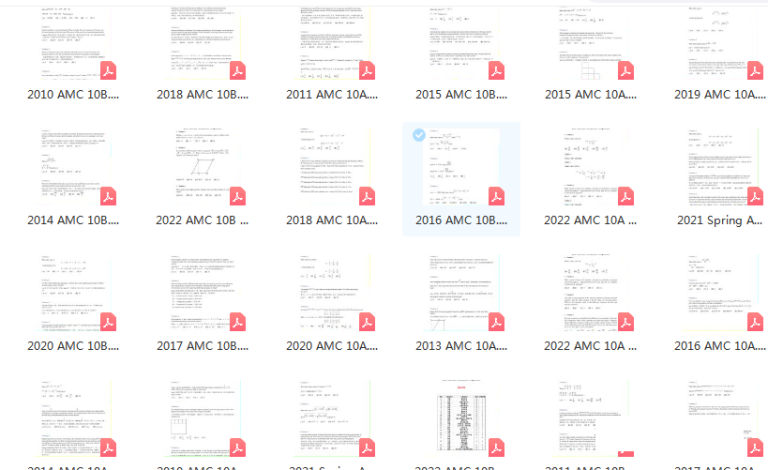
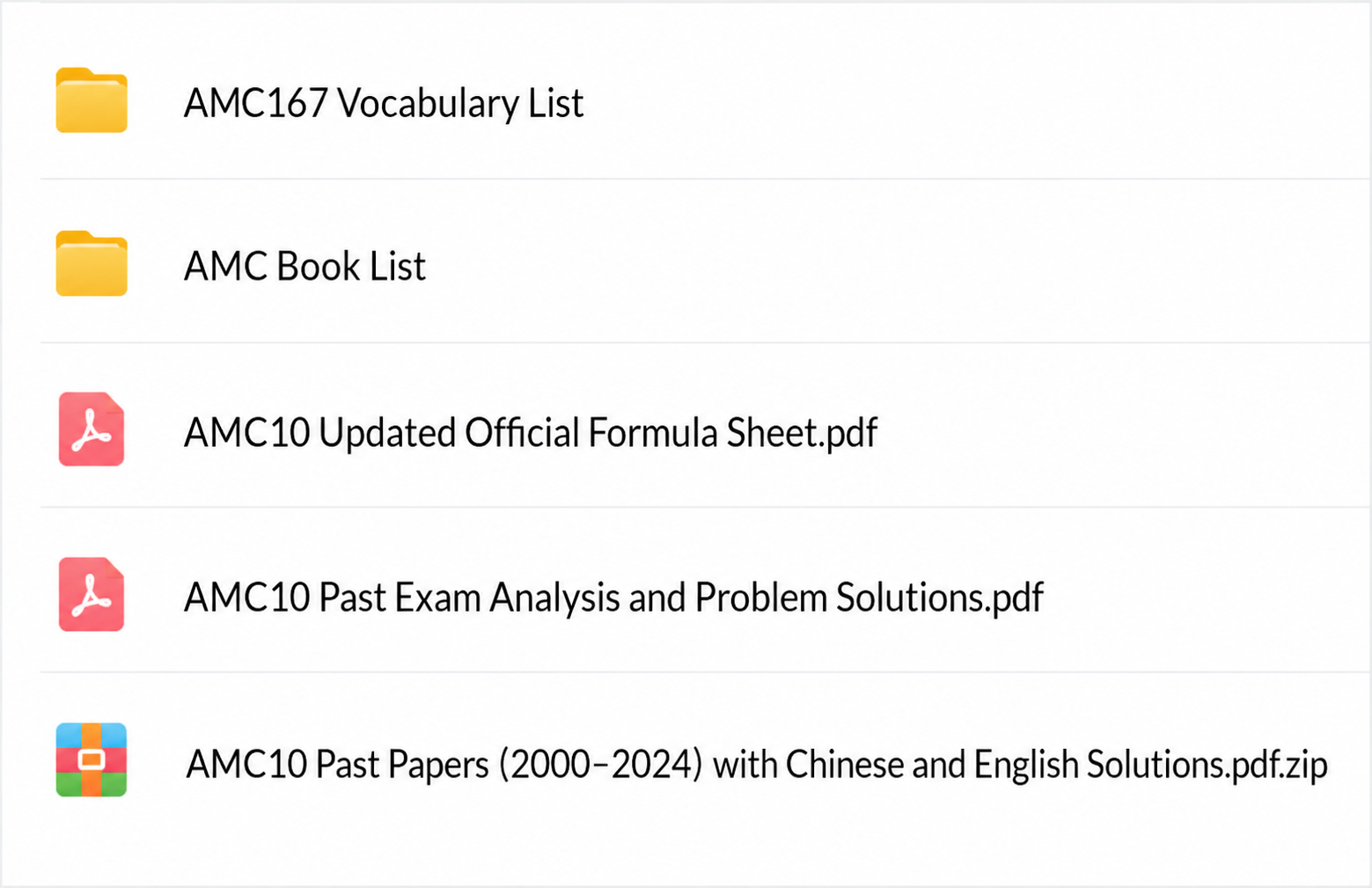
Scan for free 2010-2025 AMC 10 past papers + solutions + book list + formulas, and trial course details!

AMC10 Tutoring Courses

Our instructors are graduates of top universities worldwide, providing precise curriculum planning and full-course learning tracking to ensure you improve and win awards!

Class Type
Hours
Class Size
Start Date
Winter Break Class
30H
3–8 students
Consult teacher for details
Systematic Course
20H
1v1 / 3–8 student class
Consult teacher for details
Problem-Solving Class
20H
1v1 / 3–8 student class
Consult teacher for details

Scan the QR code to learn more about AMC 10/12 competition courses and receive a free self-developed intensive textbook.

推荐

How Can Average Students Overcome Olympiad Math Struggles? AMC10 Math Competition Empowers a Comeback! What Can Participating in AMC10 Bring?

Many parents often face this dilemma: their child's math grades are stable, but every time they try to tackle Olympiad math, they repeatedly hit a wall. Faced with obscure and tricky problems, the child not only exhausts themselves with endless drills but also sees little improvement. Does this mean that average students are truly unsuited for math competitions? Not at all! Choosing the right path is more important than blind effort. In recent years, more and more families have abandoned traditional Olympiad training and turned to the AMC10 math competition. This shift has helped many average students break through their bottlenecks, become "dark horses" in competitions, and add a valuable asset to their future academic paths.

I. AMC10 Math Competition: A More Suitable Growth Path for Average Students

Core Differences Between Domestic Olympiad Math and AMC10

Challenges of Olympiad Math:

Deep dive into single knowledge points: Olympiad problems often explore a single knowledge area in depth, with question designs that are obscure and tricky, requiring students to possess exceptional talent and long-term knowledge accumulation.

Talent-dependent, hard to break through: For most average students, even investing a lot of time in practice makes it difficult to overcome bottlenecks, leading to diminished learning confidence.

Advantages of AMC10:

Emphasis on breadth of knowledge and flexible application: Organized by the Mathematical Association of America, the AMC10 focuses more on students' understanding and flexible use of a wide range of knowledge points. The question designs do not exceed the syllabus, avoiding obscure and tricky problems.

Fits the learning pace of average students: According to statistics, the answer rate for the first 10 basic questions of the AMC10 exceeds 60%. As long as students have a solid grasp of middle school math content and extend it slightly, they can secure most of these points, thereby gaining the confidence to aim for awards.

推荐

II. What Can Participating in AMC10 Bring?

1. Authoritative Proof of Academic Ability

A differentiating benchmark beyond standardized tests: For Chinese students, standardized test scores are generally high. AMC10 scores have become an important indicator for distinguishing academic potential. An excellent AMC10 score can strongly prove a student's mathematical ability and thinking level in application materials.

2. Cultivation of In-Depth Mathematical Thinking and Problem-Solving Skills

Application of creative thinking: The knowledge scope of the AMC10 generally does not exceed the middle school math syllabus, but the questions are flexibly designed, requiring students to use creative thinking to solve problems. This differs from the "test-taking formulas" of domestic math competitions, focusing more on a deep understanding and flexible application of mathematical concepts.

3. Global Recognition of Scores

Recognition by international universities: In addition to top American institutions, universities in the UK, Canada, Australia, Singapore, and other countries and regions also value AMC10 scores. In Hong Kong, prestigious schools like Diocesan Boys' School and St. Paul's Co-educational College regard AMC as a touchstone for selecting outstanding students.

A bridge to higher-level competitions: Students with outstanding AMC10 scores will have the opportunity to be invited to participate in the American Invitational Mathematics Examination (AIME), an important selection competition for the USA Mathematical Olympiad (USAMO).

4. Threshold for Elite Domestic International Schools

In some top-tier international middle schools in cities like Beijing, Shanghai, and Shenzhen, AMC10 scores have become an implicit standard for student selection. Furthermore, the AMC10 competition not only helps students build academic confidence among their peers but also enhances self-awareness.

5. Suitable for Students of Different Levels

The AMC10 does not require all students to pursue top awards. In fact, students of different levels can find suitable goals within it. For example, for students in grades 7-8, simply receiving an Achievement Roll certificate is itself a commendable achievement.

Systematic learning and training: The process of preparing for the AMC10 helps students establish a complete mathematical knowledge system and cultivate rigorous logical reasoning habits. These abilities will benefit students' academic development in the long term.

Scan the QR code to join the AMC 10 exclusive learning community and access a wealth of preparation materials and trial courses!

Scan for free 2010-2025 AMC 10 past papers + solutions + book list + formulas, and trial course details!

AMC10 Tutoring Courses

Our instructors are graduates of top universities worldwide, providing precise curriculum planning and full-course learning tracking to ensure you improve and win awards!

Class Type
Hours
Class Size
Start Date
Winter Break Class
30H
3–8 students
Consult teacher for details
Systematic Course
20H
1v1 / 3–8 student class
Consult teacher for details
Problem-Solving Class
20H
1v1 / 3–8 student class
Consult teacher for details

Scan the QR code to learn more about AMC 10/12 competition courses and receive a free self-developed intensive textbook.

推荐

AMC 10 Suitable for Which Grade Levels? Equivalent Level in Chinese Mathematics? Differences from Chinese Math Competitions?

The AMC 10 is a mathematics competition designed by the Mathematical Association of America (MAA) for students in grade 10 and below, aiming to assess students' mathematical thinking and problem-solving abilities. This article will provide a detailed analysis of the AMC 10's target grades, exam characteristics, and strategies for choosing the right approach based on different academic backgrounds.

推荐

I. Which Grade Levels Is AMC 10 Suitable For?

1. Students transitioning to international schools after the high school entrance exam (Zhongkao)

International curriculum systems such as IGCSE/A-Level/AP/IB: These curricula emphasize mathematical thinking and interdisciplinary applications. The AMC 10 covers modules including algebra, geometry, number theory, and combinatorics, helping students build a logical framework in advance and adapt to the demands of the international curriculum.

Proof of "hard skills" in application materials: Awards in the AMC 10 math competition, especially the top 1% or 5%, can serve as strong evidence in application materials, enhancing admission competitiveness.

Example: The entrance exam of Guanghua Cambridge International School directly includes original AMC 10 questions; the entrance exam outline of WLSA also explicitly requires mastery of AMC 10 core topics such as polynomial factorization and quadratic function extremum.

2. Students aiming for China's "Top 4" prestigious high schools

Key high schools place great emphasis on mathematical ability when selecting top students: The AMC 10 is more difficult than standard school exams and can quickly identify students with outstanding mathematical literacy.

Advantages in independent enrollment and special class selection: The problem design of the AMC 10 aligns well with competition thinking, helping students stand out in independent enrollment and special class selections. At the same time, the rigorous reasoning habits developed have transferable value for other subjects.

Example: Shanghai's "Top 4" and Shenzhen's "Top 4" prestigious high schools refer to AMC 10 scores in their independent enrollment processes.

3. Students currently enrolled in international schools planning to advance to AIME

One pathway to AIME: The AMC 10 is a crucial way to qualify for the AIME. Therefore, most students choose to begin preparing for the AMC 10 in grade 8 and strive to reach the AIME qualification cutoff.

Extend preparation time, improve problem-solving speed and accuracy: Starting preparation in grade 8 extends the preparation period, allows for systematic training to enhance problem-solving speed and accuracy, accumulates experience for subsequent higher-level competitions, and avoids hasty preparation in upper grades due to academic pressure.

II. What Level of Chinese Mathematics Does AMC 10 Correspond To?

1. Knowledge Scope Comparison

AMC 10 exam content: Covers elementary algebra, basic geometry, elementary number theory, and probability problems. It does not include trigonometry, advanced algebra, or advanced geometry.

Corresponding Chinese mathematics level: 70% junior high school math + 30% mandatory high school math content. Specifically, the algebra portion corresponds roughly to Chinese grade 9 to grade 10 level, while the geometry portion is close to grade 8 to grade 9 plane geometry.

Key differences: AMC 10 emphasizes number theory and combinatorics, whereas the Chinese curriculum only touches on "properties of integers" briefly. AMC 10 requires systematic mastery of concepts like congruences and divisibility, and places greater emphasis on case analysis and constructive abilities.

2. Thinking Logic Comparison

Chinese mathematics education: Emphasizes standardized steps, problem classification, and calculation accuracy.

AMC 10: Values multi-perspective approaches, methodological innovation, and time efficiency, requiring students to possess strong creative thinking and the ability to flexibly apply knowledge.

3. Correspondence Between Score Ranges and Chinese Mathematics Levels

Around 100 points (approx. global top 25%): Equivalent to the level of an outstanding mathematics student in a key Chinese high school, with a solid grasp of in-school knowledge and the ability to solve complex comprehensive problems.

Around 120 points (approx. global top 5%): Equivalent to the level of a provincial third prize in Chinese math competitions, possessing competition thinking and the ability to solve unconventional problems.

Above 135 points (approx. global top 1%): Equivalent to the level of a provincial first prize in Chinese math competitions, with systematic competition training and strong creative problem-solving abilities.

推荐

III. Differences Between AMC 10 and Chinese Math Competitions

1. Question Types and Difficulty

AMC 10: 25 multiple-choice questions, full score 150, to be completed in 75 minutes. The problems are flexibly designed, emphasizing the integrated application of multiple knowledge points and testing students' creative thinking and problem-solving skills.

Chinese math competitions: Usually consist of fill-in-the-blank and proof-based questions, with relatively fixed problem types, focusing on formula application and calculation accuracy.

2. Scoring Standards

AMC 10: 6 points for a correct answer, 1.5 points for an unanswered question, 0 points for an incorrect answer. This scoring system encourages reasonable guessing, adding to the interest and challenge of the competition.

Chinese math competitions: Typically deduct points for incorrect answers and give no points for unanswered questions, placing greater emphasis on accuracy and stability.

Scan the QR code to join the AMC 10 exclusive learning community, where you can access a wealth of preparation materials and trial courses!

Scan for free 2010-2025 AMC 10 past papers + solutions + book list + formulas, and trial course details!

AMC 10 Tutoring Courses

Our instructors are graduates of top universities worldwide, providing precise curriculum planning and full-course learning tracking to ensure you improve and win awards!

Class Type
Hours
Class Size
Start Date
Winter Break Class
30H
3–8 students
Consult teacher for details
Systematic Course
20H
1v1 / 3–8 student class
Consult teacher for details
Problem-Solving Class
20H
1v1 / 3–8 student class
Consult teacher for details

推荐

Why Are Shanghai International School Students So Obsessed with AMC 10? Scientific Time Planning for AMC 10 for Shanghai International School Students!

In Shanghai, AMC 10 has long transcended the category of "a mathematics competition" and become a strategic pivot in the academic planning of international curriculum students. Whether in IB, A-Level, or IGCSE programs, students almost all regard AMC 10 as a must-contest arena. Behind this lies a deep interweaving of four major logics: high curriculum alignment, essential overseas applications, domestic academic advantages, and competition pathway foundation.

推荐

I. Why Must Shanghai International School Students Take AMC 10?

1. Seamless Alignment with School Curriculum, Mutual Reinforcement

International Curriculum
Overlap with AMC 10 Knowledge Points
Reciprocal Benefit
IGCSE (incl. Additional Mathematics)
Linear/quadratic equations, function graphs, triangle properties, fundamental circle theorems
AMC 10 training enhances stability for high scores in IGCSE Mathematics
IB Math AA/AI HL
Polynomials, complex numbers, trigonometric transformations, probability distributions, vector geometry
Competition thinking strengthens IB IA (Internal Assessment) modeling abilities
A-Level Maths + Further Maths
P1–P3 Pure Mathematics (functions, calculus basics), S1–S2 Statistics (probability, distributions)
A-Level's emphasis on calculation accuracy directly supports rapid problem-solving in AMC 10

Conclusion: AMC 10 is not an "extra burden" but an advanced extension and ability validation of school learning.

2. "Hard Currency" for Overseas Undergraduate Applications

With standardized test scores becoming universally high, a high score on AMC 10 = a visualizable proof of mathematical ability:

US TOP 30 (MIT, Stanford, Caltech, etc.) → Application forms explicitly require AMC/AIME scores; lack of competition background can lead to elimination.

UK G5 (Oxford, Cambridge, Imperial, UCL) → Although not mandatory, AMC 10 Top 5% can significantly enhance the persuasiveness of your Personal Statement, especially for Maths/Econ/CS majors.

Top HK/SG Universities (HKU, NUS, NTU) → Use AMC 10 as an important reference for mathematical potential; some majors may inquire about competition experience in interviews.

Even humanities applicants → AMC 10 scores can demonstrate logical rigor and quantitative thinking, making their application essays more compelling.

3. "Invisible Key" for Domestic Academic Advancement

In Shanghai's local academic advancement system, AMC 10 holds extraordinary value:

Selection for "Top 4" Science Classes (Huaer, Shangzhong, Fufu, Jiaofu) → AMC 10 110+ points can directly qualify for an interview invitation to their Technology/Science classes.

Independent Enrollment in Municipal Key High Schools (Qibao, Jianping, Nanmo, etc.) → Clearly prioritize AMC 10 Top 25% (approx. 100 points) as an admission condition; some schools accept "score threshold = automatic admission."

Middle Schoolers' Competition Ceiling → AMC 10 is one of the few high-value international competitions open to middle school students, helping them establish academic advantages early.

International School Entrance Exams → Schools like Ulink, World Foreign Language, and Pinghe incorporate AMC 10 scores into their assessments; AIME qualifiers may be exempted from the mathematics additional exam.

4. Building a "Golden Ladder" for International Competitions

AMC 10 is the starting point of the global mathematics competition system, with a clear subsequent pathway. The standard pathway for top Shanghai international school students:

Grade 8: First attempt at AMC 10 → Grade 9: Aim for AIME → Grade 10: Prepare for AMC 12 + Euclid → Grade 11: Secure Ivy League/G5 offers.

推荐

II. Scientific Time Planning for AMC 10 for Shanghai International School Students

Grade Level
Core Objectives
Key Actions
Grades 6–7
Build Foundation + Transform Thinking
Secure AMC 8 Global Top 1% (22+ points). Preview AMC 10 Algebra/Geometry modules. Cultivate competition thinking such as case analysis and number-shape combination.
Grades 8–9
First Attempt at AMC 10, Aim for Top 5%
Systematically learn the four major modules (Algebra, Geometry, Number Theory, Combinatorics). First competition in November, target 110+ points. Ensure ≥90% accuracy on the first 20 questions.
Grade 10
Sprint for Top 1%, Secure AIME
Master techniques for tackling questions 21–25, target 135+ points to securely enter Global Top 1%. Simultaneously begin AMC 12 preparation.

2026 AMC 10 Exam Date: Expected November 12, 2026 (Wednesday)
Registration Deadline: Mid to late October 2026 (through schools or partner test centers).

III. Suggestions for Parents in Shanghai

Value the "Process Points" rather than only the result: Even if no award is won, the preparation process itself has already greatly enhanced mathematical literacy.

Choose a suitable training system: Prioritize institutions that offer small-class teaching + in-depth past paper explanation + mistake tracking.

Avoid blind problem drilling: AMC 10 focuses on thinking modeling; you need to understand the mathematical essence behind each question.

Scan the QR code to join the AMC 10 exclusive learning community and access a wealth of preparation materials and trial courses!

Scan for free 2010-2025 AMC 10 past papers + solutions + book list + formulas, and trial course details!

AMC10 Preparation Courses

Our instructors are graduates from top global universities. With precise curriculum planning and comprehensive learning tracking, we ensure your score improvement and award-winning success!

Class Type Hours Class Size Start Date
Winter Break Class 30H 3–8 students Consult teacher for details
Systematic Course 20H 1v1 / 3–8 students Consult teacher for details
Problem-Solving Class 20H 1v1 / 3–8 students Consult teacher for details

推荐

AMC 10 Competition Rules Fully Analyzed! Can Average Students Take AMC 10? Why Do “Straight-A Students” Often Fail the AMC 10?

The AMC 10 (American Mathematics Competition 10), organized by the Mathematical Association of America (MAA) and established in 1950, is one of the most influential secondary school mathematics competitions globally.

推荐

I. Introduction to AMC 10 Competition Rules

Eligibility: Students in grade 10 or below worldwide, with age ≤ 17.5 years old on the day of the exam.

Exam Time: Held annually in November, divided into A and B versions (different content, similar difficulty); you may take one or both exams.

Exam Format: 25 multiple-choice questions, 75 minutes. Bilingual Chinese-English test papers (Chinese translation available at some test centers). Both online and offline test centers are available.

II. Scoring and Awards (2025 Reference)

Award
Requirement
2025 Cutoff Score (Example)
Distinguished Honor Roll (Global Top 1%)
Top 1% globally
A卷 136.5,B卷 133.5
Honor Roll (Global Top 5%)
Top 5% globally
A卷 112.5,B卷 105
Achievement Roll
Grade 8 or below + ≥90 points
AIME Qualification
Reach the qualification cutoff
A卷 105,B卷 99

Scoring Logic: 6 points per correct answer, 1.5 points for unanswered questions, 0 points for incorrect answers → total score 150 points. Answering 17–18 questions correctly ≈ top 5%; answering 22+ questions correctly ≈ top 1%.

III. Can Average Students Learn AMC 10? Of Course They Can!

AMC 10 ≠ exclusive to prodigies! It tests mathematical thinking + adaptability + time management, not just depth of knowledge.

Value for Average Students:

Reinforces in-school learning: Modules like algebra, geometry, and probability heavily overlap with IGCSE/IB/A-Level curricula.

Enhances logical thinking: Breaks the habit of "template application" and cultivates multi-angle problem-solving skills.

Builds academic confidence: Through systematic training, a score of 90–110 is entirely achievable, enough to become a highlight of your application.

Advice: If your child's in-school math is consistently at a B+/A level, they are absolutely worth trying for AMC 10. Start with a past paper as a diagnostic test, then decide whether to pursue systematic preparation.

推荐

IV. Why Do “Straight-A Students” Often Fail the AMC 10?

Many top students with excellent in-school grades perform poorly on their first attempt at the AMC 10, mainly for two reasons.

Reason 1: Rigid Thinking – Inability to Adapt to Flexible Question Types

Domestic training style: "Identify question type → apply template" (e.g., always draw auxiliary lines for geometry, always set up simultaneous equations).

AMC 10 logic: Intentionally breaks the patterns! For example:

A "geometry problem" might be solved faster using number theory and modular arithmetic.

An "algebra problem" might be solved intuitively by constructing a function graph.

Strategy: Train your "ability to identify the essence of a problem" – first ask, "What concept is this testing?" rather than "What type of problem is this?"

Reason 2: Time Pressure + Question-Reading Traps

Fast pace: Average ≤3 minutes per question; the last 5 questions often require 10+ minutes.

Complex wordings: Real-life scenarios (e.g., game rules, map paths) + lengthy text + hidden conditions.

Common mistakes:

Overlooking keywords like "positive integer," "distinct," etc.

Misreading units (miles vs. km) or chart axes.

Being overly cautious on easy questions, leaving no time for difficult ones.

Strategy:

Timed mock exams: At least one past paper per week, strictly 75 minutes.

Marking method for reading: Circle key conditions, units, and limiting words.

Learn to give up: If you have no idea on questions 21–25 after 5 minutes, skip them decisively to protect your accuracy on the first 20 questions.

Scan to enter the AMC 10 exclusive learning community and access a wealth of preparation materials and trial courses!

Scan for free 2010–2025 AMC 10 past papers + solutions + book list + formulas, and trial course details!

AMC10 Preparation Courses

Our instructors are graduates from top global universities. With precise curriculum planning and comprehensive learning tracking, we ensure your score improvement and award-winning success!

Class Type Hours Class Size Start Date
Winter Break Class 30H 3–8 students Consult teacher for details
Systematic Course 20H 1v1 / 3–8 students Consult teacher for details
Problem-Solving Class 20H 1v1 / 3–8 students Consult teacher for details

推荐

Who is AMC 10 For? Analysis of Recent Difficulty Trends! Three Principles for Efficient Score Improvement in AMC 10!

The AMC 10 is one of the secondary school mathematics competitions organized by the Mathematical Association of America (MAA), targeting students in grade 10 and below. It is not only a core academic credential for applying to top STEM institutions like MIT, Stanford, and CMU, but also an excellent platform to enhance mathematical thinking, logical reasoning, and problem-solving skills. This article will provide a detailed analysis of the AMC 10's target audience, difficulty trends, preparation strategies, and recommended quality courses to help you prepare efficiently and achieve precise score improvement.

推荐

I. Who is AMC 10 For?

Student Type
Characteristics & Advantages
Recommended Path
Students Who Performed Well on the AMC 8
Characteristics: Scored around 20 on the January AMC 8, indicating a solid math foundation.
Advantage: Already possess good calculation accuracy and basic logic, enabling faster adaptation to the breadth and depth of AMC 10 knowledge.
Directly advance to advanced study of Algebra and Geometry modules, strengthen Number Theory and Combinatorics skills.
Students Preparing to Apply to International Schools
Target Groups: Prestigious schools in Shanghai, Beijing, Shenzhen, Chengdu, etc.
Advantage: AMC 10 scores are an important reference for international school entrance exams, especially providing a significant advantage in "elementary to middle school" and "transfer" admissions.
Systematically prepare half a year to one year in advance, ensuring you achieve your desired score before the entrance exams.
Students in Grades 7–10 Wanting to Improve Their Math Foundation
Characteristics: Hope to use the competition to reinforce in-school knowledge and enhance mathematical thinking.
Advantage: AMC 10 covers all math knowledge points from middle school to high school and focuses on logical thinking, effectively compensating for the shortcomings of in-school teaching.
Start with basic questions and gradually transition to intermediate difficulty, cultivating problem-solving skills and time management abilities.

II. Analysis of AMC 10 Difficulty Trends

Trend Dimension
Changes Observed
Coping Strategies
Algebra Remains the Core
No longer just testing basic operations; greater emphasis on deep understanding and flexible application of concepts.
Thoroughly understand the essence of algebra, master advanced applications of equations, functions, sequences, etc.
Geometry: Increased Share and Computation
The proportion of geometry problems continues to increase, with higher demands on calculation precision and speed.
Practice more classic problem types like auxiliary line construction, similar triangles, and the power of a point theorem to improve proficiency and accuracy.
Number Theory and Combinatorics Cannot Be Ignored
Although the number of Number Theory problems has decreased, it remains crucial for AIME. Probability and Combinatorics problems cover a wide range and require long-term accumulation.
Systematically summarize basic Number Theory theorems (e.g., prime factorization, congruence properties) and gain experience through extensive practice.

推荐

III. AMC 10 Preparation Strategies: Scientific Planning to Sprint for the Top 1%

Three Principles for Efficient Preparation

Principle
Key Points and Implementation
1. Enhance Competition Skills
Advantage for Domestic Students: There is significant overlap between in-school knowledge and AMC 10, allowing you to leverage your school foundation for a quick start.
Competition-Specific Techniques: Learn auxiliary line construction, number theory problem-solving techniques, etc., to achieve mutual improvement in both in-school and competition performance.
2. Targeted Practice with Past Papers
Practice Strategy: Repeatedly practice AMC 10 past papers from 2010–2024, categorized by module.
Basic Questions: Ensure all are correct, solidifying your foundation.
Intermediate Questions: Strengthen problem-solving speed, improve efficiency.
Difficult Questions: Summarize problem-solving models, organize a mistake notebook, and target weak areas for breakthroughs.
3. Improve Test-Taking Skills
Essential Formulas and Theorems: Memorize common tools like geometry area formulas, number theory congruence properties.
Reading in English: Master essential math vocabulary to improve English reading efficiency.
Mock Exams: Through multiple mock exams, get familiar with the answering rhythm, allocate time reasonably, and avoid losing points due to time pressure.

IV. Quality Courses to Help You Improve Efficiently

Course
Target Audience
Course Structure
Pre-AMC 10 Direct Train
Students in grades 6–8 or those with no prior competition experience
20 hours Pre-AMC 10 Algebra Basics, 50 hours fundamental knowledge points by chapter, 30 hours topic-specific explanations, 30 hours gap-filling and past paper mock exam review.
Goal: Help students solidify their AMC 10 math foundation and bridge the knowledge gap between AMC 8 and AMC 10.
AMC 10 Direct Train
Students in grades 9–10 or those needing systematic learning
Foundation (50 hours): Fundamental knowledge points by chapter.
Enhancement (30 hours): Advanced AMC 10 course covering Algebra, Geometry, Number Theory, Probability.
Sprint (30 hours): Gap-filling, past paper mock exam review, test-taking tips.

Course Selection Advice: Students with zero foundation are advised to start with Pre-AMC 10 and progress step by step. Students with some foundation can directly enter the foundation or enhancement level, targeting weak modules for intensive training.

Scan the QR code to join the AMC 10 exclusive learning community, where you can access a wealth of preparation materials and trial courses!

Scan for free 2010-2025 AMC 10 past papers + solutions + book list + formulas, and trial course details!

AMC 10 Tutoring Courses: Our instructors are graduates of top universities worldwide, providing precise curriculum planning and full-course learning tracking to ensure you improve and win awards!

Class Type
Hours
Class Size
Start Date
Winter Break Class
30H
3-8 students
Consult teacher for details
Systematic Course
20H
1v1 / 3-8 student class
Problem-Solving Class
20H
1v1 / 3-8 student class

Scan the QR code to learn more about AMC 10/12 competition courses and receive a free self-developed intensive textbook.

AMC10 Preparation Courses

Our instructors are graduates from top global universities. With precise curriculum planning and comprehensive learning tracking, we ensure your score improvement and award-winning success!

Class Type Hours Class Size Start Date
Winter Break Class 30H 3–8 students Consult teacher for details
Systematic Course 20H 1v1 / 3–8 students Consult teacher for details
Problem-Solving Class 20H 1v1 / 3–8 students Consult teacher for details

推荐

How Long Does It Take to Prepare for the AMC 10? How to Allocate Time Across Difficulty Levels?

As one of the most influential middle school mathematics competitions globally, the AMC 10 is far more difficult than the AMC 8, approaching the level of the AMC 12. In terms of actual content, it aligns roughly with Chinese 10th-grade mathematics plus middle school mathematics league material. Due to the absence of an official syllabus, flexible question styles, and high demands on mathematical thinking, the vast majority of students need systematic preparation of more than 6 months. However, the exact duration should be adjusted dynamically based on the student's foundation and target award level.

I. AMC 10 Preparation Duration Recommendations: Tailored to the Individual, Goal-Oriented

Student Type
Recommended Preparation Cycle
Core Tasks
Average Foundation (School Math B+/A-)
10–12 months
Systematically cover the four major modules: Algebra, Geometry, Number Theory, and Combinatorics. Transition from AMC 8 past papers to the first 15 questions of the AMC 10. Cultivate competition thinking and break free from "template-based" problem-solving habits.
Good Foundation (School Math A/A+, with experience in Olympiad math or AMC 8)
6–8 months
Intensively practice past papers from the last 10 years and analyze error patterns. Conquer high-frequency models in questions 16–25 (e.g., recursive sequences, geometric transformations). Train for time-limited problem-solving and strategic selection.
Top-Tier Sprint (Target Top 1% or High AIME Score)
8–12+ months of continuous training
Expand into some AMC 12/Euclid content. Master multi-solution approaches (Algebra vs. Geometry vs. Number Theory perspectives). Participate in mock competitions to maintain competitive form.

Key Starting Point: After the November 2025 AMC 10 exam, you can immediately begin preparation for the 2026 season—use the past papers to experience the real difficulty and develop a personalized plan.

推荐

II. AMC 10 Question Difficulty Gradients and Time Allocation Strategies

The AMC 10 consists of 25 questions to be completed in 75 minutes, with a clear difficulty gradient. The key to scoring efficiently lies in layered strategies and precise trade-offs.

Section
Content & Difficulty
Strategy & Goal
Questions 1–10: Foundation (Score-Securing Zone)
Integer operations, percentages, simple equations, basic properties of triangles/circles.
Goal: Get all correct within 30 minutes (≤3 minutes per question). Strategy: Quickly identify the tested concept, avoid carelessness; skip stuck questions and return to them later.
Questions 11–20: Intermediate (Score-Differentiating Zone)
Quadratic functions, similar triangles, probability, basic combinatorics.
Goal: Aim for 80% accuracy (8 correct answers yield 48 points). Strategy: Integrate multiple knowledge points, focus on logical chains; use special values, symmetry, and elimination to speed up.
Questions 21–25: Difficult (Decisive Zone)
Complex sequences, advanced geometry, combinatorial extremal problems, constructive number theory.
Goal: Getting 1–2 correct provides a significant advantage. Strategy: Don't force complete solutions—writing key approaches may spark inspiration; never dwell too long!

III. Score and Time Allocation Reference for Different AMC 10 Targets

Target
Score Needed
Time Allocation Recommendation (Total 75 minutes)
AIME Qualification (Top 2.5%)
≈100–105 points
Questions 1–15: 30 minutes (get all correct) – Questions 16–20: 25 minutes (get 3–4 correct) – Questions 21–25: 15 minutes (attempt 1 question) – Leave 5 minutes for review.
Global Top 5% (Honor Roll)
≈110–115 points
Questions 1–15: 25 minutes – Questions 16–20: 30 minutes (strive for all correct) – Questions 21–25: 15 minutes – Leave 5 minutes for review.
Global Top 1% (Distinguished Honor Roll)
≥120 points
Questions 1–15: 20 minutes (quick resolution) – Questions 16–20: 25 minutes (must get all correct) – Questions 21–25: 25 minutes (secure at least 1 question) – Leave 5 minutes for review.

Important Reminders: Unanswered questions receive 1.5 points; blind guessing carries high risk (wrong answers earn 0 points). If you have no idea after 5 minutes on a question, decisively mark and skip it to ensure you don't lose foundational points.

IV. Four-Step Efficient Preparation Method

Step
Duration
Core Tasks
Step 1: Knowledge Review
1–2 months
Organize the four major modules: Algebra, Geometry, Number Theory, Combinatorics. Use textbooks: "Art of Problem Solving Vol. 1," "AMC 10 Problem Series."
Step 2: Categorized Breakthrough
2–3 months
Train by question type: e.g., "Extremal Geometry Problems," "Recursive Sequences," "Inclusion–Exclusion Principle." Keep an error notebook, recording "mental blocks" rather than just copying answers.
Step 3: Real Past Paper Practice
2–3 months
Intensively practice past papers from 2015–2025 (20 sets including A/B versions). Strictly time each set to simulate exam pressure.
Step 4: Final Sprint Mock Exams
1 month
Take 2 mock exams per week, analyze time allocation and strategic mistakes. Focus on reading traps (keywords like "positive integer," "distinct," etc.).

AMC10 Preparation Courses

Our instructors are graduates from top global universities. With precise curriculum planning and comprehensive learning tracking, we ensure your score improvement and award-winning success!

Class Type Hours Class Size Start Date
Winter Break Class 30H 3–8 students Consult teacher for details
Systematic Course 20H 1v1 / 3–8 students Consult teacher for details
Problem-Solving Class 20H 1v1 / 3–8 students Consult teacher for details

推荐

2026 AMC10 Full-Cycle Preparation Guide: Timeline + Curriculum System Adaptation Strategies!

As one of the most influential secondary school mathematics competitions in the world, AMC10 is not only the "golden springboard" to AIME but also an important academic credential for applying to top US and UK universities and other elite international schools. Its difficulty lies between middle school extension and advanced high school, emphasizing three key abilities: breadth of knowledge, depth of thinking, and problem-solving speed.

推荐

I. 2026 AMC10 Key Timeline (Plan Ahead!)

Time Event Preparation Focus
September–October 2025 Registration opens Confirm test center, choose version A/B, complete registration
November 6, 2025 AMC10 Version A exam Full mock exam + time allocation training
November 14, 2025 AMC10 Version B exam Use Version A past papers for review and optimize Version B strategy
December 2025 Results + awards announced Check scores, confirm AIME qualification
February 2026 AIME exam If qualified, immediately start AIME-specific training

Recommendation: Prepare systematically at least 3–6 months in advance, especially for students without a competition background.

II. How Hard Is AMC10?

Knowledge Coverage: ≈ 70% middle school math + 30% high school compulsory content, with core modules: Algebra, Geometry, Number Theory, Combinatorics.

Out-of-syllabus topics: Number theory (congruence, modular arithmetic, divisibility properties), Combinatorics (inclusion-exclusion principle, recurrence counting, probability modeling) → These are rarely systematically taught in domestic or most international curricula.

Time Pressure: 75 minutes for 25 questions ≈ 3 minutes per question. The last 10 questions often require multi-step reasoning, making it difficult for most students to finish all.

Realistic Strategy: Securing the first 20 questions correctly = foundation for awards; getting the first 23 correct = AIME qualification (approx. 103.5 points).

推荐

III. Key Focus Areas for AMC10 Preparation by Curriculum System

1. IGCSE System Students

Advantages: IGCSE Additional Math overlaps heavily with AMC10 in algebra, functions, and basic geometry; quadratic equations, inequalities, coordinate geometry, etc., are already covered.

Module Issues Countermeasures
Geometry IGCSE geometry emphasizes calculation, lacks proof and construction training Supplement: Power of a Point theorem, comprehensive similar triangle problems, auxiliary line techniques
Calculation ability Reliance on calculators → slow manual calculation, prone to errors Daily timed calculation training (e.g., quick squaring, factorization)
Competition mindset Habit of "standard solutions," lacks flexible modeling ability Focus on problems 16–25, learn strategies such as "extreme case method," "symmetry," "reverse construction"

Action Recommendation: Leverage IGCSE math foundation to quickly cover algebra modules, then focus on number theory + combinatorics + advanced geometry.

2. IB System Students

Advantages: IB Math AA/AI covers a wide range of knowledge and offers strong logic training; HL students are already exposed to some advanced topics (e.g., complex numbers, introductory calculus).

Student Level Challenges Recommendations
SL students Lack depth in knowledge; number theory/combinatorics are almost untouched Need systematic supplementation; focus on conquering the four AMC10 modules
HL students Sufficient knowledge but tight schedule (IB workload is heavy) Intensive preparation during summer break; avoid conflicts with IAs in November

Note: IB does not teach "congruence" or "recurrence counting" – high-frequency AMC10 topics that require dedicated supplementation.

3. AP System Students

Core Challenge: AP Calculus / Statistics have low alignment with AMC10; calculus is not tested at all in AMC10, creating a knowledge gap.

GapsSolutionsWeak algebraRevisit middle/high school algebra: polynomials, Vieta's theorem, inequalitiesMissing geometrySupplement plane geometry proofs, circle properties, triangle centers and linesNumber theory/combinatorics gapsLearn from scratch: modular arithmetic, pigeonhole principle, classification countingProbability transferApply probability concepts from AP Statistics to combinatorial problems (e.g., expectation models)

Key Reminder: AP students need to rebuild their AMC10 knowledge system; starting preparation at least 6 months in advance is recommended.

推荐

AMC10 Preparation Courses

Our instructors are graduates from top global universities. With precise curriculum planning and comprehensive learning tracking, we ensure your score improvement and award-winning success!

Class Type Hours Class Size Start Date
Winter Break Class 30H 3–8 students Consult teacher for details
Systematic Course 20H 1v1 / 3–8 students Consult teacher for details
Problem-Solving Class 20H 1v1 / 3–8 students Consult teacher for details

推荐

Online Customer Service
Contact Customer Service