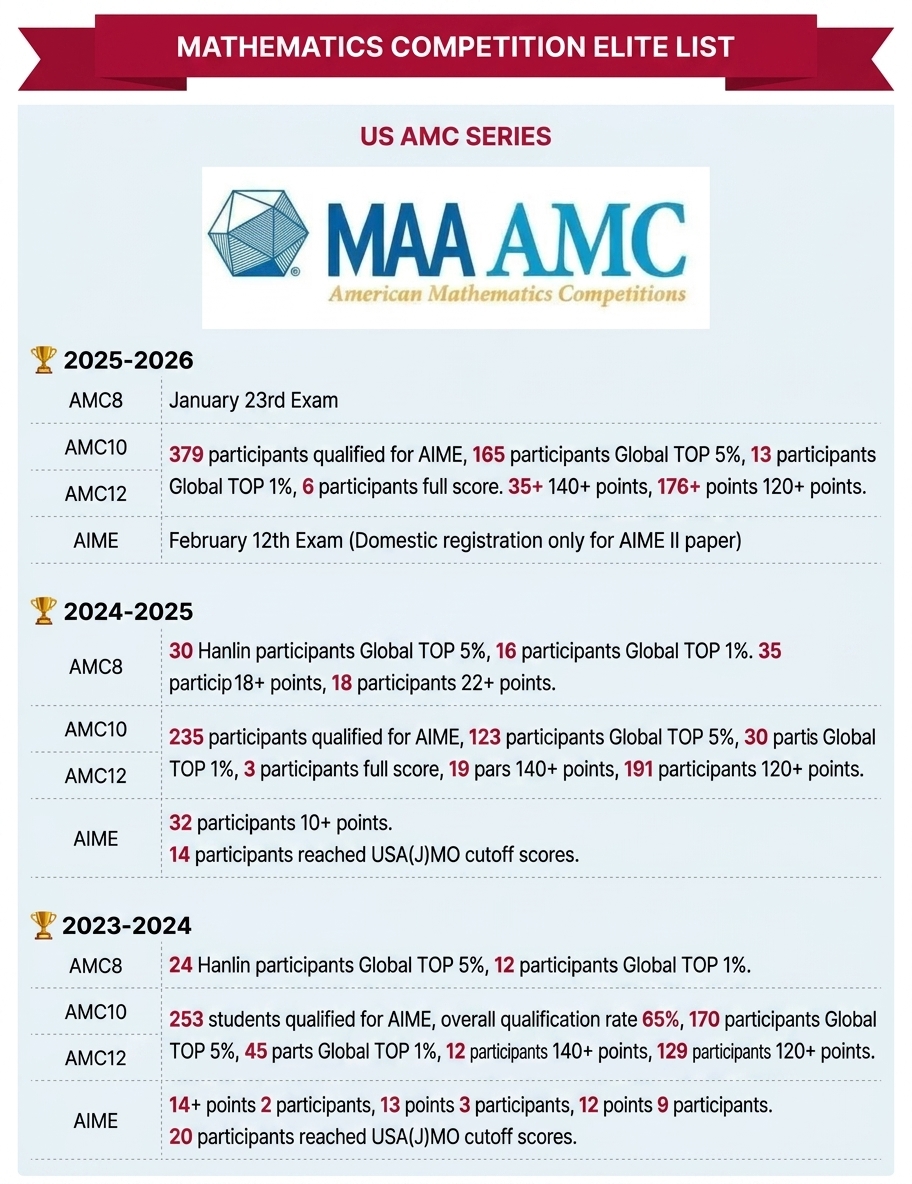

The AMC10 is one of the secondary school mathematics competitions organized by the Mathematical Association of America (MAA), open to students in grade 10 and below. It is not only a key academic credential for applying to top STEM universities such as MIT, Stanford, and CMU, but also an excellent platform for enhancing mathematical thinking, logical reasoning, and problem-solving abilities. This article will provide a detailed analysis of the target audience for AMC10, difficulty trends, preparation strategies, and quality course recommendations to help you prepare efficiently and boost your scores effectively.
I. Who Should Take AMC10?
1. Students Who Performed Well in AMC8
Characteristics: Scored around 20 points in the AMC8 held in January of the current year, indicating a solid mathematical foundation;
Advantages: Already possess good calculation accuracy and basic logic, enabling faster adaptation to the breadth and depth of AMC10 knowledge;
Recommended Path: Directly advance to higher-level study of Algebra and Geometry modules, strengthening skills in Number Theory and Combinatorics.
2. Students Preparing to Apply for International Schools
Target Groups: Prestigious schools in Shanghai (San Gong, YK Pao School, Pinghe Bilingual School), Beijing (RDFZ, Tsinghua High School), Shenzhen (Shenzhen Middle School), Chengdu (No. 7 High School), etc.;
Advantages: AMC10 scores serve as an important reference for international school entrance exams, offering significant bonus points, especially in elementary-to-middle school transitions and transfer exams;
Recommended Path: Begin systematic preparation half a year to one year in advance to secure an ideal score before entrance exams.
3. Students in Grades 7–10 Looking to Strengthen Their Mathematical Foundation
Characteristics: Wish to reinforce in-school knowledge and enhance mathematical thinking through competition preparation;
Advantages: AMC10 covers all middle school to early high school mathematics topics, with a focus on logical thinking, effectively addressing gaps in school curricula;
Recommended Path: Start with basic problems, gradually progress to intermediate difficulty levels, and develop problem-solving techniques and time management skills.

II. AMC10 Difficulty Trend Analysis
1. Algebra Remains a Core Testing Area
Changes: No longer tests only basic operations, but places greater emphasis on deep conceptual understanding and flexible application;
Strategy: Master the essence of algebra, including advanced applications of equations, functions, and sequences.
2. Geometry: Increased Proportion and Computational Demands
Changes: The proportion of geometry problems continues to increase, with higher demands on calculation accuracy and speed;
Strategy: Practice classic problem types such as auxiliary line construction, similar triangles, and the Power of a Point theorem to improve proficiency and accuracy.
3. Number Theory and Combinatorics Should Not Be Overlooked
Changes: While the number of number theory problems has decreased, it remains crucial for AIME; probability and combinatorics problems cover a wide range and require long-term accumulation;
Strategy: Systematically summarize fundamental theorems in number theory (e.g., prime factorization, properties of congruences) and gain experience through practice.
III. AMC10 Preparation Guide: Scientific Planning to Aim for the Top 1%
3 Efficient Score-Boosting Principles
1. Enhance Competition Techniques
Advantages for Domestic Students: School curriculum content overlaps significantly with AMC10, allowing quick progress using in-school foundations;
Competition-Specific Techniques: Learn auxiliary line construction, number theory problem-solving techniques, etc., to achieve dual improvement in school and competition performance.
2. Targeted Practice with Past Papers
Practice Strategy: Repeatedly work through AMC10 past papers from 2010 to 2024, categorizing problems by module;
Basic Problems: Ensure all are correct to solidify fundamentals;
Intermediate Problems: Enhance problem-solving speed and efficiency;
Difficult Problems: Summarize problem-solving models, maintain an error log, and target weak areas for breakthrough.
3. Improve Test-Taking Skills
Essential Formulas and Theorems: Memorize commonly used tools such as geometric area formulas, number theory congruence properties, etc.;
Reading Problems in English: Master essential mathematical vocabulary to improve English reading efficiency;
Mock Exams: Familiarize yourself with the test rhythm through multiple simulations, allocate time wisely, and avoid losing points due to time pressure.
IV. Quality Courses for Efficient Score Improvement
Pre-AMC10 Express Training Course
Target Audience: Students in grades 6–8 or those with no prior competition experience;
Course Structure:
- 20 hours: Pre-AMC10 Algebra Fundamentals
- 50 hours: Systematic review of basic knowledge points by chapter
- 30 hours: Topic-based classified instruction
- 30 hours: Gap filling and review + past paper mock exams and analysis
Goal: Help students build a solid AMC10 math foundation and bridge the knowledge gap between AMC8 and AMC10.
AMC10 Express Training Course
Target Audience: Students in grades 9–10 or those requiring systematic learning;
Course Structure:
- Foundation Stage (50 hours): Systematic review of basic knowledge points by chapter
- Intensive Stage (30 hours): Advanced AMC10 course covering Algebra, Geometry, Number Theory, and Probability
- Sprint Stage (30 hours): Gap filling, past paper mock exams and analysis, exam techniques
Course Selection Advice:
- Beginners: Recommended to start with Pre-AMC10 and progress step by step;
- Students with some foundation: May directly enter the Foundation or Intensive Stage for targeted training on weak modules.
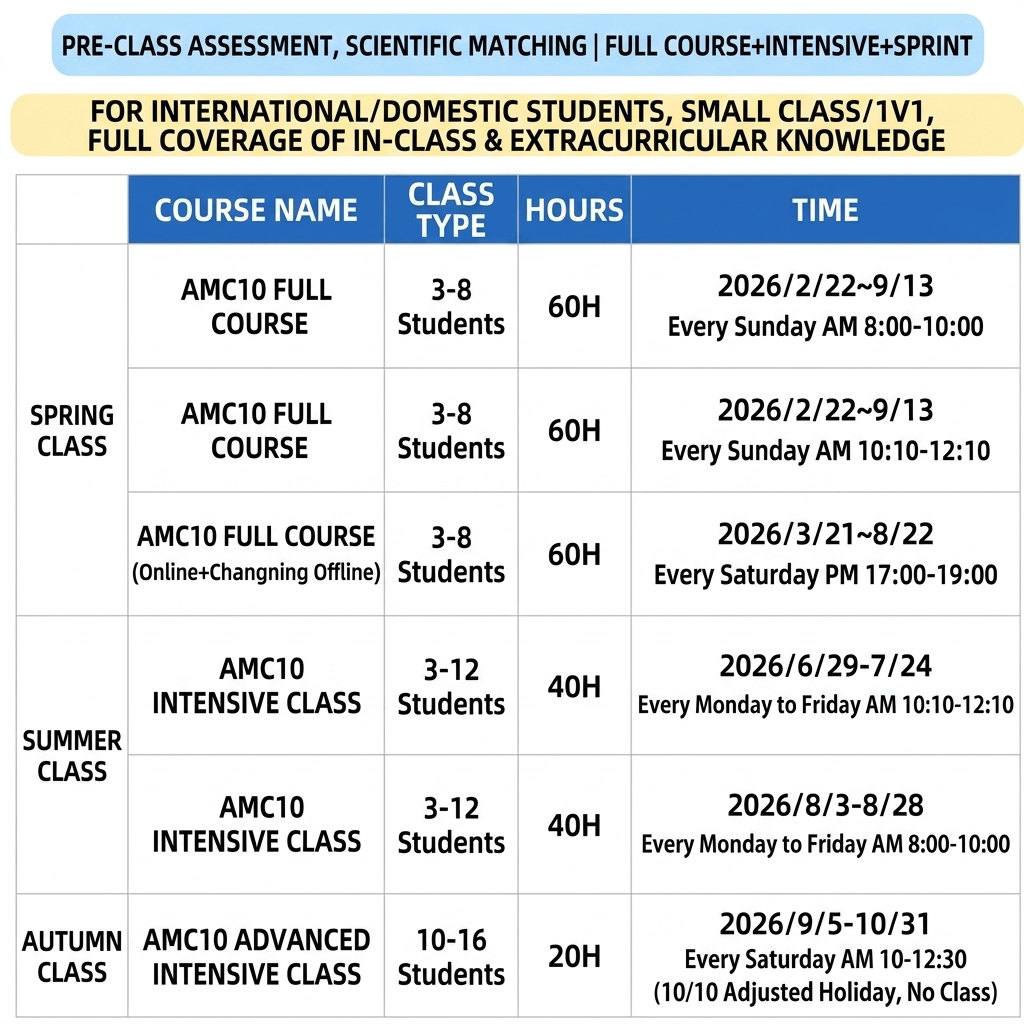
AMC10 Preparation Courses
Our instructors are graduates from top global universities. With precise curriculum planning and comprehensive learning tracking, we ensure your score improvement and award-winning success!
| Class Type | Hours | Class Size | Start Date |
|---|---|---|---|
| Winter Break Class | 30H | 3–8 students | Consult teacher for details |
| Systematic Course | 20H | 1v1 / 3–8 students | Consult teacher for details |
| Problem‑Solving Class | 20H | 1v1 / 3–8 students | Consult teacher for details |