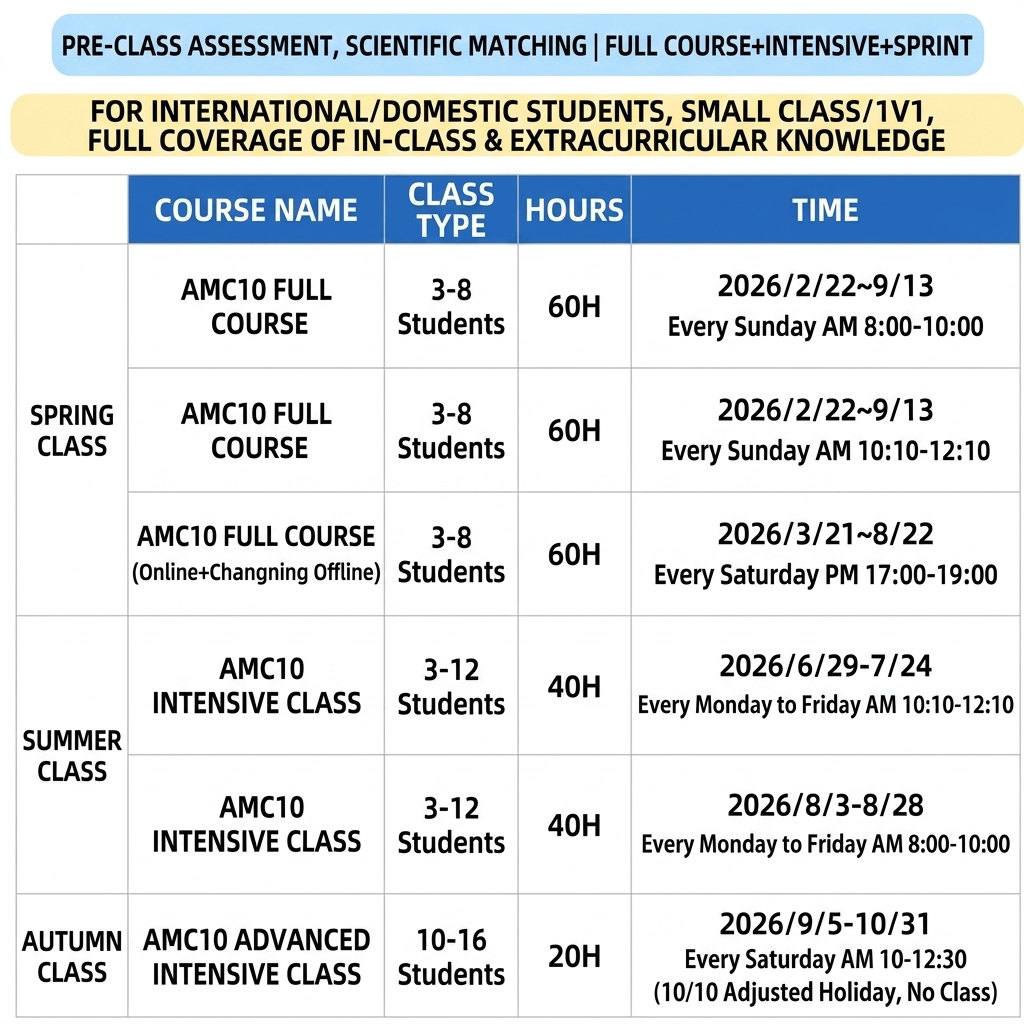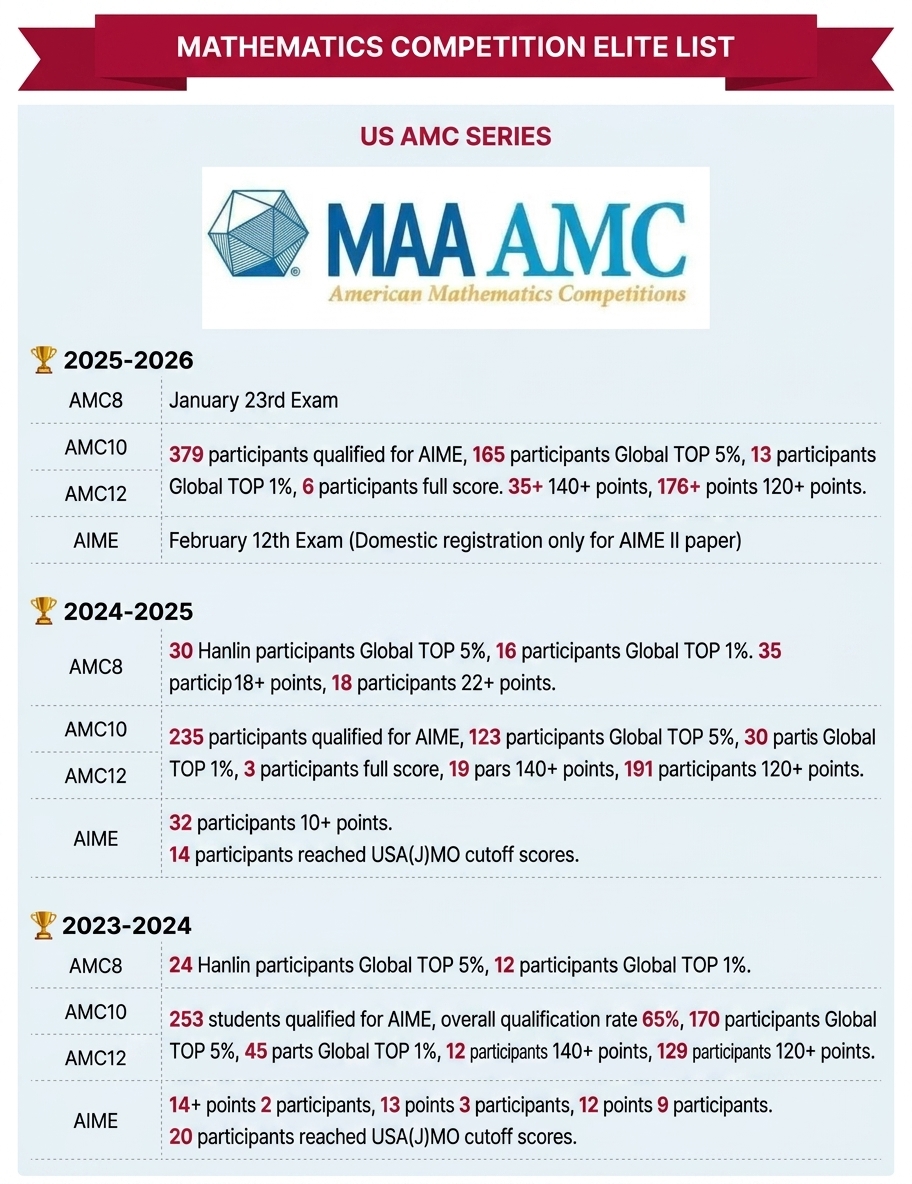

As one of the most influential secondary school mathematics competitions in the world, AMC10 is not only the "golden springboard" to AIME but also an important academic credential for applying to top US and UK universities and other elite international schools. Its difficulty lies between middle school extension and advanced high school, emphasizing three key abilities: breadth of knowledge, depth of thinking, and problem-solving speed.

I. 2026 AMC10 Key Timeline (Plan Ahead!)
| Time | Event | Preparation Focus |
|---|---|---|
| September–October 2025 | Registration opens | Confirm test center, choose version A/B, complete registration |
| November 6, 2025 | AMC10 Version A exam | Full mock exam + time allocation training |
| November 14, 2025 | AMC10 Version B exam | Use Version A past papers for review and optimize Version B strategy |
| December 2025 | Results + awards announced | Check scores, confirm AIME qualification |
| February 2026 | AIME exam | If qualified, immediately start AIME-specific training |
Recommendation: Prepare systematically at least 3–6 months in advance, especially for students without a competition background.
II. How Hard Is AMC10?
Knowledge Coverage: ≈ 70% middle school math + 30% high school compulsory content, with core modules: Algebra, Geometry, Number Theory, Combinatorics.
Out-of-syllabus topics: Number theory (congruence, modular arithmetic, divisibility properties), Combinatorics (inclusion-exclusion principle, recurrence counting, probability modeling) → These are rarely systematically taught in domestic or most international curricula.
Time Pressure: 75 minutes for 25 questions ≈ 3 minutes per question. The last 10 questions often require multi-step reasoning, making it difficult for most students to finish all.
Realistic Strategy: Securing the first 20 questions correctly = foundation for awards; getting the first 23 correct = AIME qualification (approx. 103.5 points).
III. Key Focus Areas for AMC10 Preparation by Curriculum System
1. IGCSE System Students
Advantages: IGCSE Additional Math overlaps heavily with AMC10 in algebra, functions, and basic geometry; quadratic equations, inequalities, coordinate geometry, etc., are already covered.
| Module | Issues | Countermeasures |
|---|---|---|
| Geometry | IGCSE geometry emphasizes calculation, lacks proof and construction training | Supplement: Power of a Point theorem, comprehensive similar triangle problems, auxiliary line techniques |
| Calculation ability | Reliance on calculators → slow manual calculation, prone to errors | Daily timed calculation training (e.g., quick squaring, factorization) |
| Competition mindset | Habit of "standard solutions," lacks flexible modeling ability | Focus on problems 16–25, learn strategies such as "extreme case method," "symmetry," "reverse construction" |
Action Recommendation: Leverage IGCSE math foundation to quickly cover algebra modules, then focus on number theory + combinatorics + advanced geometry.
2. IB System Students
Advantages: IB Math AA/AI covers a wide range of knowledge and offers strong logic training; HL students are already exposed to some advanced topics (e.g., complex numbers, introductory calculus).
| Student Level | Challenges | Recommendations |
|---|---|---|
| SL students | Lack depth in knowledge; number theory/combinatorics are almost untouched | Need systematic supplementation; focus on conquering the four AMC10 modules |
| HL students | Sufficient knowledge but tight schedule (IB workload is heavy) | Intensive preparation during summer break; avoid conflicts with IAs in November |
Note: IB does not teach "congruence" or "recurrence counting" – high-frequency AMC10 topics that require dedicated supplementation.
3. AP System Students
Core Challenge: AP Calculus / Statistics have low alignment with AMC10; calculus is not tested at all in AMC10, creating a knowledge gap.
GapsSolutionsWeak algebraRevisit middle/high school algebra: polynomials, Vieta's theorem, inequalitiesMissing geometrySupplement plane geometry proofs, circle properties, triangle centers and linesNumber theory/combinatorics gapsLearn from scratch: modular arithmetic, pigeonhole principle, classification countingProbability transferApply probability concepts from AP Statistics to combinatorial problems (e.g., expectation models)
Key Reminder: AP students need to rebuild their AMC10 knowledge system; starting preparation at least 6 months in advance is recommended.
AMC10 Preparation Courses
Our instructors are graduates from top global universities. With precise curriculum planning and comprehensive learning tracking, we ensure your score improvement and award-winning success!
| Class Type | Hours | Class Size | Start Date |
|---|---|---|---|
| Winter Break Class | 30H | 3–8 students | Consult teacher for details |
| Systematic Course | 20H | 1v1 / 3–8 students | Consult teacher for details |
| Problem-Solving Class | 20H | 1v1 / 3–8 students | Consult teacher for details |