
As one of the most influential middle school mathematics competitions globally, the AMC 10 is far more difficult than the AMC 8, approaching the level of the AMC 12. In terms of actual content, it aligns roughly with Chinese 10th-grade mathematics plus middle school mathematics league material. Due to the absence of an official syllabus, flexible question styles, and high demands on mathematical thinking, the vast majority of students need systematic preparation of more than 6 months. However, the exact duration should be adjusted dynamically based on the student's foundation and target award level.
I. AMC 10 Preparation Duration Recommendations: Tailored to the Individual, Goal-Oriented
|
Student Type
|
Recommended Preparation Cycle
|
Core Tasks
|
|---|---|---|
|
Average Foundation (School Math B+/A-)
|
10–12 months
|
Systematically cover the four major modules: Algebra, Geometry, Number Theory, and Combinatorics. Transition from AMC 8 past papers to the first 15 questions of the AMC 10. Cultivate competition thinking and break free from "template-based" problem-solving habits.
|
|
Good Foundation (School Math A/A+, with experience in Olympiad math or AMC 8)
|
6–8 months
|
Intensively practice past papers from the last 10 years and analyze error patterns. Conquer high-frequency models in questions 16–25 (e.g., recursive sequences, geometric transformations). Train for time-limited problem-solving and strategic selection.
|
|
Top-Tier Sprint (Target Top 1% or High AIME Score)
|
8–12+ months of continuous training
|
Expand into some AMC 12/Euclid content. Master multi-solution approaches (Algebra vs. Geometry vs. Number Theory perspectives). Participate in mock competitions to maintain competitive form.
|
Key Starting Point: After the November 2025 AMC 10 exam, you can immediately begin preparation for the 2026 season—use the past papers to experience the real difficulty and develop a personalized plan.

II. AMC 10 Question Difficulty Gradients and Time Allocation Strategies
The AMC 10 consists of 25 questions to be completed in 75 minutes, with a clear difficulty gradient. The key to scoring efficiently lies in layered strategies and precise trade-offs.
|
Section
|
Content & Difficulty
|
Strategy & Goal
|
|---|---|---|
|
Questions 1–10: Foundation (Score-Securing Zone)
|
Integer operations, percentages, simple equations, basic properties of triangles/circles.
|
Goal: Get all correct within 30 minutes (≤3 minutes per question). Strategy: Quickly identify the tested concept, avoid carelessness; skip stuck questions and return to them later.
|
|
Questions 11–20: Intermediate (Score-Differentiating Zone)
|
Quadratic functions, similar triangles, probability, basic combinatorics.
|
Goal: Aim for 80% accuracy (8 correct answers yield 48 points). Strategy: Integrate multiple knowledge points, focus on logical chains; use special values, symmetry, and elimination to speed up.
|
|
Questions 21–25: Difficult (Decisive Zone)
|
Complex sequences, advanced geometry, combinatorial extremal problems, constructive number theory.
|
Goal: Getting 1–2 correct provides a significant advantage. Strategy: Don't force complete solutions—writing key approaches may spark inspiration; never dwell too long!
|
III. Score and Time Allocation Reference for Different AMC 10 Targets
|
Target
|
Score Needed
|
Time Allocation Recommendation (Total 75 minutes)
|
|---|---|---|
|
AIME Qualification (Top 2.5%)
|
≈100–105 points
|
Questions 1–15: 30 minutes (get all correct) – Questions 16–20: 25 minutes (get 3–4 correct) – Questions 21–25: 15 minutes (attempt 1 question) – Leave 5 minutes for review.
|
|
Global Top 5% (Honor Roll)
|
≈110–115 points
|
Questions 1–15: 25 minutes – Questions 16–20: 30 minutes (strive for all correct) – Questions 21–25: 15 minutes – Leave 5 minutes for review.
|
|
Global Top 1% (Distinguished Honor Roll)
|
≥120 points
|
Questions 1–15: 20 minutes (quick resolution) – Questions 16–20: 25 minutes (must get all correct) – Questions 21–25: 25 minutes (secure at least 1 question) – Leave 5 minutes for review.
|
Important Reminders: Unanswered questions receive 1.5 points; blind guessing carries high risk (wrong answers earn 0 points). If you have no idea after 5 minutes on a question, decisively mark and skip it to ensure you don't lose foundational points.
IV. Four-Step Efficient Preparation Method
|
Step
|
Duration
|
Core Tasks
|
|---|---|---|
|
Step 1: Knowledge Review
|
1–2 months
|
Organize the four major modules: Algebra, Geometry, Number Theory, Combinatorics. Use textbooks: "Art of Problem Solving Vol. 1," "AMC 10 Problem Series."
|
|
Step 2: Categorized Breakthrough
|
2–3 months
|
Train by question type: e.g., "Extremal Geometry Problems," "Recursive Sequences," "Inclusion–Exclusion Principle." Keep an error notebook, recording "mental blocks" rather than just copying answers.
|
|
Step 3: Real Past Paper Practice
|
2–3 months
|
Intensively practice past papers from 2015–2025 (20 sets including A/B versions). Strictly time each set to simulate exam pressure.
|
|
Step 4: Final Sprint Mock Exams
|
1 month
|
Take 2 mock exams per week, analyze time allocation and strategic mistakes. Focus on reading traps (keywords like "positive integer," "distinct," etc.).
|
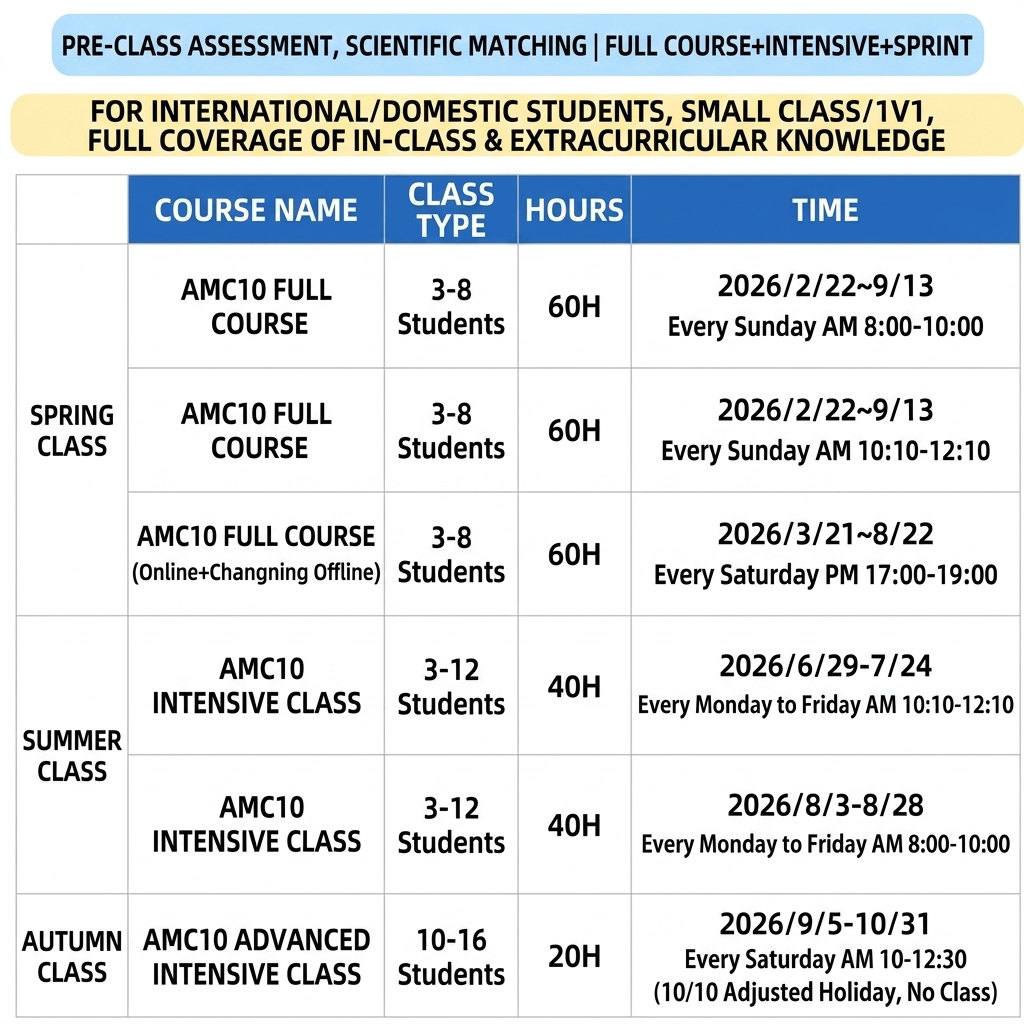
AMC10 Preparation Courses
Our instructors are graduates from top global universities. With precise curriculum planning and comprehensive learning tracking, we ensure your score improvement and award-winning success!
| Class Type | Hours | Class Size | Start Date |
|---|---|---|---|
| Winter Break Class | 30H | 3–8 students | Consult teacher for details |
| Systematic Course | 20H | 1v1 / 3–8 students | Consult teacher for details |
| Problem-Solving Class | 20H | 1v1 / 3–8 students | Consult teacher for details |