The AMC10 is an international mathematics competition organized by the Mathematical Association of America (MAA) for students in grade 10 and below. Its content covers all middle school and first-year high school math knowledge, with higher requirements in certain areas such as number theory and combinatorics. This article will provide a detailed analysis of the AMC10's knowledge point distribution, difficulty levels, and preparation strategies to help you scientifically plan your preparation path.

I. AMC10 Knowledge Points Fully Explained
1. Must-Know Knowledge Points (Key Focus Areas)
Algebra
Algebraic Calculation Techniques: factoring, substitution, expansion, etc.
Linear Functions and Equations: systems of linear equations, slope-intercept form.
Absolute Values and Floor Functions: absolute value inequalities, floor operations.
Sequences: arithmetic sequences, geometric sequences, and their applications.
Quadratic Functions and Equations: quadratic formula, Vieta's formulas, discriminant.
Geometry
Geometric Transformations: translation, rotation, symmetry.
Circle Geometry: tangents, secants, arc length, inscribed angles.
Similar Triangles: proportional relationships, similarity criteria.
Lines and Circles: intersection, tangency, distance formula.
Number Theory
Congruence: modular arithmetic, congruence equations.
Divisibility: prime factorization, greatest common divisor (GCD), least common multiple (LCM).
Prime Factorization: prime number determination, fundamental theorem of arithmetic.
Base Conversion: conversions between binary, decimal, and hexadecimal.
Combinatorics
Permutations and Combinations: fundamental counting principle, permutation and combination formulas.
Basic Probability: classical probability, conditional probability.
Inclusion-Exclusion Principle: intersections, unions, and complements in set operations.
Recurrence Relations: Fibonacci sequences, principles of dynamic programming.
2. Error-Prone Areas (By Module)
Algebra
Word Problem Comprehension: pay attention to unit conversions and implicit conditions.
Solving Absolute Value Equations: consider multiple solution cases.
Exponential and Logarithmic Calculations: special handling when the base is a fraction or negative.
Geometry
Finding Congruent Angles in Congruent/Similar Triangles: construct auxiliary lines, use properties of parallelograms.
Cutting and Complementing Shapes: decomposition and recomposition of complex figures.
Spatial Imagination in Plane Geometry: develop spatial awareness, 3D geometry projections.
Combinatorics
Distinguishing Permutations from Combinations: avoid double counting, understand combinatorial meaning.
Applications of Recurrence Relations: Fibonacci sequences, dynamic programming thinking.
Number Theory
Prime Factorization: quickly determine whether a number is prime.
Units Digit Problems: patterns of last digits, periodicity analysis.
Probability
Discrete Probability: event independence, mutually exclusive events.
Geometric Probability: area ratios, length ratios, volume ratios.
II. AMC10 Question Distribution & Difficulty Levels
Basic Questions (Questions 1-8)
Relatively low difficulty, covering basic knowledge points in algebra, geometry, and number theory.
Goal: answer all correctly, ensuring accuracy and speed to save time for the harder questions later.
Relatively Easy Questions (Questions 9-13)
Slightly higher difficulty, mainly reflected in traps and pitfalls within the problem statements.
Requires careful reading. These are questions that most students can master.
Medium Difficulty Questions (Questions 14-17)
This is the watershed—the key to achieving the top 1%.
For Grade 8 and below students, correctly answering 15 questions is already excellent. For Grade 9+ students, these must be tackled intensively, aiming for a perfect score.
Harder Questions (Questions 18-23)
Relatively difficult. Beyond basic techniques, these introduce advanced concepts such as linear functions, quadratic equations, and probability and statistics.
This is the key breakthrough area for students aiming for the top 5% and AIME qualification cutoffs.
Difficult Questions (Questions 24-25)
The true difficult questions, demanding deep knowledge and sharp thinking agility.
Only a very small proportion of students can complete these. Students aiming for a perfect score should focus on breaking through here.
III. AMC10 Preparation Timeline & Strategies
1. Foundation Building Phase (Recommended: 6-8 months in advance)
Goal: systematically review AMC10 knowledge points across all sections, expanding beyond standard school mathematics.
Approach:
– For beginners and lower-grade students: spend at least six months building a solid foundation.
– Review school-level knowledge: ensure no major weaknesses in the four core modules (Algebra, Geometry, Number Theory, Combinatorics).
– Supplement competition-specific content: e.g., congruence equations in Number Theory, recurrence relations in Combinatorics.
2. Practice Phase (2-3 months before the exam)
Goal: improve problem-solving speed and accuracy through intensive practice with real exam papers.
Approach:
– Study past years' exams: become familiar with how each knowledge point is applied in test questions.
– Connect knowledge modules across topics: train flexible problem-solving approaches.
– Keep an error log: systematically address your own weaknesses.
3. Sprint Phase (1-2 months before the exam)
Goal: comprehensively enhance exam-taking skills to ensure optimal performance on test day.
Approach:
– Targeted assault on difficult areas: intensive training on weak points.
– Comprehensive review of knowledge points: fill in any remaining gaps.
– Repeated practice of past mistakes: ensure errors are not repeated.
– Mock exams: strictly timed simulations of the real test environment.
– Time management training: improve answering speed and allocate time appropriately per question.
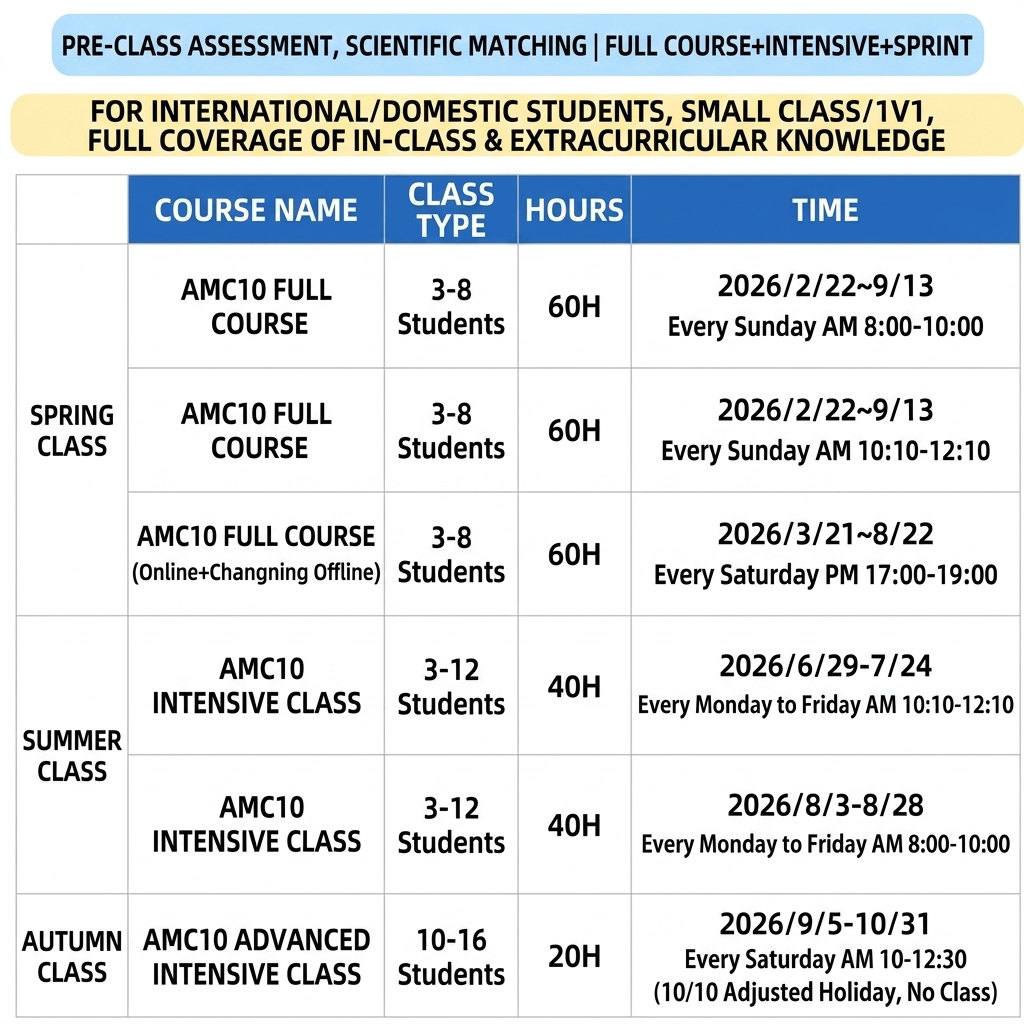
AMC10 Preparation Courses
Our instructors are graduates of top global universities. With precise curriculum planning and full learning progress tracking, we escort you to score improvement and awards!
| Class Type | Hours | Class Size | Start Date |
|---|---|---|---|
| Winter Break Class | 30H | 3-8 students | Consult teacher |
| Systematic Course | 20H | 1v1 / 3-8 students | Consult teacher |
| Problem-Solving Class | 20H | 1v1 / 3-8 students | Consult teacher |