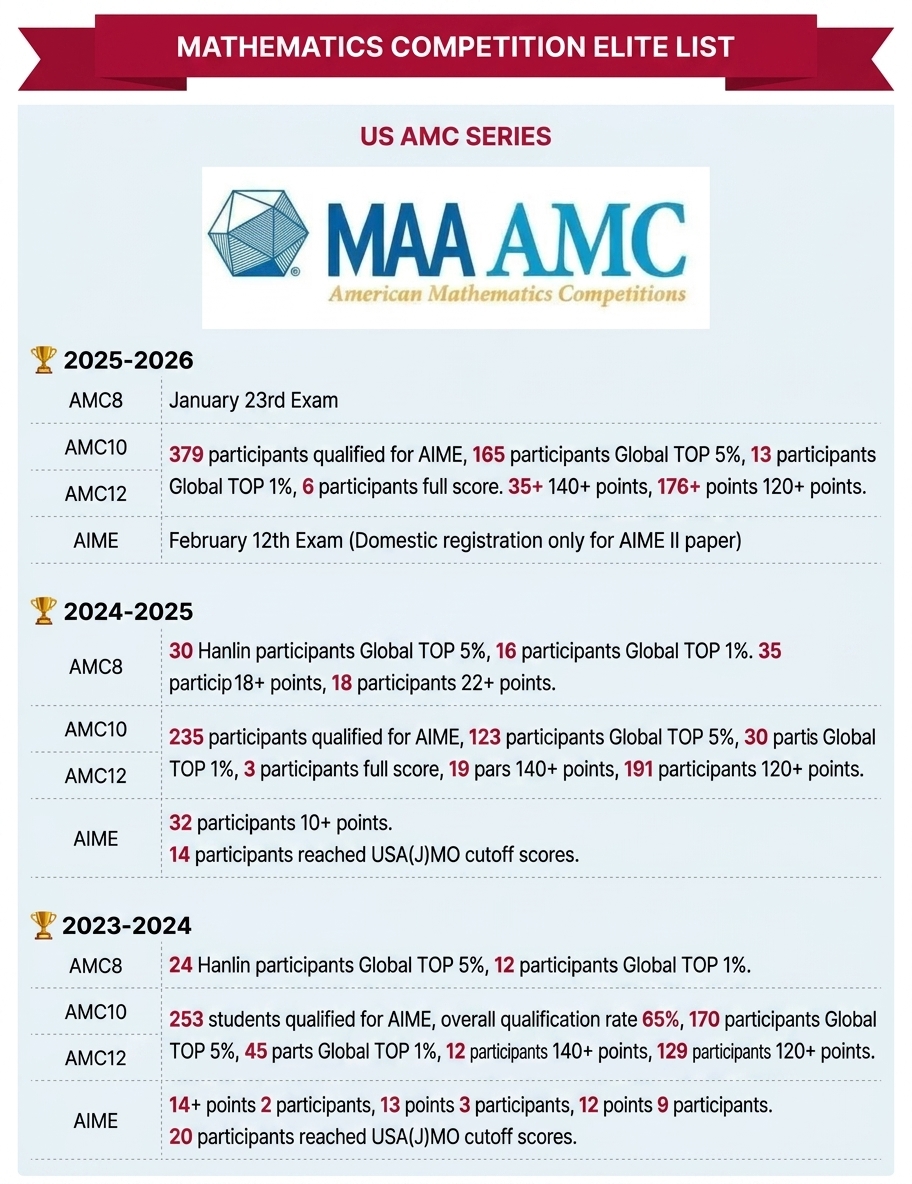

In the landscape of international math competitions, the AMC10 has always been seen as a "touchstone" for proving mathematical talent and gaining admission to top schools. With the surge in the number of participants each year, the two distinct percentile thresholds—the Global Top 1% (Honor Roll of Distinction) and the Global Top 5% (Honor Roll)—have become core indicators for measuring the academic credentials of students. For students taking the AMC10 for the first time, standing out in this time-limited competition requires not only exceptional brainpower but also precise strategic planning.

I. Deep Analysis: What Does the Global Top 1% vs. Top 5% Truly Mean?
1. Global Top 1%: The "Academic Green Card" for Top STEM Schools
Scoring in the Global Top 1% of the AMC10 means your mathematical logic and problem-solving speed are among the very best of your peers.
Admissions Boost: When applying to schools with an extreme focus on quantitative skills like MIT, Stanford, and Carnegie Mellon (CMU), a Top 1% score stands as direct evidence of strong academic potential.
Advancement Eligibility: This score usually far exceeds the cutoff for the AIME (American Invitational Mathematics Examination), giving you the confidence to aim for even higher levels of competition, such as the USA(J)MO.
2. Global Top 5%: A Powerful Endorsement for Ivy League Applications
Achieving the Global Top 5% means you've secured a ticket to AIME.
Profile Enhancement: For students applying to comprehensive Ivy League schools like Harvard or Yale, a Top 5% AMC10 score is an excellent academic highlight, proving you have superior logical thinking and problem-solving skills even beyond a busy schedule.
Confidence in the Subject: It demonstrates that you have fully mastered the core essence of high school mathematics and can flexibly tackle non-standard types of problems.
II. First-Time AMC10 Prep: Three Key Points to Keep in Mind
Many students who excel in school math feel frustrated when they first try the AMC10. The reason often lies not in "lack of knowledge," but in "lack of adaptability."
1. Beware of the "Time Trap": The 75-Minute Game
The AMC10 requires solving 25 questions in 75 minutes, averaging just 3 minutes per question.
Misconception: Many students are used to the "dogged pursuit" style of domestic exams. But in the AMC10, Questions 1-15 are foundational points, Questions 16-20 are advanced points, and Questions 21-25 are competition points.
Advice: For first-time test takers, you must practice the ability to "separate and discard." If you spend more than 40 minutes on the first 15 questions, your chance of hitting the Top 1% is very slim. The precise strategy is: zero mistakes on the first 15 questions, solid performance on the middle 5, and a timed push on the final 5.
2. Conquer the "Non-Standard Models": Break Out of In-Class Thinking
The AMC10 covers the four modules of Algebra, Geometry, Number Theory, and Combinatorics.
Difficulty: The contexts of the problems are extremely flexible. For example, congruences and divisibility in Number Theory, and probability models in Combinatorics are often underemphasized in school but frequent and challenging on the competition.
Advice: Don't just grind practice problems; summarize the models. Build muscle memory for concepts like the "Stars and Bars," "Inclusion-Exclusion Principle," and "Advanced Applications of Vieta's Formulas."
3. "Game Theory" of the Scoring System
The AMC10 scoring rule is: +6 points for a correct answer, +1.5 points for a blank answer, and 0 points for a wrong answer.
Strategy: This means if you have no idea how to solve a problem, leaving it blank is much wiser than guessing. For students aiming for the Top 5%, if you can ensure 18 correct answers and leave the rest blank, your total score can reach 118.5 points (usually well above the AIME cutoff). Guessing blindly could cause your score to drop.
III. 2026 Season Preparation Timeline Advice
If you plan to take the exam in November 2026, how should you lay out your plan now?
January - June (Foundation Phase): Scan the syllabus, especially fill the "gaps" in Number Theory and Permutations & Combinatorics.
July - September (Advanced Phase): Intensify your focus by topic. Try to challenge Questions 16-20 from past exams to enhance your problem-solving flexibility.
October - November (Mock Exam Phase): Start timed, full-proctored simulations. Focus on training your answering rhythm under pressure and get used to the "easy first, then hard" order of solving problems.
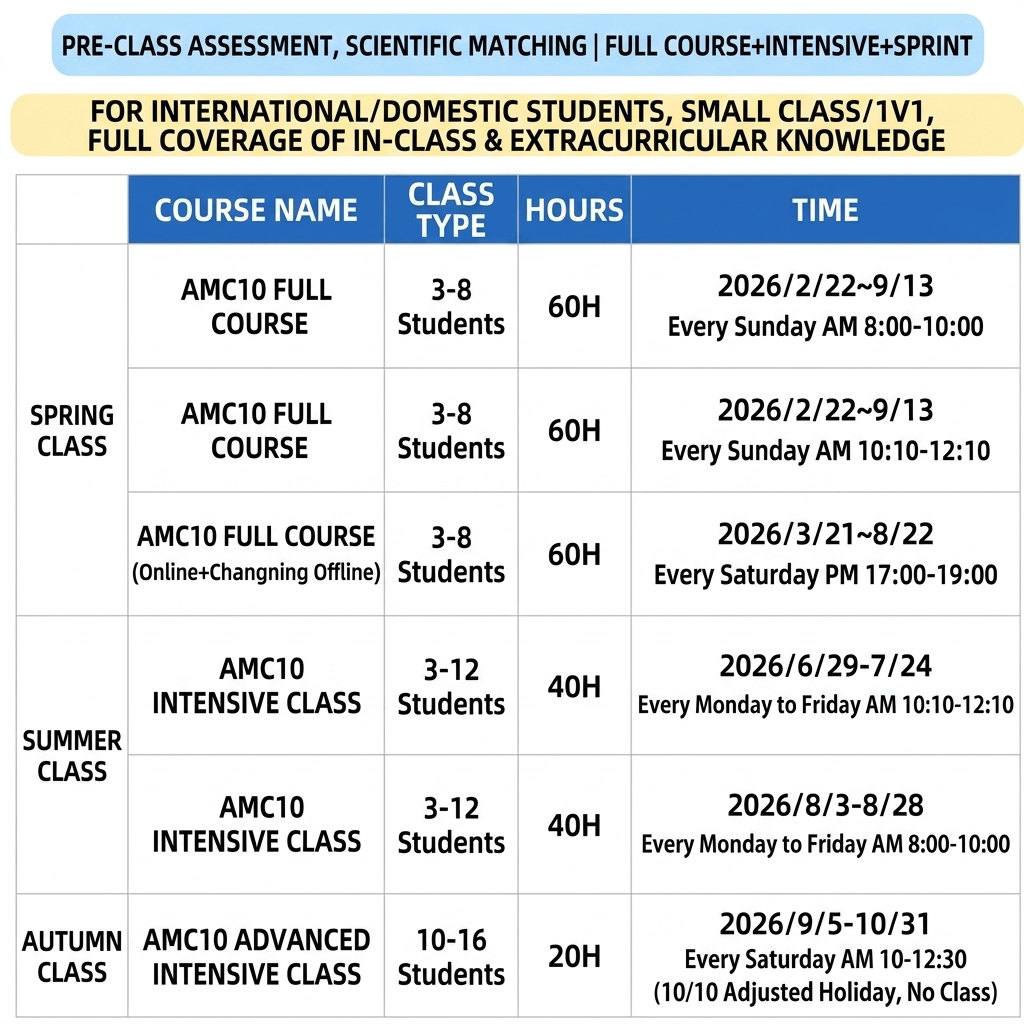
AMC10 Preparation Courses
Our instructors are graduates of top global universities. With precise curriculum planning and full learning progress tracking, we escort you to score improvement and awards!
| Class Type | Hours | Class Size | Start Date |
|---|---|---|---|
| Four-Module Short-Term Class | Varies by module | 3-8 students | Consult teacher |
| Systematic Course | 20H | 1v1 / 3-8 students | Consult teacher |
| Problem-Solving Class | 20H | 1v1 / 3-8 students | Consult teacher |