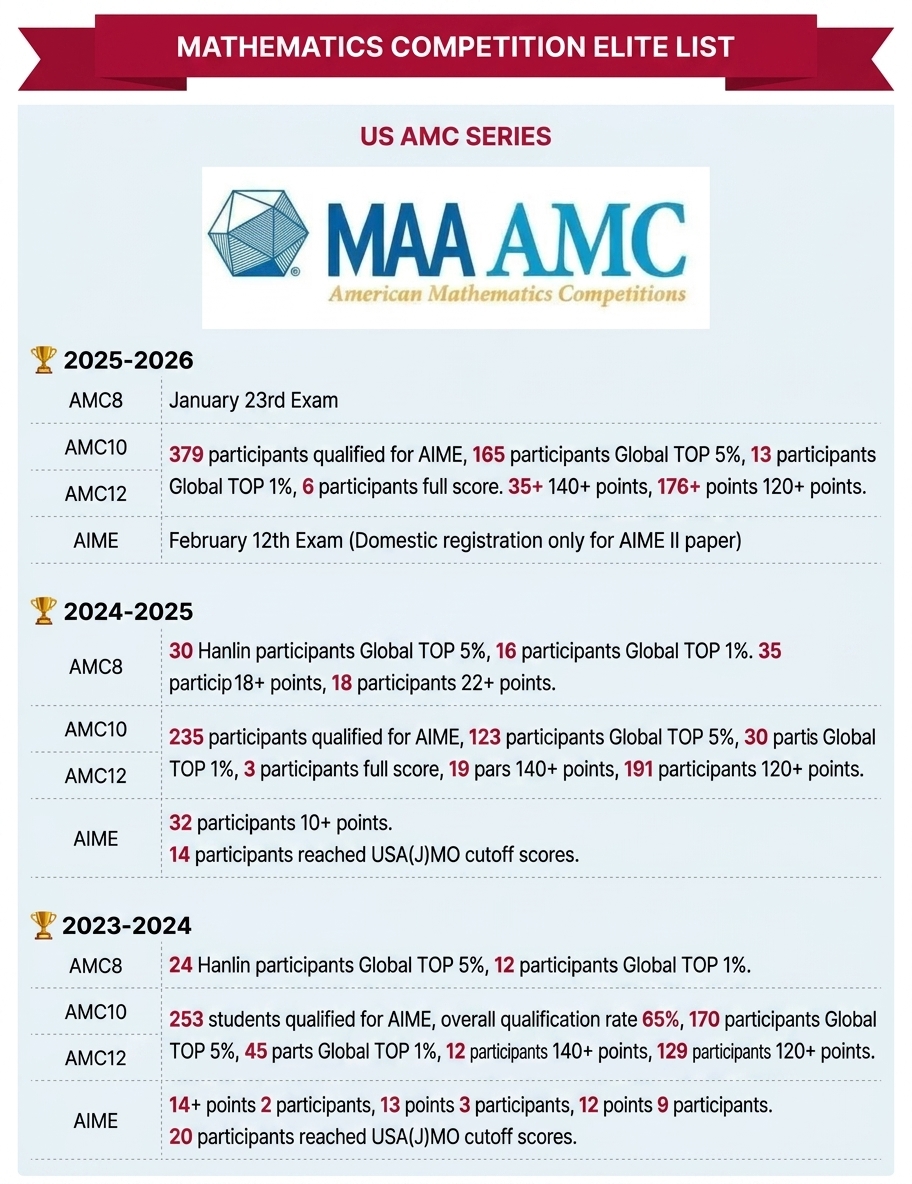

Many parents and students mistakenly believe that "the AMC10 is a competition for high school students, so middle school students are too young" or that "students in the Chinese domestic education system don't need to take international competitions."
But the opposite is true—middle school is the golden window for AMC10 preparation! Especially for students transitioning from the domestic system to international education, the AMC10 is not only proof of mathematical ability but also a "key" to breaking down educational barriers.
This article will provide a comprehensive analysis from three dimensions—academic improvement, college application value, and award pathways—explaining why middle school students (especially those in Grades 8–9) are most suited to start preparing for the AMC10 now.
I. Dual Improvement of Grades and Thinking: Competition ≠ Disconnected from Schoolwork, but an "Advanced Upgrade"
High Knowledge Overlap: Preparation Reinforces Learning
The four core modules of the AMC10 (Algebra, Geometry, Number Theory, Combinatorics) cover nearly all key middle school mathematics topics:
Algebra: Equations, inequalities, functions, sequences → Corresponds to high school entrance exam (zhongkao) problem-solving questions.
Geometry: Triangle congruence/similarity, circle properties, Pythagorean theorem → Core of middle school geometry.
Number Theory: Factors, multiples, congruences, divisibility → Extends the "integers" unit from school.
Combinatorics: Counting principles, probability → Bridges to high school elective content.
Key Difference
School problem: "Solve for the solution to this equation."
AMC10 problem: "Under certain conditions, how many integer solutions does this equation have?"
— This is not about exceeding the curriculum, but about depth + flexibility.
Thinking Skills Transfer Back to School Learning
Through AMC10 training, students will:
Learn to break down complex problem statements and quickly identify key points.
Build a knowledge network instead of memorizing formulas in isolation.
Improve time‑limited problem-solving ability, easily handling difficult entrance exam questions.
Develop the habit of summarizing patterns independently, enhancing overall science literacy.
II. Maximizing Application Value: A "Game‑Changer" for Students Transitioning from the Domestic System
For students planning to enter international high schools (such as IB, A‑Level, or AP programs), the AMC10 holds irreplaceable strategic value:
Advantage 1: Solid Foundation, Low Preparation Cost
Students from the domestic system have strong calculation skills and a solid foundation, far exceeding their peers in purely international programs. They only need to supplement competition thinking and expanded problem types (e.g., inclusion‑exclusion principle, permutations and combinations) without starting from scratch. Three to six months of systematic training can reach the AIME qualification level.
Advantage 2: Breaking Stereotypes, Highlighting Science Strengths
Admissions officers at international high schools often have two doubts about students from the domestic system:
"They just drill problems; they lack logical thinking."
"They rely on teachers; they have weak independent learning skills."
A top‑5% AMC10 certificate or an AIME qualification certificate directly proves:
You possess the mathematical reasoning skills required for international curricula.
You can independently tackle challenging problems and adapt to the inquiry‑based learning of IB/A‑Level.
Advantage 3: Filling Background Gaps, Enhancing Application Competitiveness
Compared to transfer applicants with only "school grades + IELTS/TOEFL," students with AMC10 awards:
Receive priority attention during resume screening.
Can showcase growth and resilience in interviews by discussing their competition preparation experience.
Are more likely to receive scholarships or admission to top‑tier classes.
III. How Can Middle School Students Scientifically Set AMC10 Award Goals?
Goal Tiers
| Goal Level | Correct Answers Required | Accuracy | Preparation Focus |
|---|---|---|---|
| Qualify for AIME | ≥ 17 questions | ≈ 68% | Secure points in the first 20 questions; aim for 1–2 correct in the last 5 |
| Top 5% (Honor Roll) | ≥ 20 questions | ≈ 80% | At most 1 mistake in medium questions (11–20); get 2 correct in the last 5 |
| Top 1% (DHR – Distinguished Honor Roll) | ≥ 22 questions | ≈ 88% | Spend ≤ 3 minutes/question on first 15; efficiently tackle the last 10 questions |
Suggested Pacing (75 minutes)
Questions 1–15: ≤ 40 minutes (average < 3 min/question, must be all correct).
Questions 16–20: ≤ 22 minutes (aim for few mistakes).
Questions 21–25: ≤ 13 minutes (try to get 2 correct; leave the rest blank strategically).
IV. Action Suggestions for Parents of Middle School Students
Over 80% of the AMC10 content is already covered in middle school. The missing piece is just the training in thinking. Use AMC10 to verify ability even before AMC8.
If your child consistently scores 90+ in school mathematics, AMC8 will no longer be challenging; AMC10 will better stimulate their potential.
Incorporate AMC10 into Your Application Plan
Grade 8: First participation, target Credit/Distinction.
Grade 9: Aim for AIME qualification to create a standout application highlight.
Grade 10: If not qualified, switch to AMC12 as a backup.
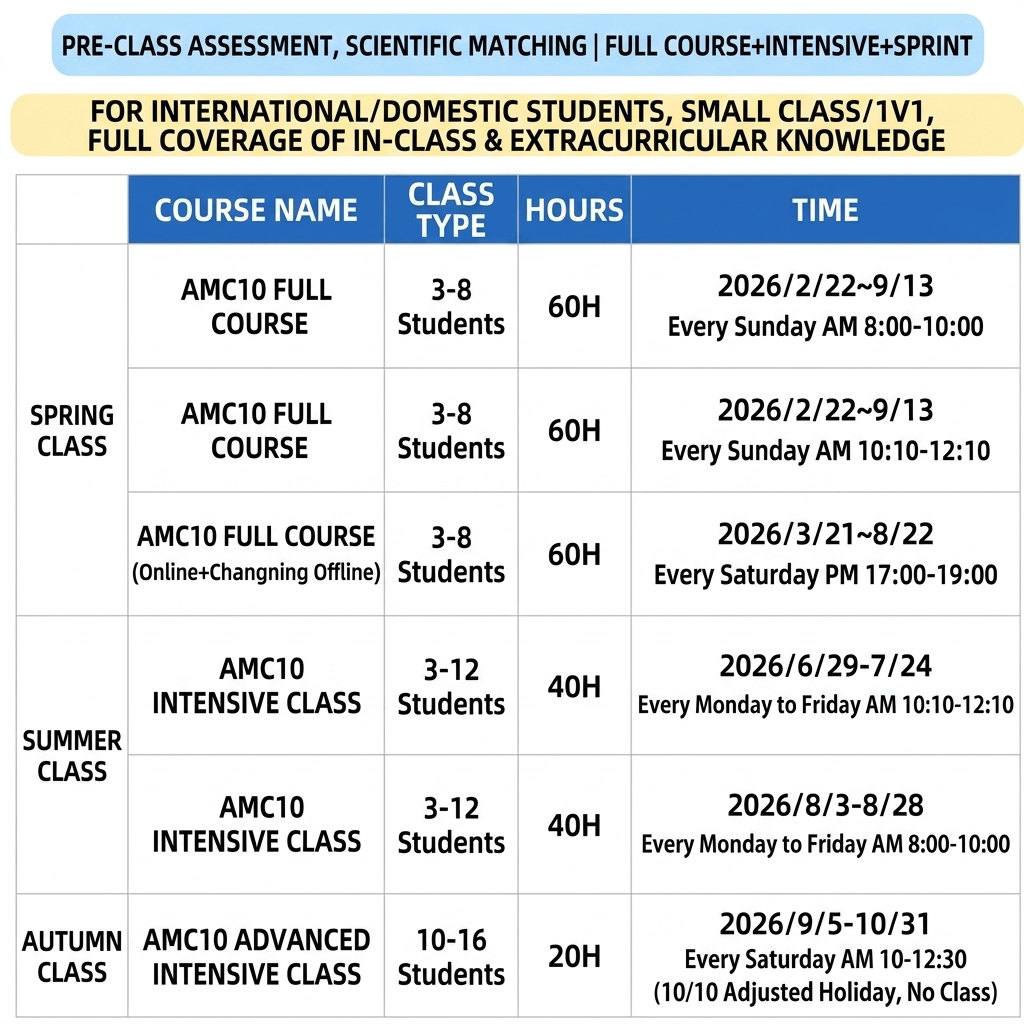
AMC10 Preparation Courses
Our instructors are from top universities around the world. With precise course planning and complete learning support, we guide you all the way to higher scores and awards!
Scan QR code to learn more about AMC10/12 competition courses. Free self-edited detailed handouts available.
Leave a Reply
Your email address will not be published. Required fields are marked with *
Online Customer Service | WeChat Consultation