
Many parents believe: "The AMC10 is too hard. My child is just an average student and not suited to take it."
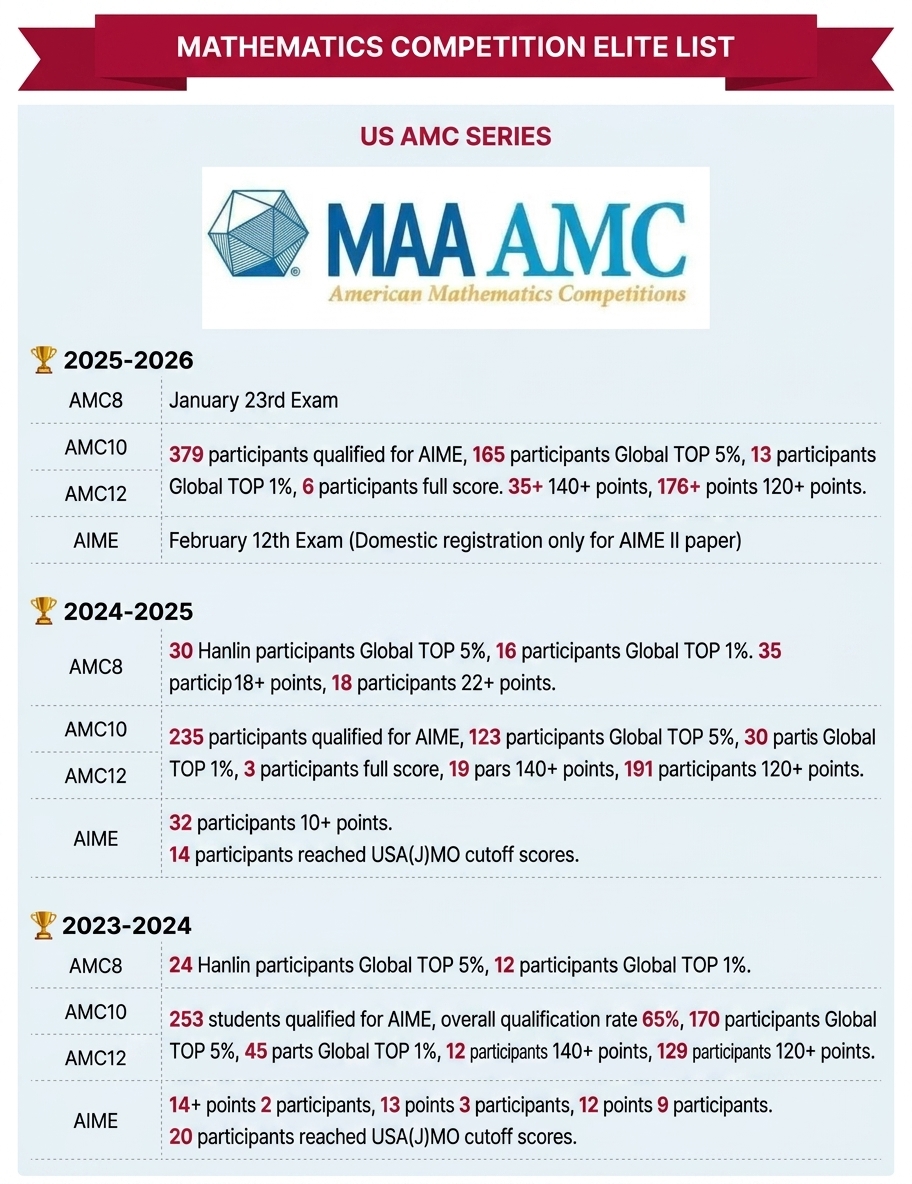
But the truth is — even though the AMC10 is challenging, it's not "exclusively for geniuses." With the right methods and a scientific plan, even beginners can achieve excellent results through systematic training, and even qualify for the AIME!
This article will fully break down the real difficulty of the AMC10, common misconceptions, preparation timeline, and test-day techniques to help you break the "spectator only" curse and go from "afraid to take it" to "securing an award."
I. How hard is the AMC10? Only by understanding its level can you prepare scientifically.
Difficulty benchmark (Chinese education system): Junior High School Math League < AMC10 < Senior High School Math League Round 1 .
Target audience: Students in grades 8–10 (ages 13–16).
Scope of knowledge: Covers entire middle school curriculum + some core high school modules (such as quadratic functions, trigonometry, sequences, basic number theory, etc.).
Depth of thinking: Emphasizes integration of multiple knowledge areas, logical reasoning, and model construction, far exceeding the requirements of the high school entrance exam .
II. Why can't you cram for the AMC10? Three major obstacles.
Misconception 1: "I can win an award by doing a few practice tests."
Reality 1: Many test points are not covered in school!
High-frequency AMC10 topics not covered in the standard curriculum include:
Principle of Inclusion-Exclusion
Permutations and combinations (addition/multiplication principles, banding/insertion methods)
Congruence and modular arithmetic
Similarity in geometry, power of a point theorem, coordinate methods
Recursive sequences, comprehensive applications of Vieta's formulas
These contents are precisely concentrated in questions 16–25, which are key to gaining points!
Suggestion: If your child hasn't systematically studied the above topics, they need at least 3–6 months of targeted review.
Misconception 2: Treating the AMC10 as an "AMC8 upgrade".
Reality 2: There's a drastic leap in difficulty!
| Aspect | AMC8 | AMC10 |
|---|---|---|
| Questions/Time | 25 questions / 40 minutes | 25 questions / 75 minutes |
| Average time per question | 1.6 minutes | 3 minutes |
| Difficulty of final questions | Junior high extension | Close to AIME level |
| Depth of knowledge | Elementary + grade 7/8 | Grades 8–10 + competition thinking |
Truth: Questions 21–25 of the AMC10 are almost like a "cliff" for the average student, requiring long-term training to overcome.
Misconception 3: Underestimating the intensity of competition.
Reality 3: The global average score is only 57 points, and 90% of test-takers are "spectators"!
Perfect score: 150
Global average: ≈ 57
AIME qualification threshold (2025): 105 points+
This means you need to score nearly 50 points higher than 90% of global participants!
III. Difficulty breakdown of AMC10 questions (25 questions = three battlefields)
| Question numbers | Difficulty | Goal strategy | Skill requirements |
|---|---|---|---|
| 1–10 | Basic (≈ hardest high school entrance exam problems) | Must get all correct! | Accurate calculation + careful reading |
| 11–20 | Medium (entry-level competition) | Miss ≤2 | Connecting multiple knowledge points + recognizing solution models |
| 21–25 | Final problems (AIME prep) | Try to get 2–3 correct | Advanced thinking + creative solutions |
Formula to win an award:
First 10 questions (30 points) + Middle 10 questions (40 points) + Last 5 questions (30 points) = 100+ points → Qualify for AIME.
IV. Scientific three‑stage preparation plan (suitable for average students)
1. Foundation consolidation period (March–July)
Goal: Fill knowledge gaps, build competition thinking framework.
Actions:
Do past exams from 2013–2018 (focus on questions 1–20).
Focus on: Algebraic identities, geometric auxiliary lines, basic number theory.
Two sets per week, analyze errors, build a "knowledge ↔ question type" mapping table.
2. Intensive improvement period (September–October)
Goal: Increase speed + conquer medium difficulty questions.
Actions:
Do past exams from 2019–2023 (full set, timed).
Targeted practice: permutations & combinations, congruences, geometric optimization.
Simulate test rhythm: first 10 questions ≤ 15 minutes, questions 11–20 ≤ 35 minutes.
3. Final sprint period ( November before the exam)
Goal: Fill gaps + solidify strategy.
Actions:
Do the most recent past exams from 2024–2025.
Review error notebook, memorize high‑frequency formulas (e.g., Pythagorean triples, difference of squares, combinatorial identities).
Solidify answering habits: circle key words, skip stuck questions, leave blanks wisely.
V. Four test-day techniques (life‑saving level!)
1. Golden time allocation ratio
Questions 1–10: ≤15 minutes (aim for all correct).
Questions 11–20: ≤35 minutes (aim for few errors).
Questions 21–25: ≤20 minutes (try to get 2 correct).
Final 5 minutes: Check answer sheet + re‑check calculations.
2. Learn to strategically skip
AMC10 scoring rule:
Correct answer: +6 points
Omitted: +1.5 points
Wrong answer: 0 points
Strategy: When uncertain, it's better to leave the question blank!
If you answer 16 questions correctly and leave 9 blank → 16×6 + 9×1.5 = 109.5 points → safely advance to AIME!
3. Use elimination to improve guessing probability
Use:
Parity (e.g., the answer must be even)
Range estimation (e.g., side length cannot exceed 100)
Unit/dimensional check
Special value substitution (test with x=0,1,2)
You can quickly eliminate 2–3 options, raising your guessing probability from 25% → 50%!
4. Mindset management: Allow yourself to "not know"
When stuck on a problem, say to yourself: "This question was designed to filter people—it's normal for me to skip it."
Prioritize getting 100% of the points from questions you know how to solve. It's always wiser than obsessing over one difficult problem.
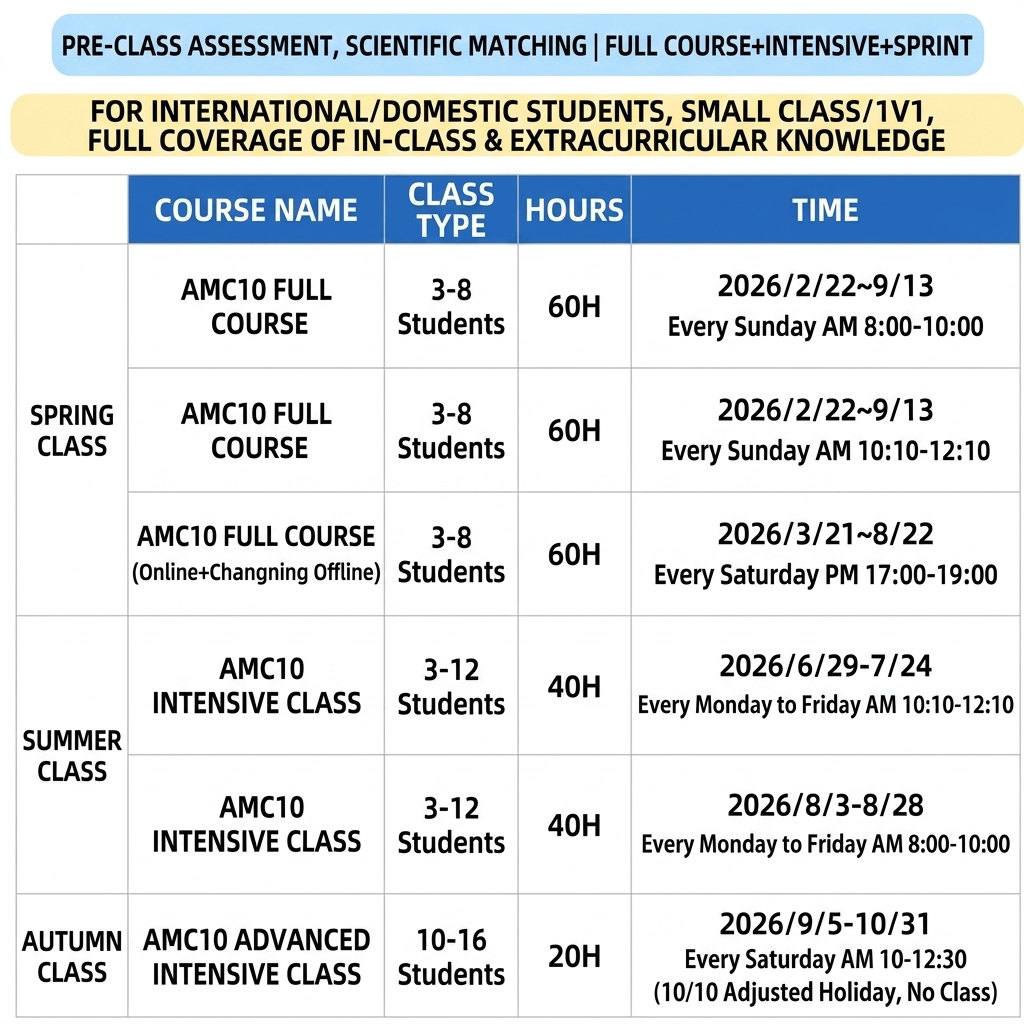
AMC10 Preparation Courses
Our instructors are from top universities around the world. With precise course planning and comprehensive learning support, we accompany you all the way to higher scores and awards!
Scan the QR code to learn more about AMC10/12 competition courses. Free self-edited detailed handouts available.
Leave a Reply
Your email address will not be published. Required fields are marked with *
Online Customer Service | WeChat Consultation