
For students preparing for the AMC10, choosing between the A and B versions is often the first major challenge in the preparation process. Although the official statement says that the difficulty and scope of the two exams are the same, looking at the style of past years' questions, there are clear "personality differences" in their focus.

I. AMC10 A vs B: Core Differences and How to Choose
The A and B exams are usually held about a week apart, with completely different questions, but rankings are separate for each. Looking at data from previous years, the overall style of the A exam is more "stable," focusing on basic application; the B exam is more "flexible," focusing on depth of thinking.
Exam A: Steady and Solid, Foundation is Key
The questions in Exam A are relatively "standardized." The proportion of basic questions (the first 15) is slightly higher, staying closer to textbooks and regular test points. The computational load is moderate, and the final problems are relatively conventional. This makes Exam A very suitable for students with a solid foundation, first-time participants, or those with limited preparation time. For students seeking stability, Exam A has a higher margin for error.
Exam B: Flexible and Variable, A Test of Thinking
The questions in Exam B are often more flexible and comprehensively integrated. It tends to feature innovative question types in areas like number theory and combinatorics. Some problems require "ingenious thinking" or reasoning across different modules. Exam B demands higher computational proficiency and sustained reasoning ability, making it ideal for students with competition experience, flexible thinking, and aspirations for high scores (DHR, top 1% globally).
Three Key Strategies for Choosing Your Exam:
Goal: Securely Qualify for AIME:
It is highly recommended to register for both Exam A and Exam B. The competition will take your best score from the two exams as your final result, significantly increasing your chances of qualification. If you can only choose one, prioritize Exam A, as the basic questions are more direct and points are easier to secure.
Goal: Achieve a High Score/DHR:
Prioritize Exam B. The highly discriminative questions in Exam B are better for creating distance between scores. If you are strong in number theory and combinatorics, Exam B makes it easier to stand out in the high-score bracket.
Goal: Transition to AMC12 / Long-term Competition Preparation:
You can try the strategy of "taking AMC10 for Exam A and AMC12 for Exam B." Using the one-week interval between the two exams, you can first consolidate your AMC10 foundation with Exam A to secure an award, then challenge the difficulty of AMC12 with Exam B, getting an early feel for the pace of higher-level competitions.
II. AMC10 Core Topics and Trends
The difficulty of AMC10 questions increases in a step-like manner. The knowledge points align with the junior high and high school math syllabus but are extended further. Four major high-frequency topics cover the vast majority of questions:
Algebra (Highest Proportion):
Includes linear/quadratic functions, polynomials, sequences, inequalities, etc. This is the foundational section for scoring points. It involves significant calculation and flexible question types, requiring mastery of computational skills.
Geometry (Where difficulties cluster):
Primarily plane geometry, involving triangles, circles, polygons, similarity/congruence, and area/perimeter calculations. Geometric constructions are often complex, and the ability to think about auxiliary lines is key to solving problems.
Number Theory (Core for Differentiation):
Covers divisibility, remainders, prime factorization, parity, etc. This section is less encountered in regular school curricula, making it a weak area for many students. It is the core for differentiation between medium and high score ranges.
Combinatorics (Flexible and Variable):
Includes permutations, combinations, probability, logical reasoning, and counting principles. These questions have no fixed solution templates, focus on testing mathematical thinking, and difficult problems are often concentrated in the last 5 challenging questions.
III. 2026 AMC10 Preparation Plan (Targeting the November Exam)
For students planning to take the AMC10 in November 2026 and aiming to successfully qualify for AIME, it is essential to seize the golden summer preparation period:
Master all knowledge points comprehensively (June - July):
Use the free time before summer vacation to solidify your foundation. This is especially crucial for students in grades 7-9 or lower, as there is a significant gap between their current knowledge and competition requirements in number theory and probability. Systematic learning is needed to fill these knowledge gaps.
Connect knowledge points (August - September):
After mastering the basics, practice simple problems first, then gradually tackle medium-difficulty problems. Focus on learning how to solve problems integrating multiple knowledge points, or delve deeply into a single difficult knowledge point to learn how to apply concepts flexibly.
Intensive problem-solving and mock tests (October - pre-exam in November):
Focus intensively on past AMC10 exams. It's recommended to do them multiple times. While solving problems, promptly summarize mistakes, become familiar with the question styles and patterns, and develop your own time allocation strategy for the exam.
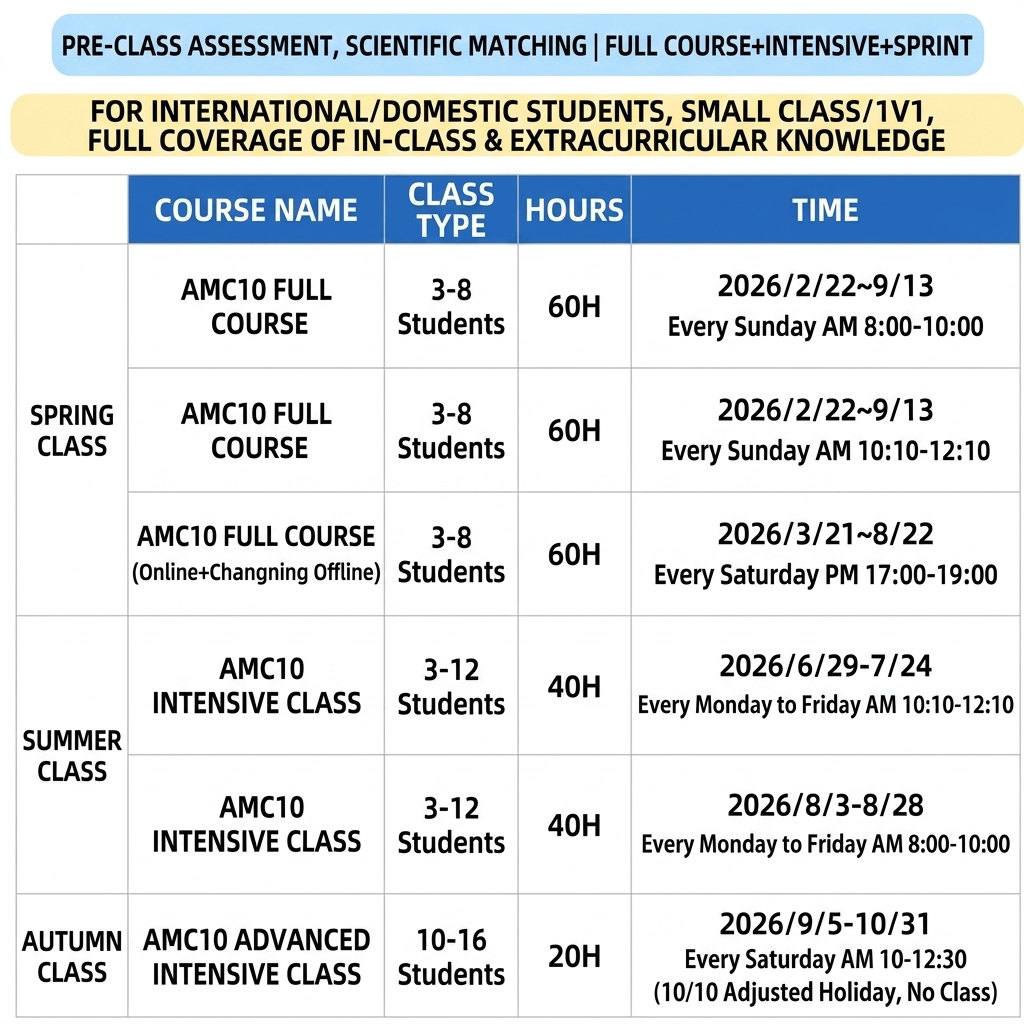
We are an authorized AMC test center and can assist with registration for free! Scan the QR code to inquire about registration for the 2026 AMC10 season.