

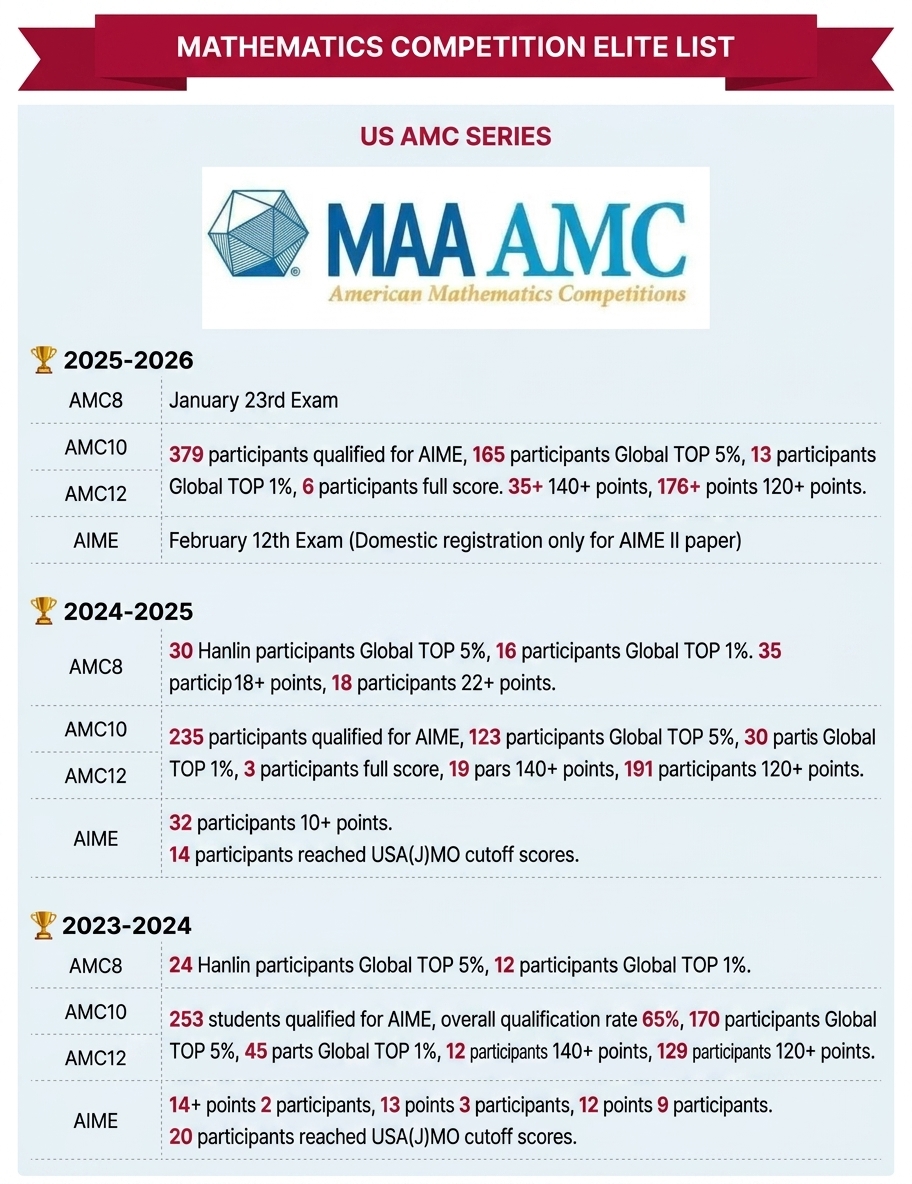
The AMC10/12 award system is actually quite friendly—it's not a game that only "math geniuses" can play. Starting from 2025, the official AMC has made significant upgrades to its awards, adding "Top 10%" and "Top 25%" global awards, greatly broadening the chances of winning. This means that with systematic preparation, students at different levels can earn their own official honors.

I. AMC10/12 Award System and Award Percentages
AMC awards are mainly divided into three categories: global ranking awards, special awards for lower grades, and qualification for advancement:
| Award Name | Award Percentage/Criteria | Difficulty and Significance |
|---|---|---|
| Perfect Score | Score of 150 (perfect score) | Extremely rare, only a handful globally, represents absolute mathematical mastery. |
| Distinguished Honor Roll (DHR) | Top 1% globally | Top academic signal. Highly competitive for applications to Top 20 US universities/Ivy League STEM programs. |
| Honor Roll (HR) | Top 5% globally | Strong academic proof. Usually a powerful plus for targeting Top 30 US universities. |
| Top 10% Honor Roll | Top 10% globally | Excellent level. Suitable as a stepping stone for applications to Top 50 US universities or quality international school summer programs. |
| Top 25% Honor Roll | Top 25% globally | Good level. Proves math ability above the global average, suitable for competition beginners to build confidence. |
| Achievement Roll (AR) | Grade 10 or below and score ≥ 90 | Specifically for talented younger students, proving cross-grade mathematical talent. |
| AIME Qualification | Approximately Top 2.5%–5% globally | The ticket to advanced competitions, an important milestone for the value of the AMC. |
(Note: Specific cutoff scores fluctuate each year based on the difficulty of the A/B exams and the overall performance of global participants.)
II. 8-Week Summer Efficient Preparation Plan
We can break down the preparation into four stages to maximize the use of the holiday and achieve rapid progress:
Stage 1: Accurate Diagnosis, Identify Weaknesses (Weeks 1-2)
Core Task: Find a set of AMC10/12 past papers from the last 3 years and take a diagnostic test strictly within the 75-minute time limit.
Implementation Details: Only attempt questions you know, leave blank ones as 0 points. After the test, calculate your score and analyze the distribution of mistakes. Identify whether your issues are "knowledge gaps" (completely can't do), "speed weaknesses" (know how but too slow), or "strategy flaws" (wasting time on a single problem). This will help you understand your true starting point and avoid ineffective problem-cramming.
Stage 2: Solidify Foundation, Breakthrough by Topic (Weeks 3-6)
Core Task: Systematically build a knowledge map by module. It is recommended to proceed in the order "Algebra → Geometry → Number Theory → Combinatorics," maintaining 2-3 hours of study daily.
Implementation Details: Focus on conquering the Number Theory and Combinatorics modules, which are rarely covered in domestic school curricula (e.g., modular arithmetic, congruences, inclusion-exclusion principle, recursive counting). These are the core differentiating factors for scoring high. You can use the "AOPS Introduction" textbook series or related topic-specific handouts for targeted reinforcement.
Stage 3: Comprehensive Speed-Up, Timed Practice (Weeks 4-6, overlapping with the later part of Stage 2)
Core Task: Enter a training cycle centered on real past papers, completing at least 3 full sets of real exams per week.
Implementation Details: Must strictly time yourself to 75 minutes. After each set, create an error log, mark the reasons for mistakes (e.g., calculation error, confusion of formulas, stuck thinking), and redo all the incorrect questions.
Stage 4: Mock Exam Sprint, Mental Preparation (Weeks 7-8)
Core Task: Full simulation mock exams and breakthrough on challenging final problems.
Implementation Details: Increase the intensity of full simulation mocks to 2-3 times per week, strictly simulating real exam conditions. After the mocks, perform a "debriefing analysis," comparing the scoring rate and time spent on each module, identifying the types of "stuck" problems and addressing them specifically. At the same time, you can appropriately practice innovative solution methods for the final challenging problems (questions 21-25), but only on the premise of ensuring a very high accuracy rate on the first 20 questions.
III. Exclusive Score-Boosting Tips
Leave-Blank Strategy:
The AMC scoring rule is: +6 points for a correct answer, +1.5 points for leaving a question blank, and 0 points for an incorrect answer. When encountering a problem you have no idea how to solve, leaving it blank is more advantageous than guessing blindly!
1-Minute Quick Assessment Method:
For each problem, give yourself a 60-second rapid assessment period. If the basic concept is clear, solve it decisively. If it involves unfamiliar knowledge points or your thinking gets stuck for more than 2 minutes, mark it to skip immediately—establish a "loss-cutting mechanism".
Targeting Weaknesses for Students from Different Curricula:
AP System: Calculus is not tested in the AMC at all; need to supplement Number Theory, Combinatorics, and Geometric Proofs.
IB System: Broad knowledge but lacks depth; need to specifically supplement high-frequency topics like "congruences" and "recursive counting" during the summer.
A-Level System: Although it covers some knowledge points, it lacks training in competition skills and cross-module integration problems; needs targeted reinforcement.
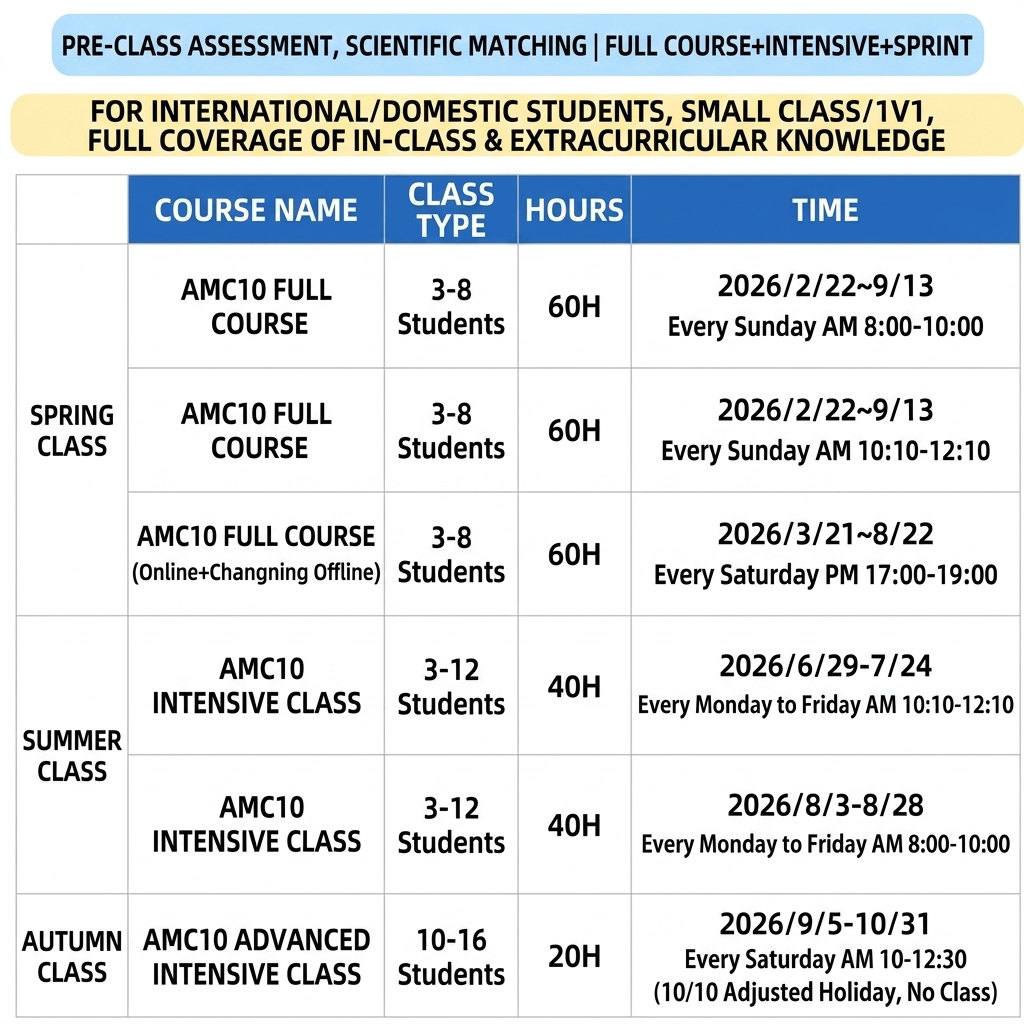
We are an authorized AMC test center and can assist with registration for free!