

As one of the most influential youth math competitions in the world, the AMC10 (American Mathematics Competition 10) is not only the gateway to the AIME (American Invitational Mathematics Examination) but also a "golden ticket" for applying to STEM programs at top universities. With the 2026 season approaching, preparation planning is urgent.

I. AMC10 Registration and Exam Timeline
The AMC10 is typically held in November each year, with the registration window for the Chinese region generally opening in September. Based on the rhythm of previous years, the key dates for the 2026 season are as follows (subject to official final notice):
Registration Time: Usually from September to October. In previous years, the registration deadline for the A version was around October 27, and for the B version around November 3.
Exam Time: Typically in early November. The AMC10 is divided into the A and B versions, with comparable difficulty. Students can choose either or both exams, and their highest score will be used for ranking.
Exam Format: 75 minutes, 25 multiple-choice questions, maximum score of 150 points (6 points for a correct answer, 1.5 points for no answer, 0 points for an incorrect answer).
II. Why Do Top Math Students at School Often "Fail" in the AMC10?
Many parents find that their children, who consistently get full marks in school math, frequently fail when they first encounter the AMC10. This is not due to a weak foundation, but rather falling into two major "high-score traps":
1. Over-reliance on "Routine Thinking"
Domestic in-school training often focuses on identifying question types and applying fixed solution templates (for example, drawing auxiliary lines for geometry problems first, or directly solving equations simultaneously). However, the AMC10's question design is extremely flexible, and even intentionally avoids conventional routines. Many problems that appear to be geometry are actually easier to solve using algebra or number theory methods. If a child relies on "routine thinking," they can easily go down the wrong path, leading to significantly reduced efficiency and accuracy.
2. Ignoring Details and Traps in Question Reading
The AMC10 has 25 questions to be solved in only 75 minutes, giving an average of less than 3 minutes per question. The questions often incorporate real-life scenarios, with relatively long problem statements that hide detailed traps. Children accustomed to the generous time limits of domestic math exams often struggle to adapt to the high-pressure rhythm of "quick problem comprehension, logical sorting, and decisive decision-making," making them prone to losing points by overlooking key conditions.
III. Comprehensive 2026 AMC10 Preparation Plan
As it is now May 2026, there are only about 6 months left until the November exam. This is a golden preparation period – not too long, not too short, just enough for systematic breakthroughs.
Stage 1: Foundation Building (May – July)
Systematically review the four core modules of the AMC10: Algebra, Geometry, Number Theory, and Combinatorics. Focus on clearing knowledge blind spots, especially number theory (such as modular arithmetic, congruences, base conversion) and combinatorics, which are less covered in the school curriculum.
Stage 2: Intensive Breakthrough (July – September)
Start working on AMC10 past papers from the last 10 years. It is recommended to practice by topic and maintain a dedicated notebook for mistakes. The goal is not just to practice problems, but to train your thinking. After completing each set of past papers, it is suggested to spend three times as long reviewing: analyze the root cause of each mistake – was it a lack of knowledge, a deviation in thinking, or a calculation error?
Stage 3: Sprint and Mock Exams (September – November)
Enter the full simulation phase. Complete at least one set of past papers per week, strictly within the 75-minute time limit, to adapt to the exam rhythm and adjust your test-taking mentality.
Core Score-Boosting Strategies
Conquer Key Modules: Geometry is the foundation for scoring, while Number Theory is often the key to widening the gap. For many students, number theory is a new area, but it is tested with high frequency in the AMC10, so it requires dedicated effort.
Optimize Exam Strategy: The AIME qualification line is usually around 99-105 points, which means you only need to get about 70% of the questions correct. Therefore, do not stubbornly focus on difficult problems. The strategy should be: aim for a perfect score on the first 15 questions, try to solve the medium-difficulty ones, and attempt only the difficult problems from modules you are good at – skip those you cannot do.
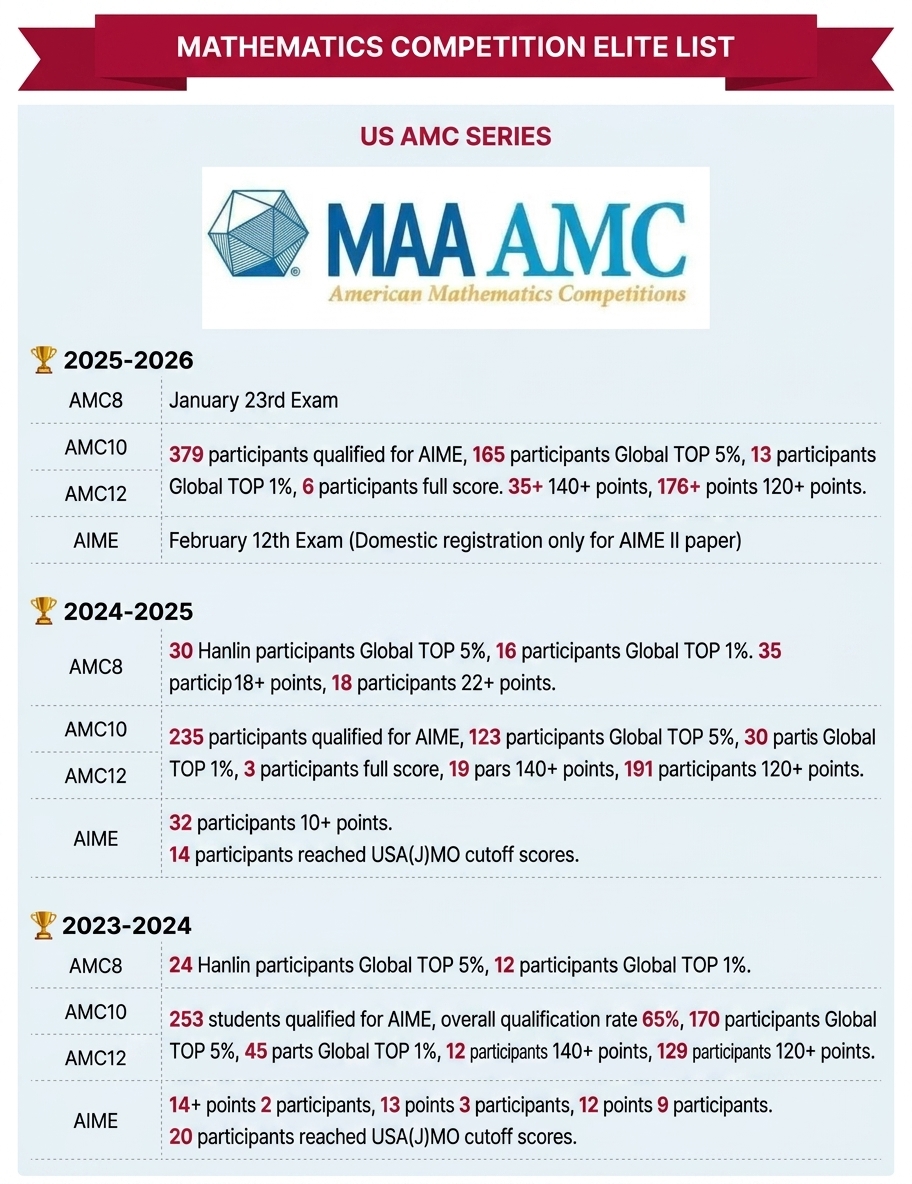
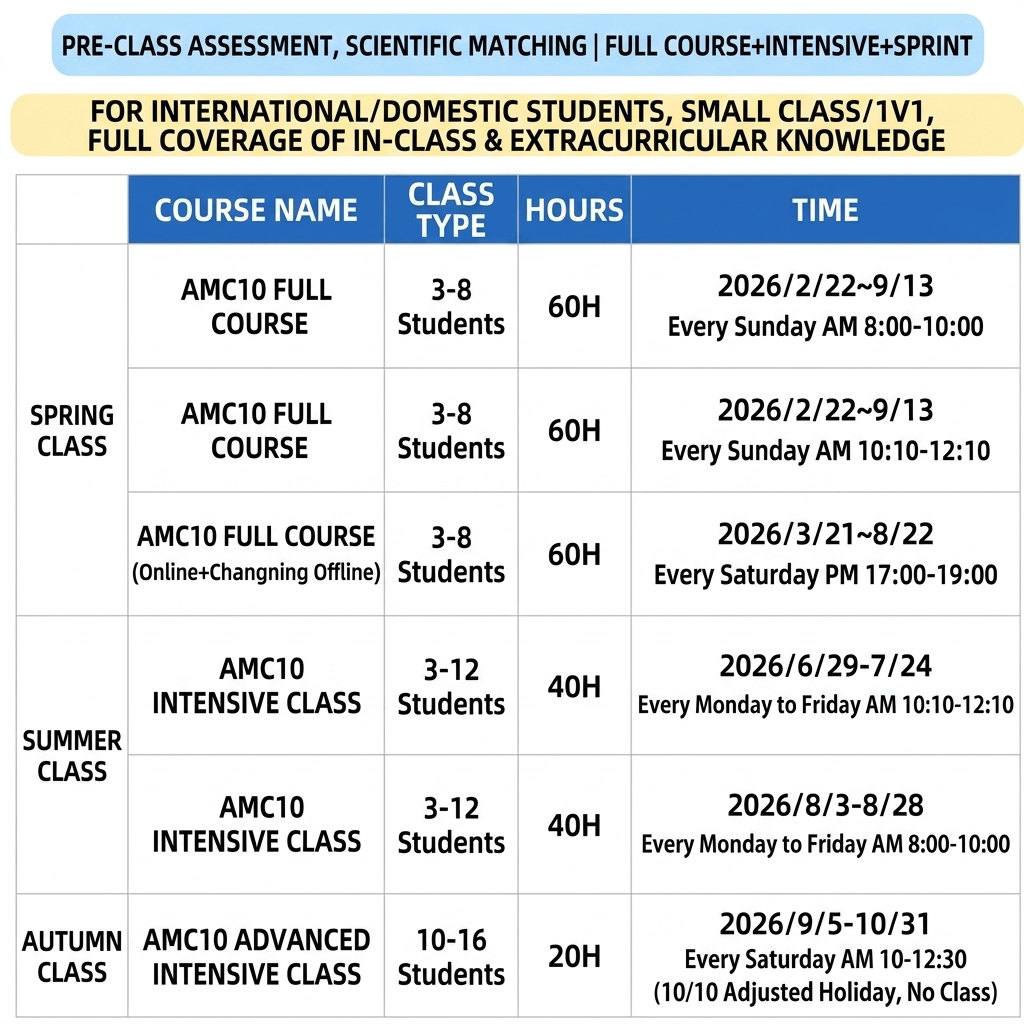
We are an authorized AMC test center and can assist with registration for free!