

As the core bridge to AIME, the competition in AMC10 is intensifying year by year. To stand out within 75 minutes, candidates must not only precisely grasp the paper's difficulty layers, but also keenly capture the 2026 exam trends and seize the summer golden window for scientific planning.
I. AMC10 Paper Difficulty Layers & Scoring Strategies
The AMC10 paper progresses in difficulty step by step. Solidly mastering the foundational test points to secure 90 points, then strategically tackling the intermediate-level challenges, is the core strategy for qualifying for AIME and securing a Global Top 5% award.
Foundation "Gimme" Questions (Questions 1-8): Overall difficulty is low, covering foundational test points in algebra, geometry, and number theory. These points must be secured fully to build a solid scoring base.
Intermediate Trap Questions (Questions 9-13): Difficulty rises slightly, with questions hiding computational and logical traps. Rely on complete logical reasoning to solve these, aiming for zero mistakes. Slow down the pace of reading and calculation.
Mid-Range Watershed Questions (Questions 14-17): These are the difficulty dividing line of the entire paper, demanding a higher level of mathematical proficiency and comprehensive thinking. To win honors and awards, these questions are crucial and require flexible switching between multiple problem-solving approaches.
Comprehensive Difficult Questions (Questions 18-23): Test points are complex and require integrating multiple knowledge modules to solve. This is the core section for achieving high scores. Daily practice with comprehensive past papers is recommended to strengthen the ability to connect knowledge points.
Final Top-Tier Challenge Questions (Questions 24-25): These are the ceiling of difficulty for the entire paper, comprehensively assessing knowledge reserves and problem-solving thinking. Targeted training is only recommended for students aiming for Global Top 1% or a perfect score, who have surplus capacity.
We are an officially authorized AMC test center and can provide free registration assistance! Scan the QR code to inquire about the 2026 AMC10 registration details ⇓
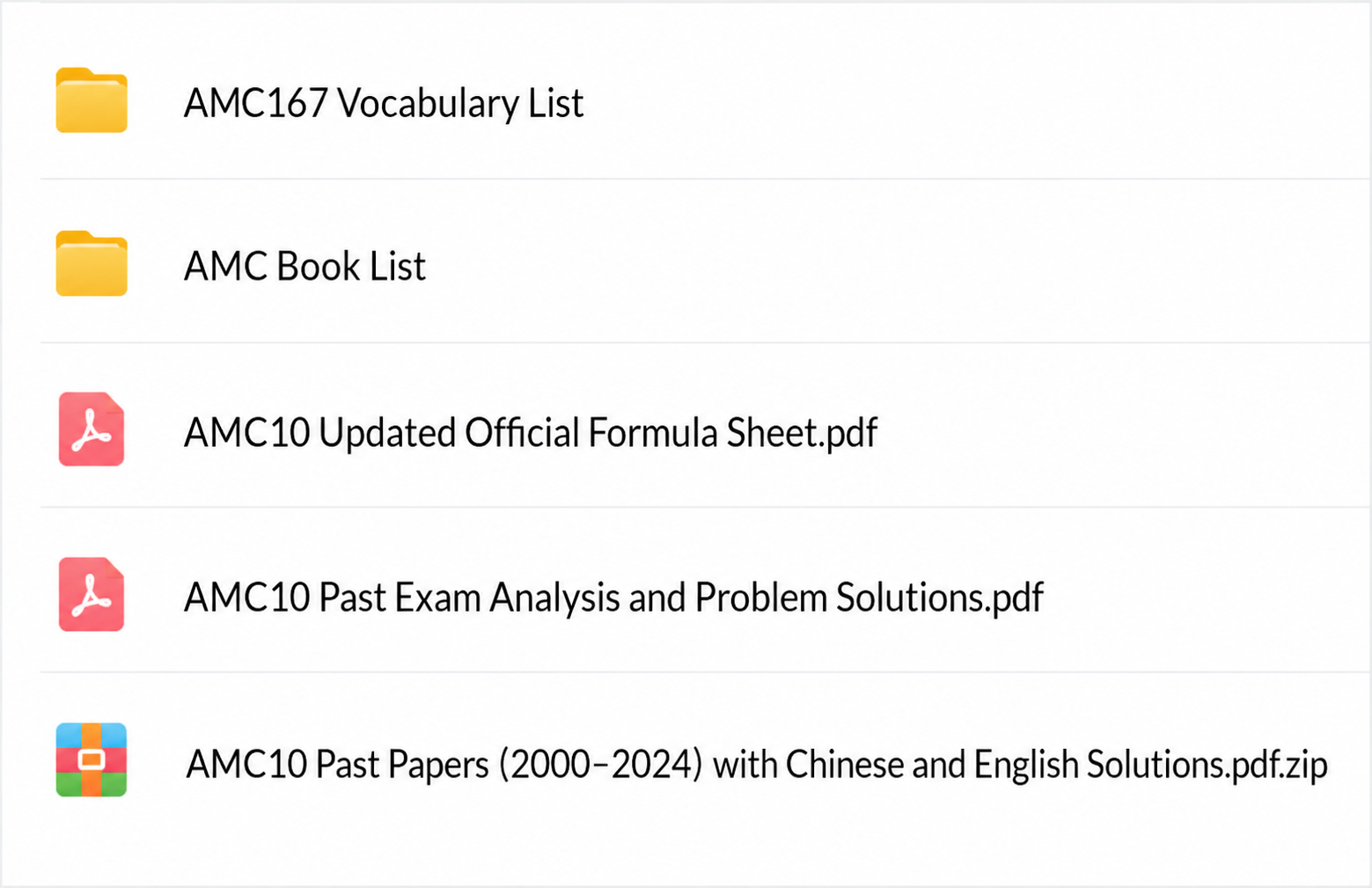
Scan the QR code for free access to AMC10 past papers (2010–2025) + solutions + book lists + formula sheets, and trial course information!

II. 2026 AMC10 In-Depth Analysis
1. Explosive Growth in Participants
The number of AMC10 participants in the China region has grown from 2,000 in 2007 to over 50,000 today—a 25-fold increase over 16 years—and continues to grow at an annual rate of 20%–25%. Cutoff scores continue to rise, making last-minute cramming no longer a viable strategy.
2. Vast Knowledge System
The AMC10 covers four major modules: Algebra (35%–40%), Geometry (25%–30%), Number Theory (20%–25%), and Combinatorics (10%–15%). Among these, Number Theory and Combinatorics are the most neglected areas in domestic school curricula, yet they account for a significant proportion of the AMC10. A student who scores perfectly in school math may, without systematic training, only be able to correctly answer the first 15 questions.
3. Scarce In-Person Test Seats
The 2026 AMC10 season has fully reverted to in-person paper-based exams. A test seat equals eligibility—no make-up exams, no extensions. In popular cities, core test center seats are already hard to come by. Early planning and early seat reservation are just as important as systematic preparation.
III. Four-Month Summer Efficient Preparation Plan
From July to the November exam, the four-month preparation period can be scientifically divided into three phases:
Phase 1: July – Foundation Building: Systematically identify and fill gaps across the four modules, focusing on competition-specific knowledge such as polynomials, function graphs, congruences, circle theorems, and the inclusion-exclusion principle. Dedicate 1.5 hours daily, maintain an error log, and ensure an accuracy rate above 90% on the first 15 foundational questions.
Phase 2: August – Targeted Breakthrough: Focus on intermediate questions (16–20), training quick-solving techniques such as substitution and elimination. Concentrate on conquering high-frequency like geometric auxiliary lines and number theory modular arithmetic to solving speed.
Phase 3: September–October – Past Paper Sprint: Complete 2–3 sets of past papers weekly, strictly timed at 75 minutes. It is recommended to finish the first 20 questions within 55 minutes, leaving a full 20 minutes for the last 5 questions. Learn to make strategic choices and avoid getting bogged down on excessively difficult problems.