

With the official schedule for the 2026 AMC10 now confirmed, summer has become the golden preparation window for the year. As a key stepping stone to the top-tier mathematics competition AIME, the AMC10 is not only a "hard currency" for applying to prestigious overseas universities but also the best way to develop fundamental mathematical thinking. This article will comprehensively sort out the optimal timing for participation, score trends, and efficient preparation strategies to help you prepare scientifically.
I. AMC10 Participation Timing and Grade Planning: A Path to Success Amid the Trend of Younger Participants
The official requirement for the AMC10 is that students must be in grade 10 or below and not exceed 17.5 years of age on the day of the exam. Looking at the actual participation situation in China, the main group of participants has significantly shifted to grades 7–9, and winning awards at a younger age is more favored by prestigious schools. For different grades, differentiated strategies are recommended:
Grades 7–8 (Foundation Building Period): Students need to have the ability to learn ahead of the curriculum. It is recommended to transition smoothly to the AMC10 after achieving a score of 17 or above (top 5%) on the AMC8. The preparation period at this stage is recommended to be 6–12 months, with the core task being to fill the gaps in middle and high school knowledge and complete the transition from school mathematics to competition thinking.
Grade 9 (Golden Period): This is the best stage for running school knowledge accumulation and competition thinking development in parallel. The preparation period is about 3–6 months, with a focus on breaking through the algebra and number theory modules to build a solid foundation for achieving high scores.
Grade 10 (Sprint Period): As the last opportunity to participate in the AMC10, students need to strengthen the comprehensive application of cross-topic knowledge and timed practice, with the goal set directly on the AIME qualification line.
Regarding Language and Tools: The China region provides bilingual Chinese-English test papers, so the language barrier is minimal; the core assessment is mathematical thinking. In addition, the AMC10 strictly prohibits the use of calculators; all questions must be completed by hand, fully testing students' mental arithmetic and logical deduction abilities.
II. Interpretation of AMC10 Score Trends: Increasing Competition, Targets Need to Be Adjusted Upward
In recent years, AMC10 score cutoffs have shown a trend of increasing year by year, so preparation targets should be adjusted upward appropriately:
Global Top 1% (DHR): Competition is extremely fierce. In 2026, the cutoff for Paper A reached 136.5 points, and Paper B reached 114 points. Historically, it has generally been above 120 points.
AIME Qualification: The cutoff for Paper A is typically around 105 points, and for Paper B between 99 and 105 points (in 2022, affected by the pandemic, it dropped to 93 points but quickly rebounded after restrictions were lifted).
Global Top 5% (HR): In recent years, the award cutoff has stabilized between 105 and 112 points, and in easier years, it can even exceed 120 points.
We are an authorized AMC test center and can provide free registration assistance! Scan the QR code to inquire about the 2026 AMC10 registration details ⇓
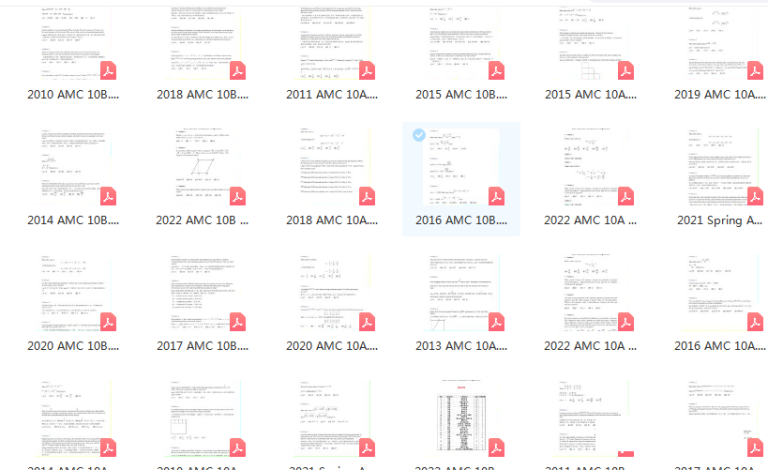
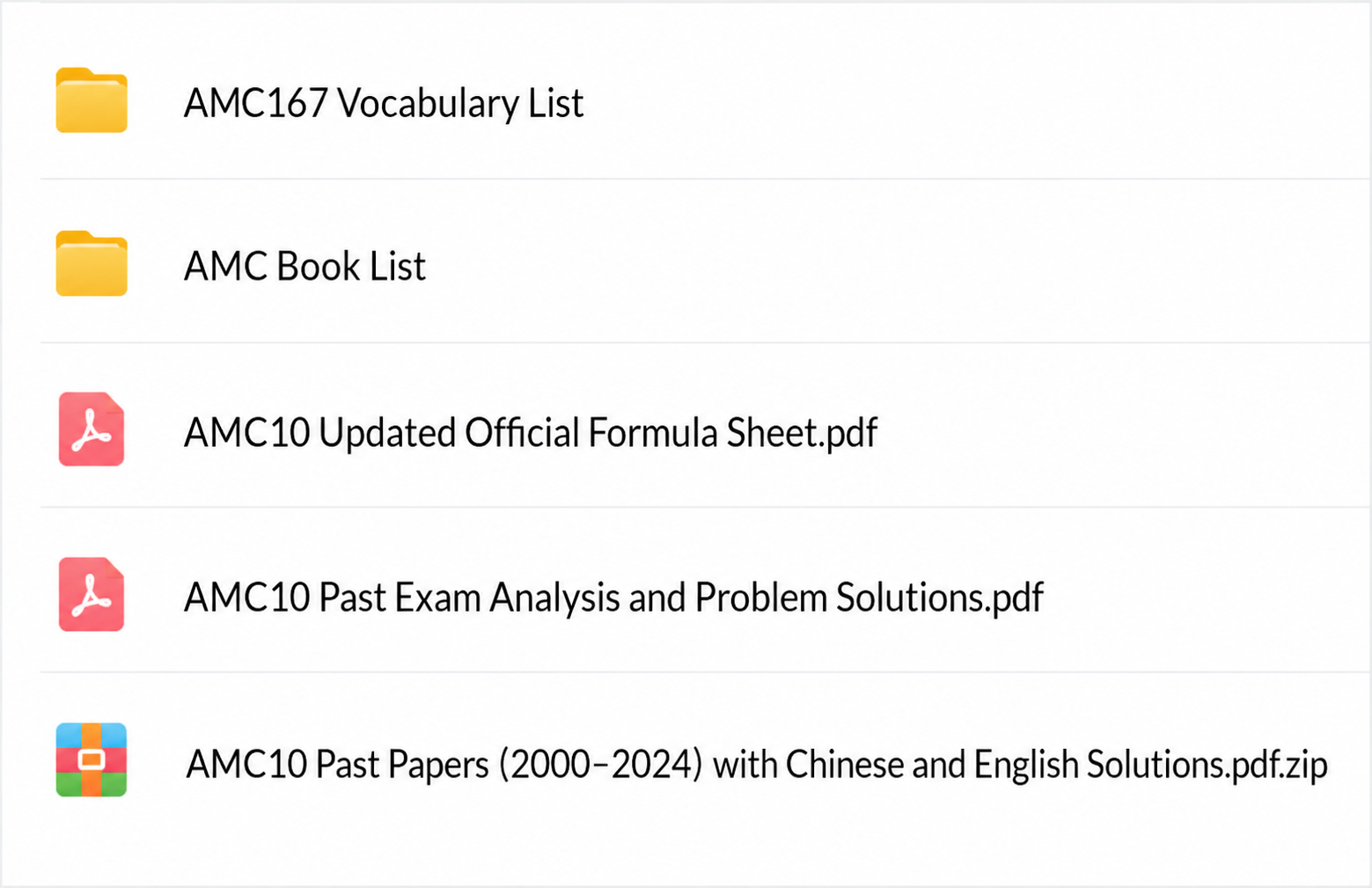
Scan the QR code for free access to AMC10 past papers (2010-2025) + solutions + book lists + formula sheets, and trial course information!

III. Efficient AMC10 Preparation Strategies
Given the mathematical foundation of most Chinese students, "taking the test with no preparation" might allow them to solve some questions, but the goal of the AMC10 is to achieve a high score. This requires students to master specific problem-solving techniques and strategies:
1. Scientific Practice with Graded Accuracy Targets
It is recommended to practice at least 5 years of past papers and set strict accuracy targets based on difficulty gradients:
Basic Questions (1–15): Aim for over 90% accuracy. This is the foundation for winning awards and must be solidly mastered to ensure no points are lost.
Advanced Questions (16–20): Aim for over 60% accuracy. This is the key range for breaking into the top 5% (HR) and requires specialized training in problem-solving routines.
Challenge Questions (21–25): Aim for over 40% accuracy. This is the decisive area for sprinting to the top 1% (DHR) and AIME qualification, testing logical reasoning and innovative problem-solving abilities.
2. Time Management and Answering Strategies
Since the scoring rule is "+6 for correct, +1.5 for blank, 0 for incorrect", it is more cost-effective to reasonably skip questions than to guess blindly. It is recommended to:
Complete the first 10 questions within 20 minutes.
For questions 11–18, spend 3–4 minutes each. If you get stuck, decisively mark and skip.
For questions 19–25, prioritize the modules you are good at and do not dwell on unfamiliar question types.
Finally, be sure to leave 5 minutes to check the calculation accuracy of the first 15 questions.
3. Sprint Phase: Fill Gaps and Securely Win Awards
In the last month before the exam, time is tight. It is recommended to focus most of your energy on weak areas and intensively review your error log. Through high-density error correction and pre-exam mock tests, you can achieve twice the result with half the effort.