

As a key stepping stone to the top-tier mathematics competition AIME, AMC10 preparation requires not only solid knowledge but also a scientific strategic plan. The following provides a comprehensive preparation guide from three dimensions: test selection, score positioning, and zero-based preparation.
I. AMC10 A/B Paper Selection Strategy: Multi-Line Layout for Maximum Benefit
The A and B papers of the AMC10 are consistent in their scope and difficulty design, and the final advancement to AIME follows the principle of "selecting the best score." Therefore, the test-taking strategy should directly serve the ultimate goal:
Students aiming to advance to AIME: It is highly recommended to register for both A and B papers. Taking two exams is equivalent to giving yourself an extra chance, effectively reducing the risk of an off-performance in a single session and maximizing the probability of advancing.
Students aiming for AMC12 or higher-level competitions: A combined strategy of "1 AMC10 + 1 AMC12" can be adopted. This allows you to use the AMC10 to familiarize yourself with the test pace and aim for a high score, while also adapting early to the difficulty level of AMC12 question types.
Students who can only take one exam: It is recommended to prioritize Paper A. Paper A questions are generally closer to textbook fundamentals and offer a higher margin for error, making it an excellent "benchmark test" to gain experience and provide targeted direction for subsequent Paper B preparation.
II. AMC10 Score Positioning and Advanced Planning
AMC10 scores are not only the basis for awards but also a "health check" for diagnosing students' mathematical abilities. Different score ranges represent different ability levels and require corresponding advanced planning:
Targeting Global Top 1% (DHR): This indicates that the student has an extremely solid mathematical foundation, with almost zero errors on basic and intermediate-difficulty questions, and possesses the ability to tackle challenging problems. The next step should focus on developing flexible mathematical thinking, breaking through difficult problem models, and preparing for the high-intensity challenges of AIME.
Targeting Global Top 5% (HR): This indicates that the student has good learning ability and a solid mathematical foundation, but is only one step away from the AIME qualification line. The bottleneck at this stage usually lies in answering rhythm and logical analysis of key difficult points. Preparation should focus on optimizing time allocation and conquering weak question types among questions 16-25.
Targeting a score around 90: For middle school students, this score indicates a solid foundation in school mathematics, but there are weaknesses in the competition knowledge system and unclear problem-solving approaches. The next step should be to aim for the top 5%, shifting the preparation focus to medium-to-high-difficulty questions after question 15, and systematically supplementing extended modules such as number theory and combinatorics.
We are an officially authorized AMC test center and can provide free registration assistance! Scan the QR code to inquire about the 2026 AMC10 registration details ⇓
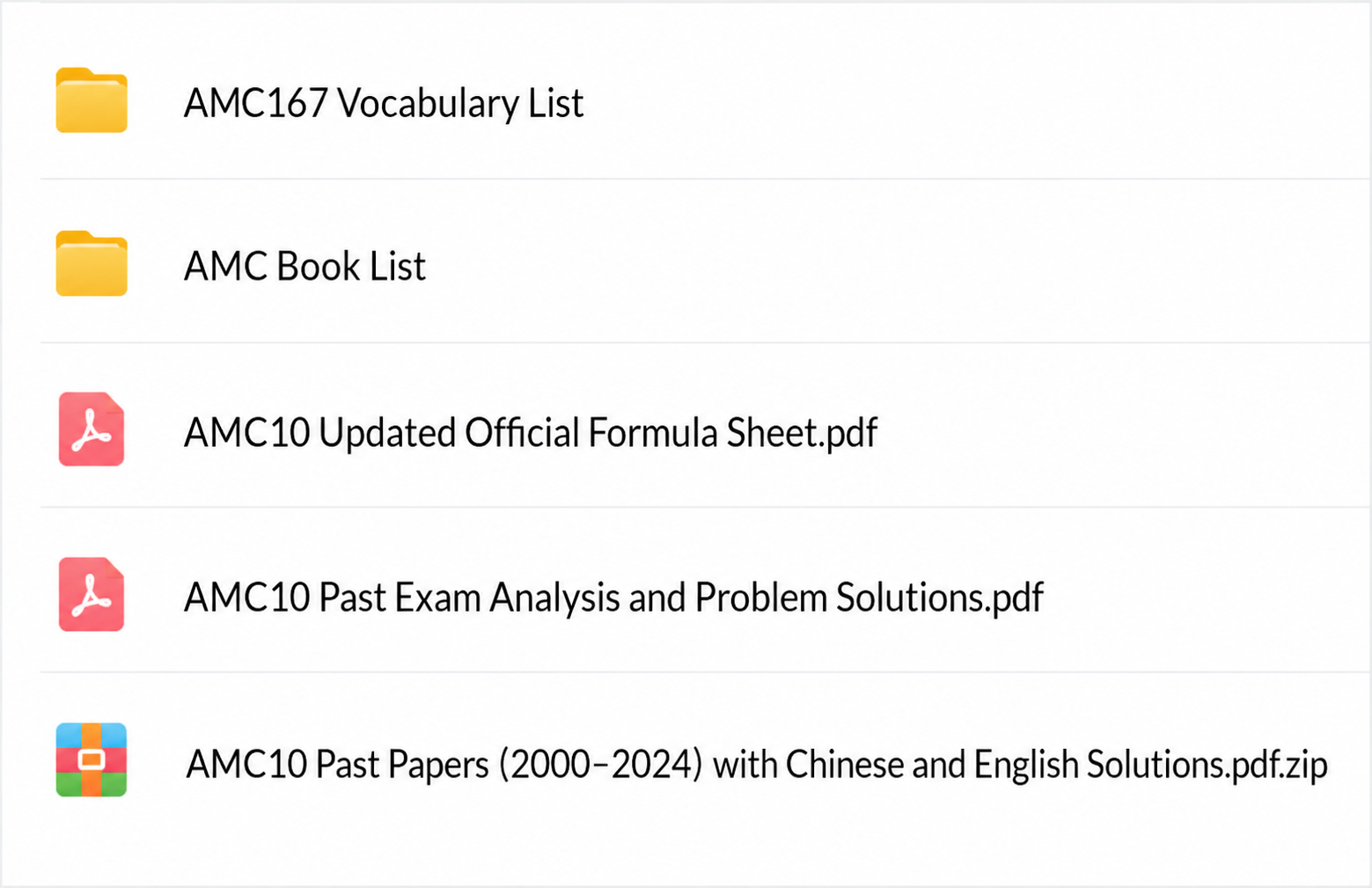
Scan the QR code for free access to AMC10 past papers (2010-2025) + solutions + book lists + formula sheets, and trial course information!

III. Time and Difficulty for Zero-Based AMC10 Preparation
Zero-based preparation for the AMC10 typically requires about six months, but the challenges and preparation cycles vary significantly for students in different grades:
Grades 7-8 (Recommended preparation period: 6-12 months)
Younger students face two core challenges when preparing for the AMC10:
Large knowledge gap: The AMC10 covers content from the third year of middle school to the first year of high school, while the school mathematics for grades 7-8 typically covers only about half of the test points. In the early stages of preparation, a significant amount of time must be invested in filling knowledge gaps in elementary algebra, basic geometry, number theory, and probability.
Difficulty in shifting thinking: The transition from "plugging into formulas" in school mathematics to "logical reasoning" in competition mathematics is key to. Specialized training in competition thinking is required to develop problem-solving intuition such as case-based discussion and the combination of numerical and graphical methods.
Grades 9-10 (Recommended preparation period: 3-6 months)
Students at this stage have a relatively solid school foundation and higher preparation efficiency. It is recommended to advance steadily in three phases:
Foundation learning phase (2-3 months): Systematically cover the four modules of algebra, geometry, number theory, and combinatorics to build a complete competition knowledge framework.
Intensive training phase (1-2 months): Practice past papers by topic, summarize error logs, focus on improving problem-solving speed and accuracy, and master test-taking techniques such as substitution and special value methods.
Pre-exam sprint phase (1 month): Conduct full-length mock tests, strictly adapt to the 75-minute test pace, optimize time allocation strategies, and adjust pre-exam mindset.