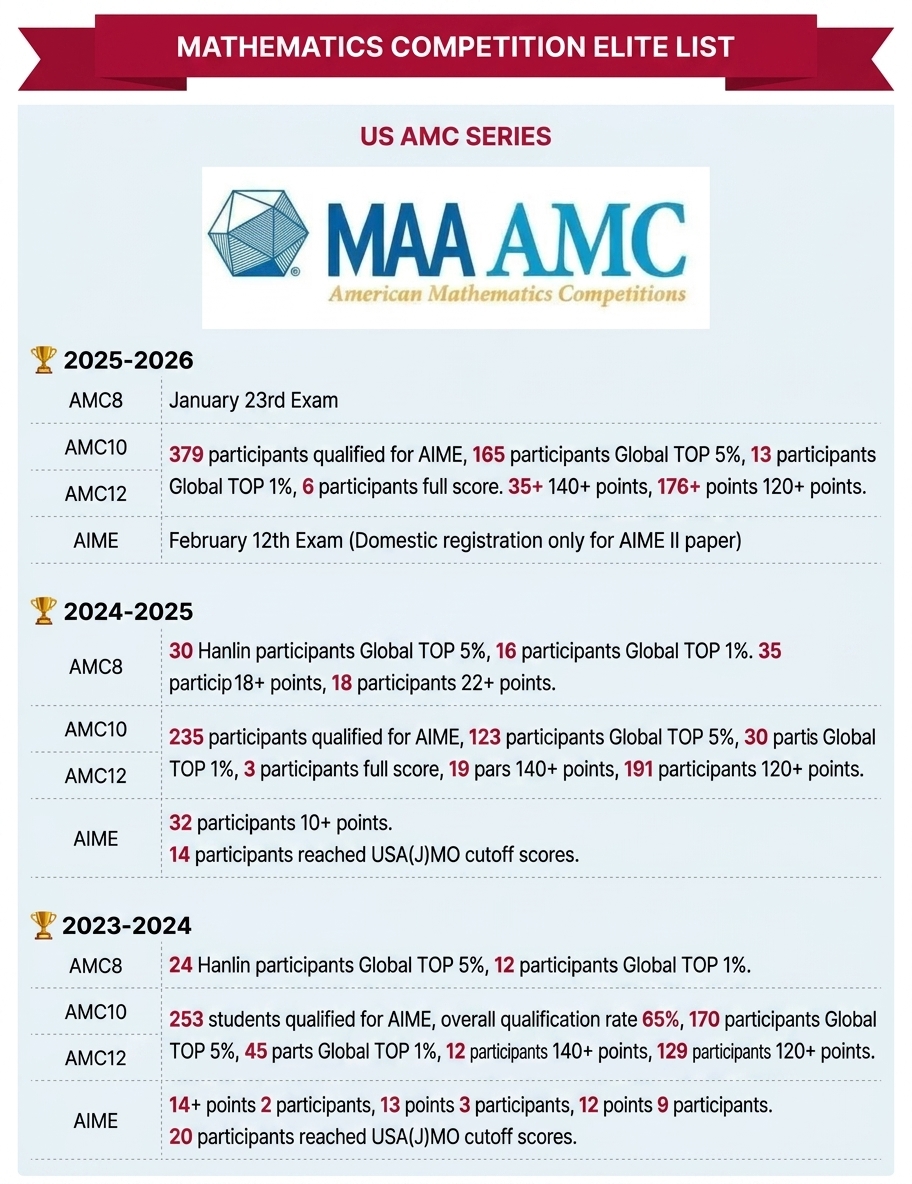

The 2025 AMC 10 cutoffs send a clear signal: the difficulty of the competition and the level of participants have risen in tandem, making short-term cramming strategies no longer effective. AIME qualification cutoffs: Version A: 105 points (↑3 points), Version B: 99 points (↑12 points); Global Top 1% (DHR): Stabilized at 130+ points, meaning you need to answer at least 22 questions correctly, and among questions 21–25, you must solve at least 3–4 of them. In the face of this new situation characterized by "high thresholds and intense competition," candidates for 2026 must embark on a long-term, systematic, and phased scientific preparation. This article will break down the core knowledge points of the four major AMC 10 modules, the four-stage advancement pathway, and precise problem-solving strategies for you, helping you move from foundation consolidation to top-level breakthrough.

I. In-Depth Interpretation of the 2025 AMC 10 Cutoff Trends
|
Goal
|
Score Required
|
Answering Requirements
|
Practical Challenges
|
|---|---|---|---|
|
AIME Qualification (Top 2.5% Globally)
|
≥100–105 points
|
- All of first 15 questions correct
- 3 correct among questions 16–20 - Total incorrect ≤5 questions |
The 2025 Version B cutoff of 99 points for qualification, but the margin for error is only 5 questions.
|
|
Global Top 5% (Honor Roll)
|
≈108–112 points
|
- ≤2 incorrect among first 20 questions
- Attempt and get 1–2 correct among questions 21–25 |
Requires stability on intermediate questions plus tackling some difficult questions.
|
|
Global Top 1% (Distinguished Honor Roll)
|
≥130 points
|
- ≤1 incorrect among first 20 questions
- 3–4 correct among questions 21–25 |
The ability to tackle difficult questions becomes the key to victory.
|
II. The Four Core Modules of AMC 10
The content of the AMC 10 focuses on four major areas. In recent years, the proportion of Combinatorics and Number Theory has increased, while the integration of Algebra and Geometry has deepened.
|
Module
|
Proportion
|
High-Frequency Topics
|
2025 Difficulties & Trends
|
|---|---|---|---|
|
Algebra
|
≈30%
|
- Quadratic equations and inequalities
- Function graphs and transformations - Sequences (recursion/periodicity) - Polynomial factorization |
More comprehensive questions combining functions and geometry (e.g., trigonometric functions + circles).
|
|
Geometry
|
≈25%
|
- Similar/congruent triangles
- Power of a Point theorem, Ptolemy's theorem - Trigonometric ratios and area formulas - Solid geometry (volume/cross-section) |
Auxiliary line construction is more concealed; frequency of solid geometry problems ↑.
|
|
Number Theory
|
≈20%
|
- Prime factorization
- Modular arithmetic and congruences - Fermat's Little Theorem - Chinese Remainder Theorem (advanced) |
Cross-topic problems combining Number Theory and Combinatorics are frequent (e.g., integer partitions + counting).
|
|
Combinatorics
|
≈25%
|
- Permutations and combinations (with constraints)
- Inclusion–Exclusion Principle - Recurrence relation modeling - Conditional probability and expectation |
The difficulty of recurrence modeling problems has surged, requiring abstract thinking.
|
III. 2026 AMC 10 Four-Stage Scientific Preparation Plan
Stage 1: Foundation Consolidation Period (From now until June 2026)
Goal: Build a complete knowledge framework and complete the leap from middle school to high school mathematical thinking.
|
Module
|
Core Tasks
|
|---|---|
|
Algebra
|
Master function graph transformations, solving quadratic inequalities, deriving general terms for arithmetic/geometric/recursive sequences.
|
|
Geometry
|
Proficiently add auxiliary lines (e.g., drawing altitudes, connecting midpoints, completing shapes), master the application scenarios of the Power of a Point theorem.
|
|
Number Theory
|
Understand the essence of modular arithmetic (a ≡ b mod m ⇔ m | (a - b)), grasp the fundamental properties of congruence.
|
|
Combinatorics
|
Distinguish between permutations and combinations, master the Inclusion–Exclusion Principle formula: |A∪B| = |A| + |B| − |A∩B|.
|
Stage 2: Ability Enhancement Period (July 2026 – August 2026)
Goal: Break through high-frequency difficult points, develop problem-solving intuition, and improve speed and accuracy.
Topic-Specific Breakthrough Checklist:
Algebra: Polynomial factorization techniques, comprehensive problems combining functions and geometry.
Geometry: Complex similarity models (e.g., "double perpendicular," "common side ratio"), solid geometry cross-section construction.
Number Theory: Solving congruence equations (e.g., 3x ≡ 1 mod 7), applying Fermat's Little Theorem (a^(p−1) ≡ 1 mod p).
Combinatorics: Recurrence modeling (e.g., staircase climbing problems), conditional probability (P(A|B) = P(A∩B)/P(B)).
Timed Training Standards:
|
Question Range
|
Time
|
Goal
|
|---|---|---|
|
1–10
|
≤15 minutes
|
100% accuracy, no calculation errors
|
|
11–20
|
≤35 minutes
|
Accuracy ≥80%, focus on practicing cross-module problems
|
|
21–25
|
≤25 minutes
|
Develop strategy: prioritize Combinatorics/Geometry; Number Theory difficult problems can be strategically skipped.
|
Stage 3: Past Paper Mock Exam Period (September 2026 – November 2026)
Goal: Adapt to the exam pace, expose knowledge blind spots, and optimize time allocation.
Complete 1–2 full past paper mock exams per week (2021–2025 papers), strictly timed at 75 minutes.
Spend double the exam time on review: record the time spent on each question to identify "time sinks"; categorize mistakes: knowledge gaps? calculation errors? misreading of the problem? Return to topic-specific training to address weak areas.
Stage 4: Sprint and Adjustment Period (December 2026 – Before the Exam)
Goal: Solidify answering strategies, enhance stress resistance, and ensure peak performance.
Develop a personalized schedule:
0–15 min: Complete questions 1–10 (review once before turning the page)
15–50 min: Tackle questions 11–20 (mark uncertain questions)
50–75 min: Focus on questions 21–25 (start with those you have a clue about).
Establish a checklist:
Are the units consistent? (e.g., cm vs m)
Are you answering the question asked? (e.g., calculating area but being asked for perimeter)
Did you bubble in the answer sheet correctly?
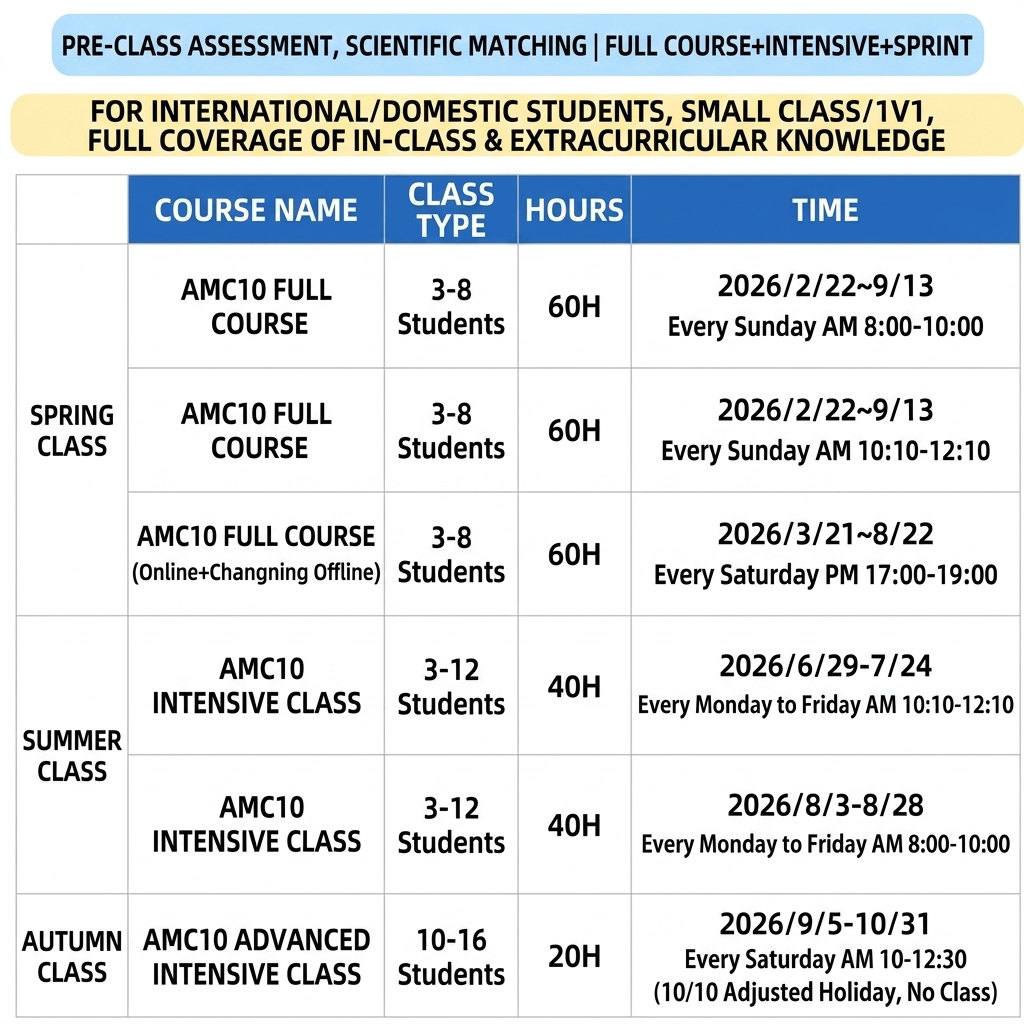
For more information about AMC 10/12 competition courses, please contact us.
AMC10 Preparation Courses
Our instructors are graduates from top global universities. With precise curriculum planning and comprehensive learning tracking, we ensure your score improvement and award-winning success!
| Class Type | Hours | Class Size | Start Date |
|---|---|---|---|
| Winter Break Class | 30H | 3–8 students | Consult teacher for details |
| Systematic Course | 20H | 1v1 / 3–8 students | Consult teacher for details |
| Problem-Solving Class | 20H | 1v1 / 3–8 students | Consult teacher for details |