
The AMC10 is an international mathematics competition sponsored by the Mathematical Association of America (MAA) for students in grade 10 and below. Its difficulty lies between that of the Chinese high school entrance exam and competition-level mathematics, with a particular emphasis on logical thinking and flexible application skills. This article will provide a detailed analysis of the AMC10's difficulty level, suitable grade levels for students, and preparation strategies.

I. Difficulty Level of AMC10
1. Comparison of Knowledge Scope
Algebra: Involves equations, inequalities, functions, etc., with a difficulty level close to the Chinese curriculum for grades 9 to 10. Emphasizes proficiency and quick problem-solving with polynomials, function transformations, sequences, and inequalities.
Geometry: Includes triangles, circles, polygons, etc., with some problems approaching domestic competition difficulty. Special emphasis is placed on techniques such as the four centers of a triangle, the power of a point theorem, and auxiliary line construction.
Number Theory: This content is rarely covered in ordinary middle school curricula, and is closer to the level of mathematics olympiad or independent admissions exams. Covers topics such as divisibility and congruence, the Chinese Remainder Theorem, and integer partitions.
Combinatorics: Presents the greatest difficulty in terms of thinking, involving permutations and combinations, recurrence relations, probability recursion, etc. Abstract thinking is key, requiring students to possess strong logical reasoning abilities.
2. Differences in Thinking Requirements
Quick Problem-Solving Ability: 75 minutes for 25 questions, averaging 3 minutes per question, demanding a high level of proficiency.
Logical Reasoning Ability: Problems often do not rely on complex calculations but rather test ingenious mathematical thinking.
English Reading Ability: The problems are in English, which poses a significant challenge for domestic students; however, in recent years, domestic institutions have provided Chinese translations.
II. Which Grade Levels is AMC10 Suitable For?
1. Official Eligibility
Students in grade 10 or below, and under 17.5 years of age on the day of the exam.
2. Preparation Suggestions for Different Grade Levels
Grades 7-9: Golden Period for Preparation
Advantage: Time is relatively abundant, allowing for multiple attempts to gain experience.
Suggestions:
Grades 7-8: Systematically start preparing, gradually improving scores.
Grade 9: Aim for high-scoring awards or strive to qualify for AIME.
One set of specialized practice per week: Focus on breakthroughs in geometry, number theory, and combinatorics.
5 challenging problems daily to build speed: Improve problem-solving speed in algebra.
Grade 10: Balancing Academic Pressure
Challenge: At this stage, students typically need to balance various exams and academic pressures, making preparation time potentially tight.
Suggestions:
If a student has a solid mathematical foundation and a clear need to enhance their college application, participating in the AMC10 is feasible.
Focus on conquering medium difficulty problems (questions 14-17) and relatively hard problems (questions 18-23), striving for the top 5% or the AIME qualification cutoff.
Grade 6 and Below: Talented Students May Try
Conditions: Exceptional mathematical talent, a solid foundation, and strong interest.
Suggestions:
Avoid "hothousing" — ensure the child's interest in learning and mental health are maintained.
Systematically organize basic knowledge, gradually increase difficulty, and cultivate competition thinking.
III. Key Preparation Focus for AMC10
1. Algebra: The Main Source of Points
Key Topics: Polynomials, function transformations, sequences, inequalities.
Suggestions: Practice 5 challenging problems daily to build speed, ensuring 100% accuracy on problems from these topics. Strengthen techniques such as polynomial factorization, function graph analysis, and sequence summation.
2. Geometry: A Common Weakness for Domestic Students
Key Topics: The four centers of a triangle, the power of a point theorem, auxiliary line construction.
Suggestions: One set of specialized practice per week to improve problem-solving ability in geometry. Focus on techniques such as cutting and augmenting figures, and finding equal angles in congruent or similar triangles.
3. Number Theory: Differentiator for High Scores
Key Topics: Divisibility and congruence, the Chinese Remainder Theorem, integer partitions.
Suggestions: Practice extensively to develop number sense and become familiar with common number theory problems and solution methods. Practice techniques such as prime factorization, units digit problems, and base conversion.
4. Combinatorics: Greatest Thinking Difficulty
Key Topics: Permutations and combinations, recurrence relations, probability recursion.
Suggestions: Abstract thinking is key; focus on logical reasoning and creative problem-solving. Train the application of recurrence relations such as the Fibonacci sequence and dynamic programming concepts.
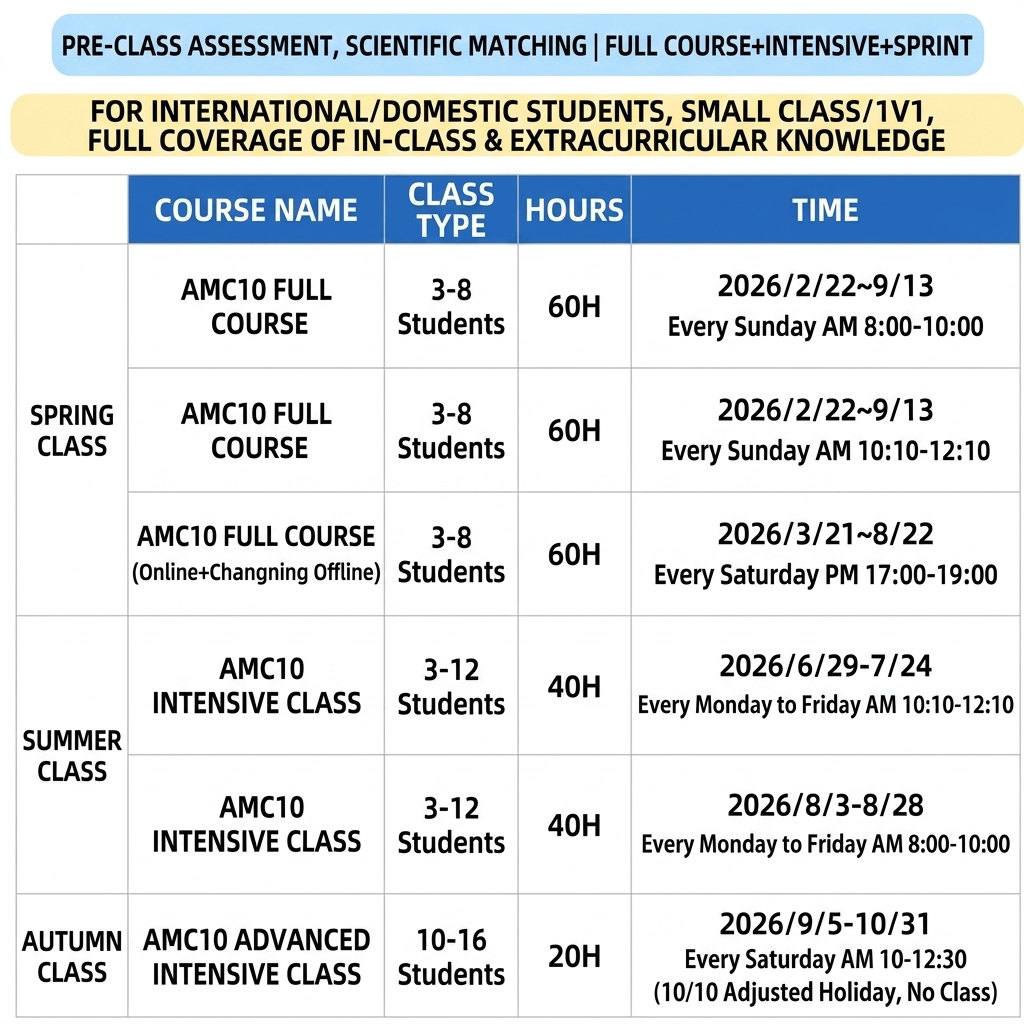
AMC10 Preparation Courses
Our instructors are graduates from top global universities. With precise curriculum planning and comprehensive learning tracking, we ensure your score improvement and award-winning success!
| Class Type | Hours | Class Size | Start Date |
|---|---|---|---|
| Winter Break Class | 30H | 3–8 students | Consult teacher for details |
| Systematic Course | 20H | 1v1 / 3–8 students | Consult teacher for details |
| Problem-Solving Class | 20H | 1v1 / 3–8 students | Consult teacher for details |