
The AMC8 and AMC10 are two important math competitions organized by the Mathematical Association of America (MAA), targeting students at different grade levels. Although both aim to cultivate mathematical thinking and problem-solving skills, there are significant differences in knowledge breadth, depth of thinking, time pressure, and more. This article provides a detailed analysis of the transition difficulty from AMC8 to AMC10 and offers a systematic preparation guide.
I. Difficulty Comparison between AMC8 and AMC10
1. Breadth of Knowledge
AMC8: Mainly consolidates elementary school math foundations and inspires mathematical thinking; the questions are relatively easier, suitable for beginners.
AMC10: Adds advanced algebra (e.g., Vieta's theorem, factor theorem), advanced plane geometry (congruent triangles, trigonometric applications), in-depth number theory (modular arithmetic, congruence equations, indefinite equations), and combinatorics (permutations, combinations, probability models). The coverage of knowledge points is broader, requiring students to master high school (grade 9–10) math knowledge.
2. Depth of Thinking
AMC8: Emphasizes application of basic knowledge; questions are relatively straightforward; focuses on fundamental logical reasoning training.
AMC10: Places more emphasis on the integration of multiple knowledge points and flexibility in logical reasoning; a single problem may involve number theory, algebraic manipulation, and geometric construction, testing students' comprehensive application ability.
3. Time Pressure
AMC8: 40 minutes for 25 questions; time is relatively ample, suitable for beginners to get used to competition pacing.
AMC10: 75 minutes for 25 questions; significantly higher demands on proficiency and strategic question selection; average of only 3 minutes per question.

II. Analysis of Transition Difficulty from AMC8 to AMC10
1. Expansion of Knowledge Breadth
Advanced Algebra: Vieta's theorem, factor theorem, etc.
Advanced Plane Geometry: Congruent triangles, similar triangles, power of a point theorem, trigonometric applications.
In-depth Number Theory: Modular arithmetic, congruence equations, indefinite equations.
Combinatorics: Permutations and combinations, probability models, recurrence relations.
2. Enhancement of Thinking Depth
Multi-knowledge Integration: A single question may involve the comprehensive application of multiple knowledge points.
Flexibility in Logical Reasoning: Students need strong abstract thinking and creative problem-solving abilities.
3. Coping with Time Pressure
Timed Training: Improve answering speed and accuracy through timed mock exams.
Strategic Question Selection: Learn to allocate time reasonably, prioritizing questions you are confident about.
III. Preparation Guide from AMC8 to AMC10
1. Filling Knowledge Gaps
Real Test Assessment: It is recommended to test students with AMC10 past papers to accurately locate their mathematical foundation.
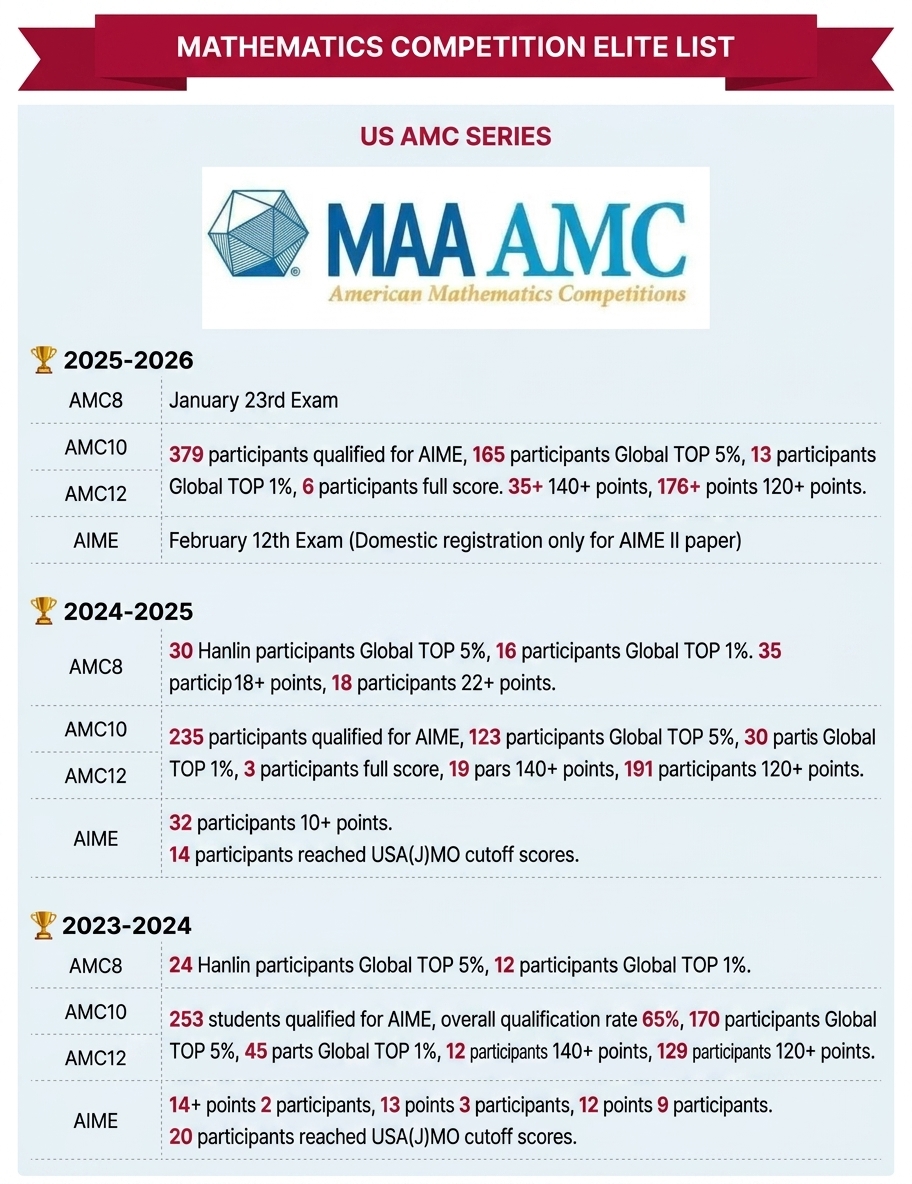
Supplementing Knowledge Points: If the AMC8 score reaches the top 5% or top 1%, it indicates a good math foundation; students need to supplement missing AMC10 knowledge points, such as sequences, linear functions, permutations & combinations, probability, and overall operations.
2. Practice to Train Problem-Solving Thinking
Categorized Training: Categorize AMC10 past papers, focusing on medium-difficulty questions to improve problem-solving approaches and accuracy rates.
Cross-knowledge Thinking: Starting from question 16, the flexibility of the AMC10 increases; the same question may involve multiple knowledge points. Therefore, summarize approaches during practice and cultivate the ability to think from cross-knowledge perspectives.
3. Training Answering Techniques
Timed Mock Exams: Arrange timed mock exams to simulate the real test environment, enhancing speed and accuracy.
Answering Skills: Master common techniques such as quick estimation, elimination, and special value substitution to save time.
IV. Recommended AMC10 Training Courses
To help students better transition from AMC8 to AMC10, the following targeted training courses are available:
1. Pre-AMC10 Express
Target Audience: G6-8 students
Course Content: Four major middle school math topics: algebraic operations, functions and graphs, similar triangles, circles; two in-school advanced topics: algebra and geometry.
Course Duration: 120 hours
2. AMC10 Express Training
Target Audience: G9-10 students
Course Content: Systematically review AMC10 competition test points; train problem-solving approaches and answer techniques for the AMC10.
Course Duration: 110 hours
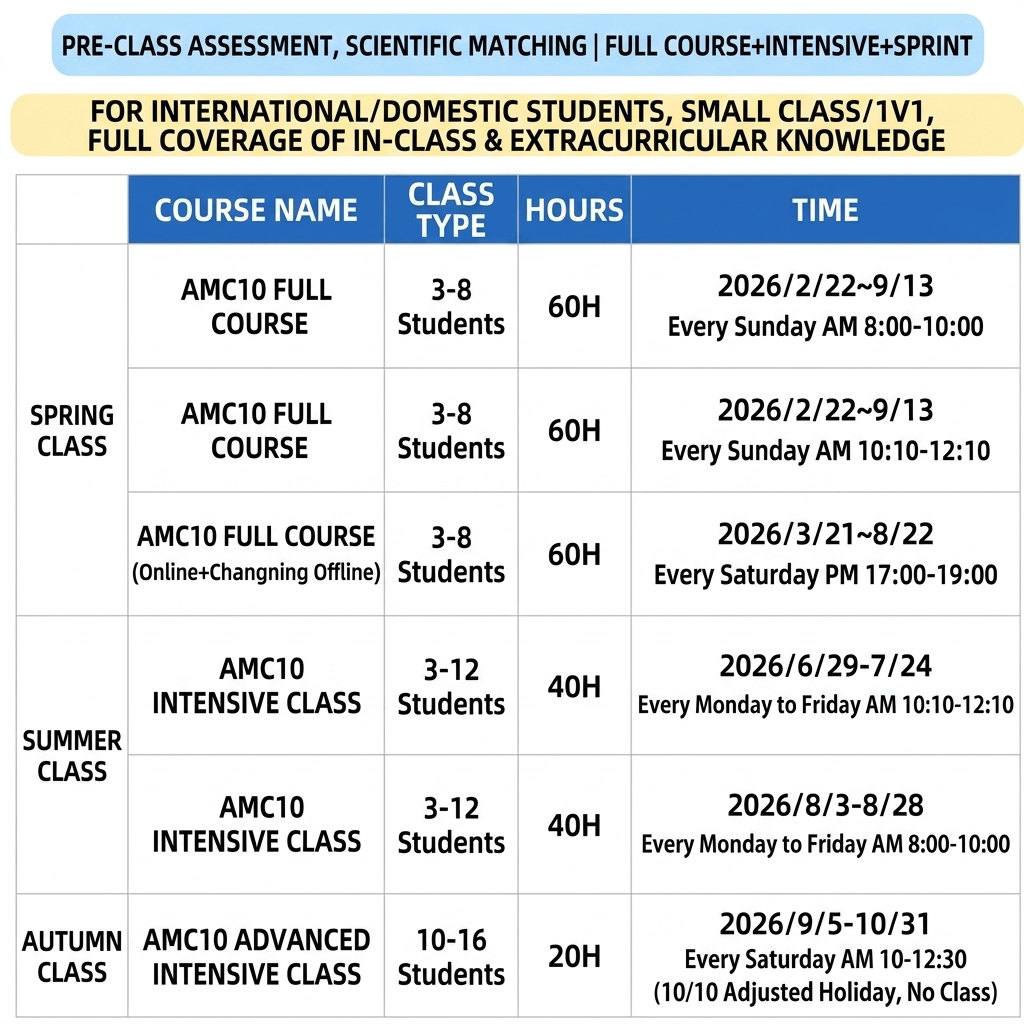
3. Class Options
| Course Name | Class Size | Hours |
|---|---|---|
| AMC10 Full Course | 3-8 students | 110 hours |
| Pre-AMC10 Full Course | 3-8 students | 120 hours |
| AMC10 Foundation Course | 3-8 students | 50 hours |
| AMC10 Intensive Course | 3-8 students | 30 hours |
| AMC10 Sprint Course | 3-8 students | 30 hours |
| AMC10 Personalized Tutoring | 1V1 / 1V2 / 1V3 | Customized |
4. Course Features
Layered & Phased Teaching: Different course setups based on students' foundational levels.
Online & Offline Synchronous Classes: Convenient for students to choose their preferred learning method.
Replayable Courses: Supports repeated learning to ensure mastery of knowledge points.
Our instructors are from top universities around the world. With precise course planning and comprehensive learning tracking, we accompany you all the way to improve scores and win awards!