

Many parents find that their children consistently score high on school math exams, yet when they challenge the AMC10, they make frequent mistakes and even feel a strong sense of frustration. This phenomenon is not an isolated case but is determined by the fundamental differences in thinking logic between competition and school exams.

I. The Three Core Challenges of the AMC10
1. Depth Leap: From "Tool Usage" to "Principle Mastery"
The AMC10 syllabus indeed covers 7th to 10th-grade mathematics knowledge, but that doesn't mean it's "easy."
School Logic: Focuses on "tool proficiency." For example, for quadratic functions, you just need to learn to plug into formulas to find the vertex and solve roots.
AMC Logic: Focuses on "deep insight into principles." Problems often require students to embed functional principles into real-life scenarios, testing how to construct mathematical models rather than simple substitution and calculation. If a child only stays at the "calculation" level, they will be at a loss when encountering modified problems.
2. Pacing Game: Psychological and Strategic Struggle Within 75 Minutes
Completing 25 problems in 75 minutes averages out to about 3 minutes per problem, which seems generous, but the difficulty climbs dynamically:
Problems 1-15: Relatively conventional problems that must be secured as the "baseline."
Problems 16-25: Difficulty increases sharply, each possibly taking 5-8 minutes or more.
The difficulty lies not in solving problems but in decision-making. Many children dwell too long on the first 15 problems, leading them to panic-guess in the second half. Therefore, mock tests are not just about measuring scores, but also about training the ability to make strategic trade-offs under intense time pressure.
3. Error Tolerance Trap: The Narrow Path to High Scores
The total score is 150 points. Aiming for the top 5% or qualifying for AIME often requires a score of 100+. This means that among 25 problems, you can only afford to get 5-7 wrong at most. This extremely high accuracy requirement makes "carefulness" and "rigorous thinking" as important core competencies as "intelligence."
II. 2025 Awards System Overhaul: From a "Pyramid" to a "Multi-Path" Structure
The 2025 reform marks an important turning point in AMC10 history. It transformed the single structure where "only top academic geniuses could win awards" into a "seven-honor system":
| Award Name | Threshold Level | Core Value |
|---|---|---|
| Perfect Score | 150 points | Proof of ultimate academic ability |
| Distinguished Honor Roll (Top 1%) | Top 1% globally | Powerful credential for top-tier applications |
| Honor Roll (Top 5%) | Top 5% globally | Core competitiveness for prestigious school applications |
| Top 10% / 25% | Top 10% / 25% globally | NEW: Broader recognition of growth |
| Achievement Roll | Grade 8 or below, score ≥ 90 | Special encouragement for younger students |
| AIME Qualification Certificate | Cutoff score | Ticket to advanced mathematics competitions |
Significance of the New Policy: No matter what stage of mathematical foundation a child is at, they can find a corresponding goal within this system. This not only lowers the psychological barrier to entry but also makes academic profiles more diverse.
III. Application Season FAQ: The Value and Presentation of the AMC10
Q: Can an AMC10 score directly guarantee admission?
A: No. US college applications value a comprehensive background. The AMC10 is strong evidence of your mathematical talent and academic dedication, but it cannot replace standardized test scores or core research experiences.
Q: Is it still useful to have only the AMC10 without AIME?
A: Yes, it has value. It demonstrates your investment in mathematical fundamentals and competition interest. However, when aiming for the most elite universities (such as MIT, Caltech), AIME or higher-level achievements (such as USAMO) carry significantly more weight.
Q: Where should AMC10 be written on the application?
A: Honors/Awards section: Fill in the award level. Activities section: If you have participated in related club research or organized school math activities, you can describe the impact and growth brought by this experience in depth.
Advice for Parents on Preparation
Diagnose First: Don't rush into solving problems. First, take a past exam paper and analyze whether the child's issue is "lack of knowledge points," "absence of thinking models," or "loss of pace control."
Mock Exams Are Paramount: In the sprint phase, maintain the rhythm of strict 75-minute mock exams to cultivate a calm mindset when facing difficult problems.
Connect with Schoolwork: Improving mathematical ability is not isolated. Integrating school knowledge with competition thinking not only enhances competition performance but also strengthens academic stability at school.
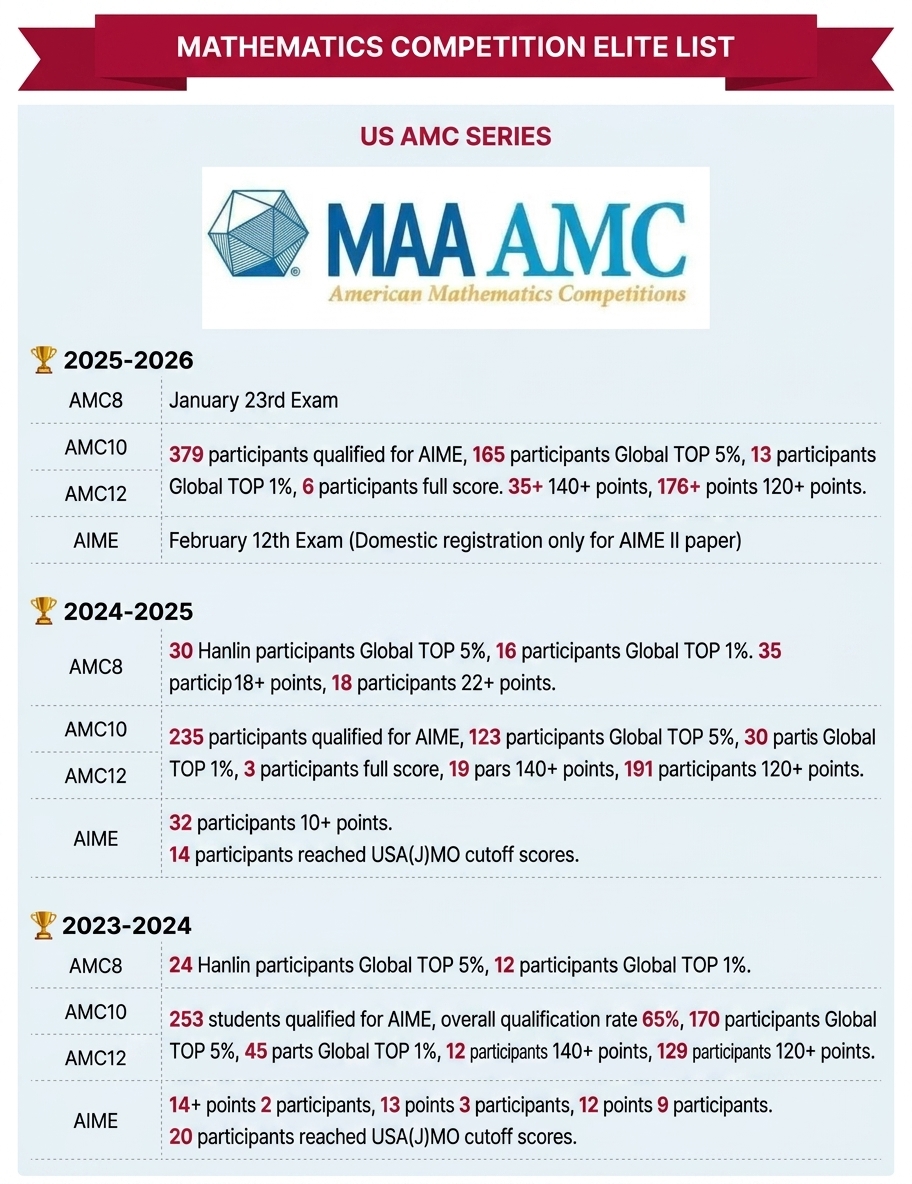
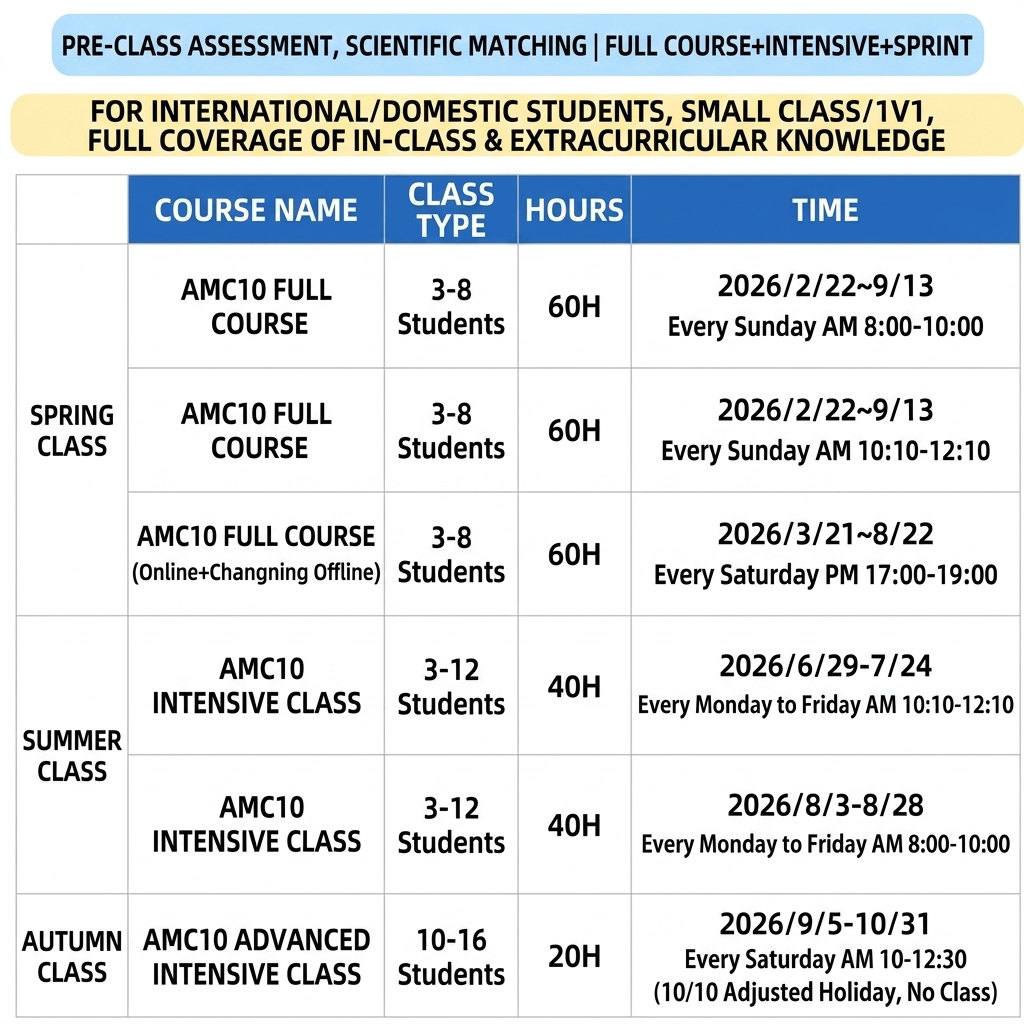
We are an authorized AMC test center and can assist with registration for free!