
The AMC10 is a pivotal link in the AMC competition system—it is both an advanced goal for AMC8 participants and a golden springboard for AIME, USAMO, and even IMO. In the 2025 season, the AIME qualification cutoff for the A soared to 105 points, a sharp increase of 10.5 points from 94.5 in 2024, highlighting the intensity of competition. Understanding what is tested, how it is tested, and how to practice is essential to scoring precisely in this "three-minutes-determine-your-fate" competition.
I. Deep Dive into the Four Core Exam Areas of AMC10
According to statistics from the past five years of real exams, the 25 questions of the AMC10 are distributed across four modules: Algebra, Geometry, Number Theory, and Combinatorics. The knowledge scope covers grades 8 to 10, but the difficulty stratification is very pronounced.
Algebra Module (35%-40%, about 8-10 questions)
This is the "foundation" of the AMC10 and the module with the highest scoring potential.
Foundation Level (equivalent to Grade 9): Polynomial operations, factorization, solving linear/quadratic equations, domain and range of functions.
Intermediate Level (equivalent to Grade 10): Graphs and properties of quadratic functions, exponential functions, absolute value functions, general term formulas for sequences.
Competition Extension Level: Functional equations, comprehensive inequalities (AM-GM inequality, Cauchy inequality basics), advanced applications of Vieta's formulas, polynomial remainder theorem.
The difficulty lies in the fact that school curricula only require "solving equations," whereas the AMC10 demands "perfectly integrating equations with function graphs"—for example, analyzing the symmetry and boundary values of a quadratic function to determine the number of integer solutions to an equation within a specific interval.
Geometry Module (25%-30%, about 6-8 questions)
This is a "scoring disaster zone" for Chinese students and the module that most widens the gap.
Foundation Level (equivalent to Grade 9 Olympiad): Triangle similarity and congruence, Pythagorean theorem, basic properties of circles, area and perimeter calculations.
Intermediate Level (equivalent to Grade 10): Power of a point theorem, law of sines/cosines, basics of analytic geometry (positional relationships between lines and circles).
Competition Extension Level: Solid geometry (cross-sections and volumes), graph flipping and folding, comprehensive geometry in coordinate systems.
The difficulty is that geometry problems in the AMC10 are very flexible; there are almost no straightforward "plug-and-formula" questions. They often require constructing clever auxiliary lines. Recent trends favor coordinate-based plane geometry or examining dynamic transformations of figures.
Number Theory Module (15%-20%, about 4-5 questions)
This is a nearly absent topic in school curricula—an "invisible watershed" and a weakness for most Chinese students.
Foundation Level (equivalent to Grades 7-8): Prime factorization, greatest common divisor and least common multiple, divisibility rules.
Intermediate Level (equivalent to introductory high school competition): Modular arithmetic, congruence equations, place value principles.
Competition Extension Level: Fermat's little theorem, introduction to Euler's totient function, Diophantine equations.
The difficulty is that the problem statements are often extremely short, but the depth of thought required is immense. Strong "number sense" is essential—memorizing common modular cycles (e.g., the cycle of powers of 7 modulo 10 is 4) allows for rapid problem-solving under time constraints.
Combinatorics Module (15%-20%, about 5-6 questions)
This is a "logic trap zone" where it is easy to make mistakes.
Foundation Level (equivalent to Grade 10): Basics of permutations and combinations, addition and multiplication principles, classical probability.
Intermediate Level: Inclusion-exclusion principle, pigeonhole principle, conditional probability.
Competition Extension Level: Recurrence counting, applications of the binomial theorem, geometric probability, infinite recurrence probability.
The difficulty is that problems often appear in an interesting guise (rolling dice, navigating mazes, distributing cards) but hide traps concerning "no omissions and no double counting." Without a clear mental model of "case-based discussion" and "solving the harder reverse problem," it is easy to arrive at a "seemingly correct" wrong answer.
II. Difficulty Stratification: The "Three-Stage Rocket" of 25 Questions
The AMC10 problems are generally arranged in a stepwise manner; the further you go, the higher the demands on comprehensive ability and the greater the time pressure.
Stage 1: Questions 1-10 — Foundation Level (Goal: Get all correct)
Content: Linear equations, basic geometry, elementary number theory, fundamental counting.
Difficulty: Comparable to domestic middle school curriculum level.
Core Trap: The difficulty is not the problems themselves, but the time constraint—averaging only 3 minutes per question, both calculation speed and accuracy are indispensable.
Strategy: Aim to get all correct in this range to save time for the harder questions later. It is recommended to complete this section within 15 minutes.
Stage 2: Questions 11-20 — Key Level (Goal: Get 7-8 correct)
Content: Comprehensive quadratic functions, sequence recurrence, circle and triangle combinations, advanced permutations and combinations.
Difficulty: Requires cross-topic problem-solving; memorizing isolated formulas is insufficient.
Core Trap: Often requires the intersection of 2-3 knowledge points, such as "geometry + algebraic modeling" or "number theory + combinatorial counting."
Strategy: This is the critical range for scores. Allocate about 4 minutes per question. If stuck for more than 2 minutes, decisively skip and move on.
Stage 3: Questions 21-25 — Top-Tier Level (Goal: Get 2-3 correct)
Content: Comprehensive modular arithmetic, congruence equations, solid geometry in coordinate systems, innovative definition problems.
Difficulty: Often requires constructing auxiliary lines, flexibly applying number theory tools, or even "learning and applying" new definitions on the spot.
Core Trap: Problems are ingeniously designed; they may seem impossible at first glance but often contain elegant solutions.
Strategy: Do not force perfection, but to reach the top 1% (DHR), you need to solve at least 2-3 of these. Allocate 5-6 minutes per question.
III. Score Trend Analysis: Why is the AMC10's Value Increasing?
Many parents see the AIME qualification cutoff rise from 94.5 in 2024 to 105 in 2025, and the threshold for the global top 5% also noticeably increase, leading to concerns about "inflation" of the AMC10. However, the opposite is true. The rising cutoff reflects three realities:
Expanding Participant Pool: The AMC10 has evolved from a niche game for a few math prodigies to a standard requirement for an increasing number of students on international tracks. The number of participants in the China region surged from fewer than 5,000 in 2015 to 87,000 in 2023. With a larger base, competition at the top naturally becomes more intense.
More Systematic and Earlier Preparation: In the past, many students crammed for a few months before the exam. Now, students start long-term planning from grade 8 or 9, or even earlier, significantly raising the overall level.
Enduring Value for College Admissions: Whether for US undergraduate applications or UK background enhancement, a competitive AMC10 score remains an important endorsement of mathematical ability and logical thinking. The MIT application system includes a dedicated section for AMC scores. At Carnegie Mellon University, 37% of admitted students in the past three years were in the top 5% of the AMC10. The harder the certificate is to obtain, the more it proves the holder's capability.
We are an officially authorized AMC test center and can provide free registration assistance! Scan the QR code to inquire about the 2026 AMC10 registration details ⇓

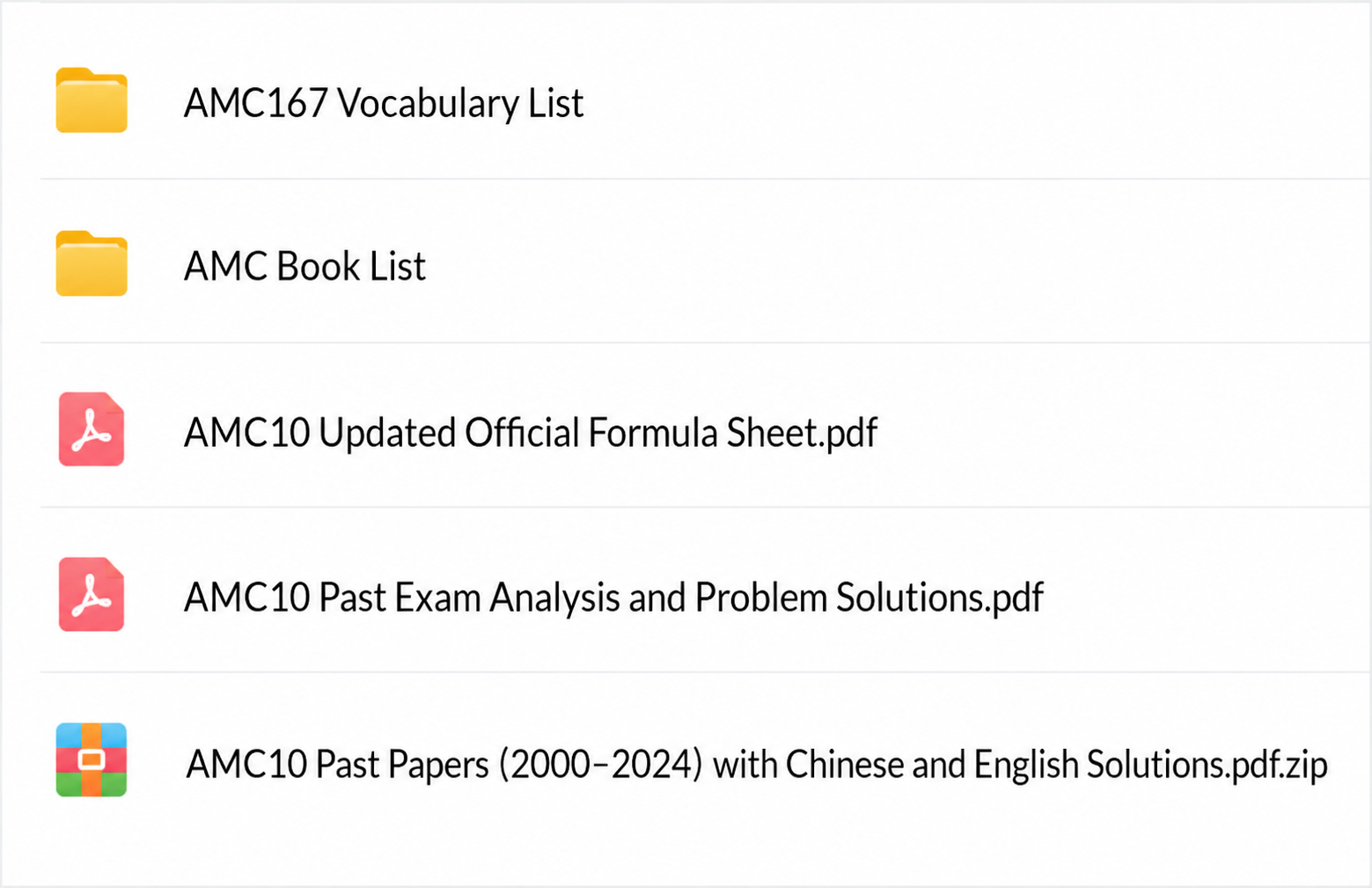
Scan the QR code for free access to AMC10 past papers (2010-2025) + solutions + book lists + formula sheets, and trial course information!