The AMC10 (American Mathematics Competition 10), hosted by the Mathematical Association of America (MAA), is open to students in grade 10 and below worldwide. It is one of the most widely recognized secondary school mathematics competitions globally. The 2026 season brings major changes. Understanding the new rules, grasping the trends, and preparing scientifically are key to standing out.
I. Exam Rules and Paper Structure
| Item | Details |
|---|---|
| Exam Format | Paper-based test (China region: bilingual Chinese-English) |
| Number of Questions | 25 multiple-choice questions (5 options each) |
| Duration | 75 minutes |
| Scoring | +6 for correct, +1.5 for blank, 0 for incorrect |
| Maximum Score | 150 |
| Calculator | Not permitted |
Core Assessment Areas:
| Module | Questions | Focus |
|---|---|---|
| Algebra | 9–10 | Polynomials, exponents/logarithms, arithmetic/geometric sequences, inequalities, function graphs |
| Geometry | 6–8 | Plane geometry, circles, 3D volume/surface area, analytic geometry, trigonometry |
| Number Theory | 4–6 | Factors/multiples, modular arithmetic, primes, congruences, Diophantine equations |
| Combinatorics & Probability | 3–5 | Permutations/combinations, recurrence counting, probability & statistics |
Difficulty Gradient:
| Question Range | Difficulty Level | Strategy |
|---|---|---|
| 1–10 | Foundation – "gimme" questions | Master in-curriculum content; must get all correct |
| 11–20 | Intermediate – integrated questions | Cross-topic application; determines top 10%–15% placement |
| 21–25 | Competition-level – final challenge | High-order thinking (combinatorial construction, function extrema); separates top 5% from top 1% |
II. AMC10 Difficulty: Comparison with Domestic Competitions
The AMC10 syllabus covers approximately 70% of core Chinese middle school content plus 30% of grade 10 compulsory material, making it well-suited for students in grades 8–10. In several dimensions, however, the AMC10 demands slightly more than traditional domestic competitions:
Broader Knowledge Scope: Domestic middle school leagues focus mainly on algebra and geometry, with limited number theory and almost no combinatorics. The AMC10 treats all four modules—algebra, geometry, number theory, and combinatorics—equally, with number theory and combinatorics carrying significant weight and difficulty.
More Flexible Question Styles: Domestic competition questions often drill deep into a single knowledge point. The AMC10 favors "cross-module fusion"—a single problem may simultaneously test algebra, geometry, and probability, requiring strong ability to connect knowledge and build models.
Intense Time Pressure: 25 multiple-choice questions in 75 minutes means an average of only 3 minutes per question. This tests not only problem-solving skills but also reading speed, mental agility, and calculation accuracy under extreme pressure.
| Dimension | AMC10 | Chinese High School Math League (First Round) |
|---|---|---|
| Depth of Knowledge | Not deep; emphasizes breadth and application | Extremely deep; emphasizes techniques and proofs |
| Question Style | Application-oriented, multi-module integration | Technique-oriented, classic model variations |
| Target Audience | Grades 8–10, broad accessibility | High school competition students, highly selective |
Score Benchmarking Reference: ~100 points ≈ Provincial Third Prize in Chinese Middle School Math League; ~110 points ≈ Provincial Second Prize; 120+ points ≈ Provincial First Prize.
We are an AMC-authorized test center and can provide free registration assistance! Scan the QR code to inquire about 2026 AMC10 registration details ⇓
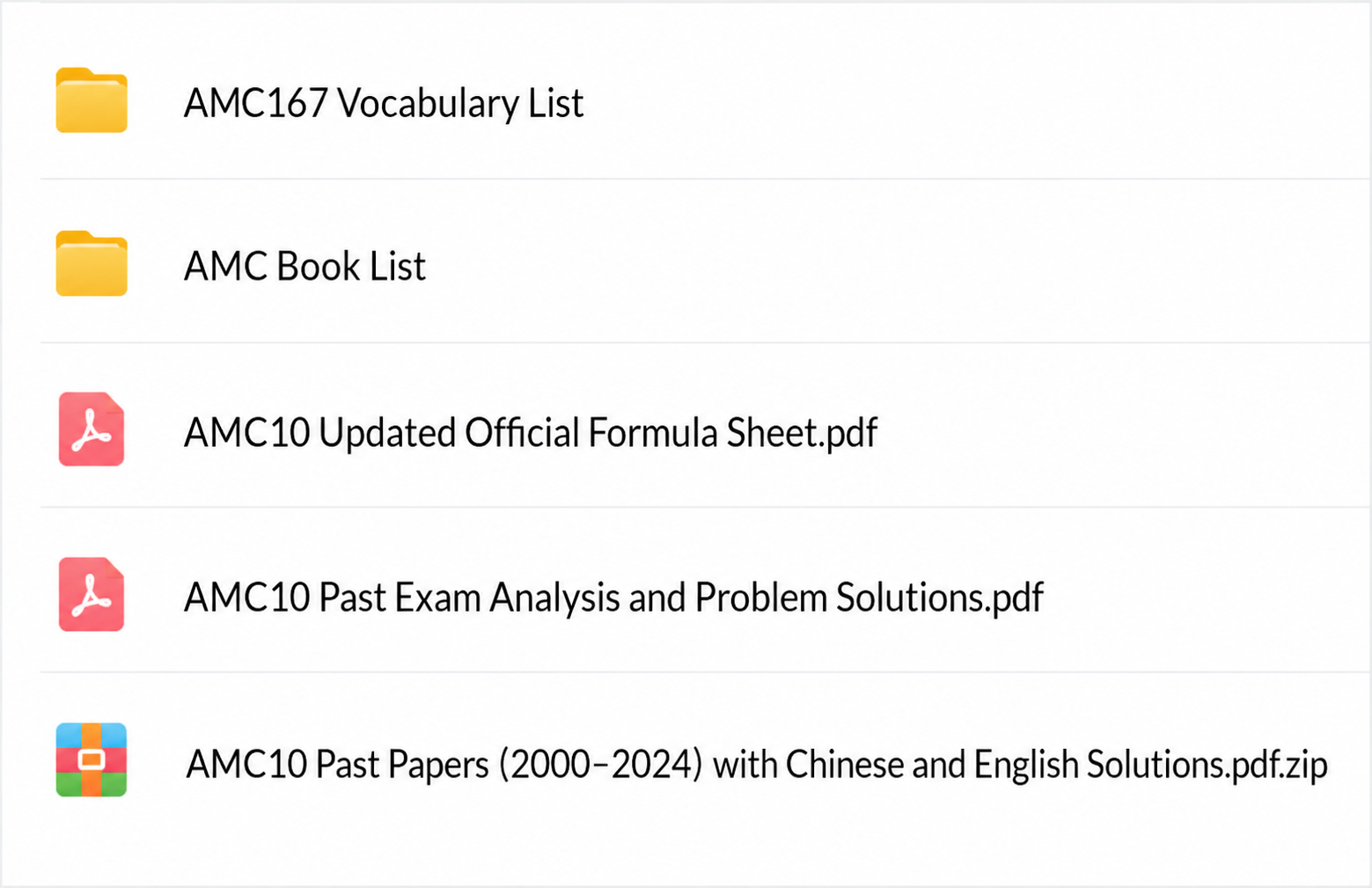
Scan the QR code for free access to AMC10 past papers (2010–2025) + solutions + book lists + formula sheets, and trial course information!

III. Five-Year Score Trends: Rising Competition
AMC10 Score Summary (2020–2025)
| Year | Paper | AIME Cutoff | Top 5% (HR) | Top 1% (DHR) |
|---|---|---|---|---|
| 2025 | A | 105 | 112.5 | 136.5 |
| 2025 | B | 99 | 105 | 133.5 |
| 2024 | A | 94.5 | 105 | 132 |
| 2024 | B | 105 | 114 | 138 |
| 2023 | A | 103.5 | 111 | 136.5 |
| 2023 | B | 105 | 112.5 | 135 |
| 2022 | A | 93 | 100.5 | 121.5 |
| 2022 | B | 94.5 | 100.5 | 114 |
| 2021 | A | 96 | 96 | 117 |
| 2021 | B | 96 | 96 | 120 |
New Award Cutoffs for 2025
| Award | Paper A | Paper B |
|---|---|---|
| Global Top 10% | 94.5 | 87 |
| Global Top 25% | 69 | — |
Key Trend Interpretations:
Overall upward trajectory: 2022 was a low point in recent years; cutoffs have risen each year since. The 2025 AIME cutoff for Paper A surged by 10.5 points compared to 2024.
Alternating difficulty between A and B papers: Each year, Papers A and B differ in difficulty, with cutoffs varying by 5–10 points. It is advisable to register for both if possible.
Increasingly competitive at the top: The top 1% cutoff has remained above 130 for years, reaching 136.5 on the 2025 A paper—meaning at most 2–3 incorrect answers out of 25.
Growing participant numbers: In 2025, global AMC10 participation reached 56,812 (31,617 for Paper A + 25,195 for Paper B), continuously expanding the competitive base.
IV. Why Does the AMC10 Matter?
A "Hard Currency" for US College Applications: MIT's application system includes a dedicated field for AMC/AIME scores. Statistics show that over 80% of MIT admitted students have AMC competition experience. Among students admitted to UK G5 universities and US Top 30 STEM/business programs, over 45% have AMC participation records.
Global Top 5% (Honor Roll) is a baseline for CS and engineering majors.
Advancing to AIME can be directly listed on the Common App, significantly enhancing your academic profile.
Top domestic international schools also use AMC10 as a screening tool:
Shanghai Guanghua Cambridge: Uses AMC10 original problems as advanced-level entrance math questions.
Shenzhen College of International Education (SCIE), BASIS: Admissions committees reference AMC10 scores; math written tests are benchmarked to competition difficulty.
Linke, World Foreign Language, Pinghe: AIME qualifiers are often exempt from additional math tests and may proceed directly to interviews.
Beijing: AMC10 ≥ 110 can waive math placement tests and enter IB AA HL advanced mathematics directly.
A Complete Competition Pathway: AMC10 → AIME → USAJMO → MOP → TSTs → IMO — the full selection path to the International Mathematical Olympiad.