
How Long to Prepare for AMC10? How to Allocate Time for Different Difficulty Levels?

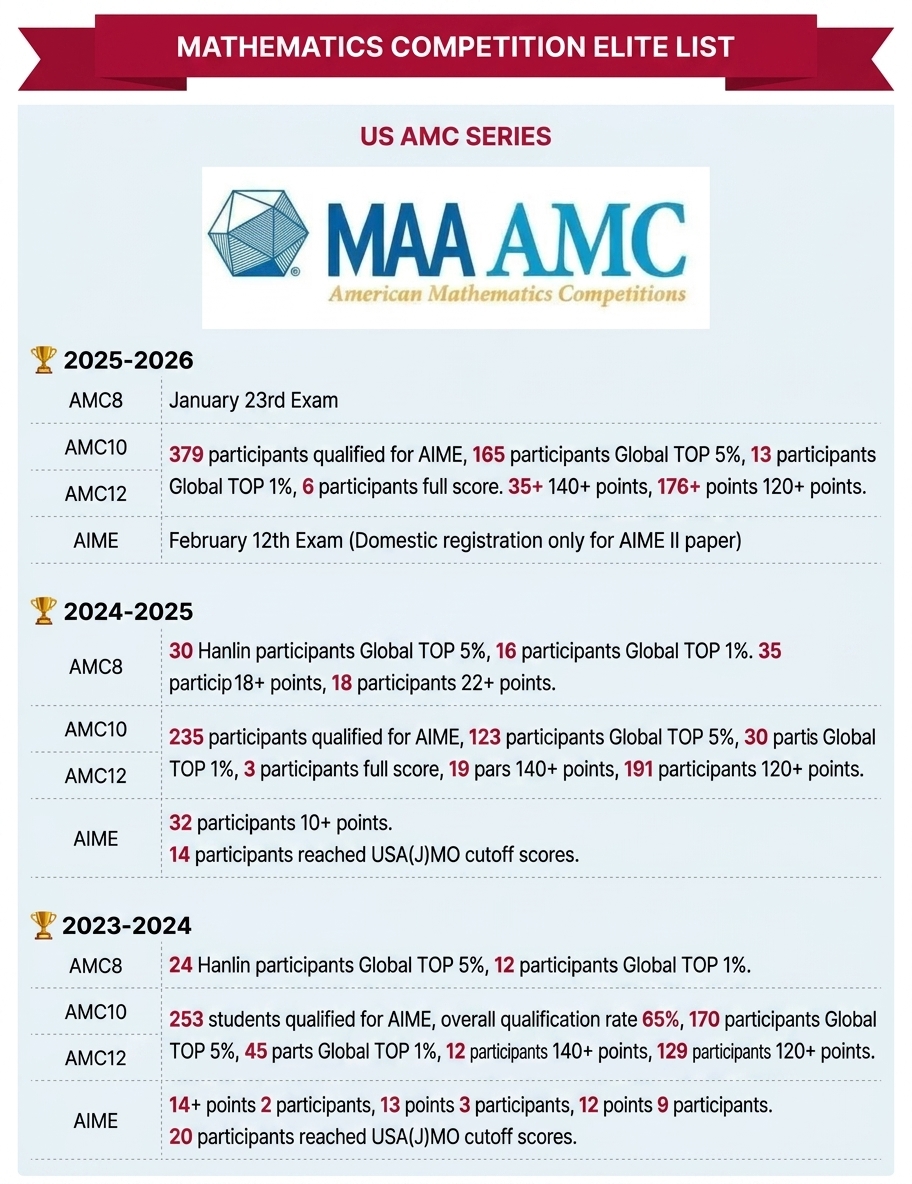
As one of the world's most influential middle school mathematics competitions, the AMC10 is far more difficult than the AMC8 and is close to the level of the AMC12. In terms of the Chinese education system, it corresponds roughly to the content of the first year of high school combined with the middle school mathematics league. Due to the absence of an official syllabus, flexible question types, and high demands on logical thinking, most students need at least six months of systematic preparation. However, the exact duration should be dynamically adjusted based on the student's foundation and target award level.

推荐

I. Recommended AMC10 Preparation Duration: Tailored to the Individual, Goal-Oriented

Student Profile Recommended Preparation Period Core Tasks
Average foundation (school math grade B+/A-) 10–12 months Systematically cover the four main modules: Algebra, Geometry, Number Theory, and Combinatorics. Transition from AMC8 past papers to the first 15 questions of AMC10. Develop competition thinking and break the habit of "rote memorization."
Good foundation (school math grade A/A+, experience with Olympiad or AMC8) 6–8 months Intensively work through the past 10 years' exams, analyze error patterns. Conquer high-frequency models in questions 16–25 (e.g., recursive sequences, geometric transformations). Train for time-constrained problem-solving and strategic decision-making.
Top tier (aiming for top 1% or high AIME score) 8–12+ months of continuous training Expand knowledge into AMC12/Euclid contest content. Master multiple solution methods (algebraic vs. geometric vs. number-theoretic perspectives). Participate in mock competitions to maintain competitive edge.

Key Starting Point: After the November 2025 AMC10, preparation for the 2026 season can begin immediately—use past exams to gauge the real difficulty and create a personalized plan.

推荐

II. AMC10 Difficulty Breakdown and Time Allocation Strategy

The AMC10 consists of 25 questions to be solved in 75 minutes. The difficulty follows a clear gradient. The key to achieving a high score is a layered approach combined with precise decision-making:

Questions 1–10: Foundational (Points Guarantee Zone)

Content: Integer operations, percentages, simple equations, basic properties of triangles and circles.
Goal: Answer all correctly within 30 minutes (≤3 minutes per question).
Strategy: Quickly identify the knowledge points being tested, avoid careless mistakes. If stuck, skip and return later.

Questions 11–20: Intermediate (Points Differential Zone)

Content: Quadratic functions, similar triangles, probability, fundamentals of permutations and combinations.
Goal: Aim for 80% accuracy (8 correct answers = 48 points).
Strategy: Integrate multiple knowledge points, focus on logical flow. Learn to use special values, symmetry, and the process of elimination to speed up.

Questions 21–25: Hard (Decisive Zone)

Content: Complex sequences, advanced geometry, combinatorial extremal problems, number theory constructions.
Goal: Getting 1–2 correct gives a significant advantage.
Strategy: Do not force a full solution; even outlining key ideas can spark inspiration. Do not get stuck!

III. Score and Time Allocation Reference for Different AMC10 Targets

Target Required Score Time Allocation Advice (Total 75 min)
Advance to AIME (top 2.5%) ≈100–105 points Questions 1–15: 30 min (all correct); Questions 16–20: 25 min (3–4 correct); Questions 21–25: 15 min (attempt 1); Leave 5 min for review.
Top 5% (Honor Roll) ≈110–115 points Questions 1–15: 25 min; Questions 16–20: 30 min (strive for all correct); Questions 21–25: 15 min; 5 min review.
Top 1% (Distinguished Honor Roll) ≥120 points Questions 1–15: 20 min (rapid fire); Questions 16–20: 25 min (must be all correct); Questions 21–25: 25 min (get at least 1 correct); 5 min review.
Important Reminder: Unanswered questions earn 1.5 points, while guessing blindly is risky (incorrect answers get 0 points). If you have no clue after 5 minutes on a question, decisively skip it to secure your foundational points.

IV. Four Steps to Efficient Preparation

Step 1: Knowledge Review (1–2 months)

Systematically review the four main modules: Algebra, Geometry, Number Theory, Combinatorics.
Recommended materials: The Art of Problem Solving Vol. 1, AMC10 Problem Series.

Step 2: Categorized Breakthroughs (2–3 months)

Train by question type, e.g., "geometric extremal value problems," "recursive sequences," "inclusion–exclusion principle."
Keep an error log, recording "thought bottlenecks" rather than just copying answers.

Step 3: Past Paper Practice (2–3 months)

Intensively work through past exams from 2015 to 2025 (20 sets, including both A and B versions).
Strictly time each set to simulate exam conditions.

Step 4: Sprint Mock Exams (1 month)

Complete 2 mock exams per week, analyzing time allocation and strategic mistakes.
Focus on avoiding traps in problem statements (e.g., keywords like "positive integer," "distinct").

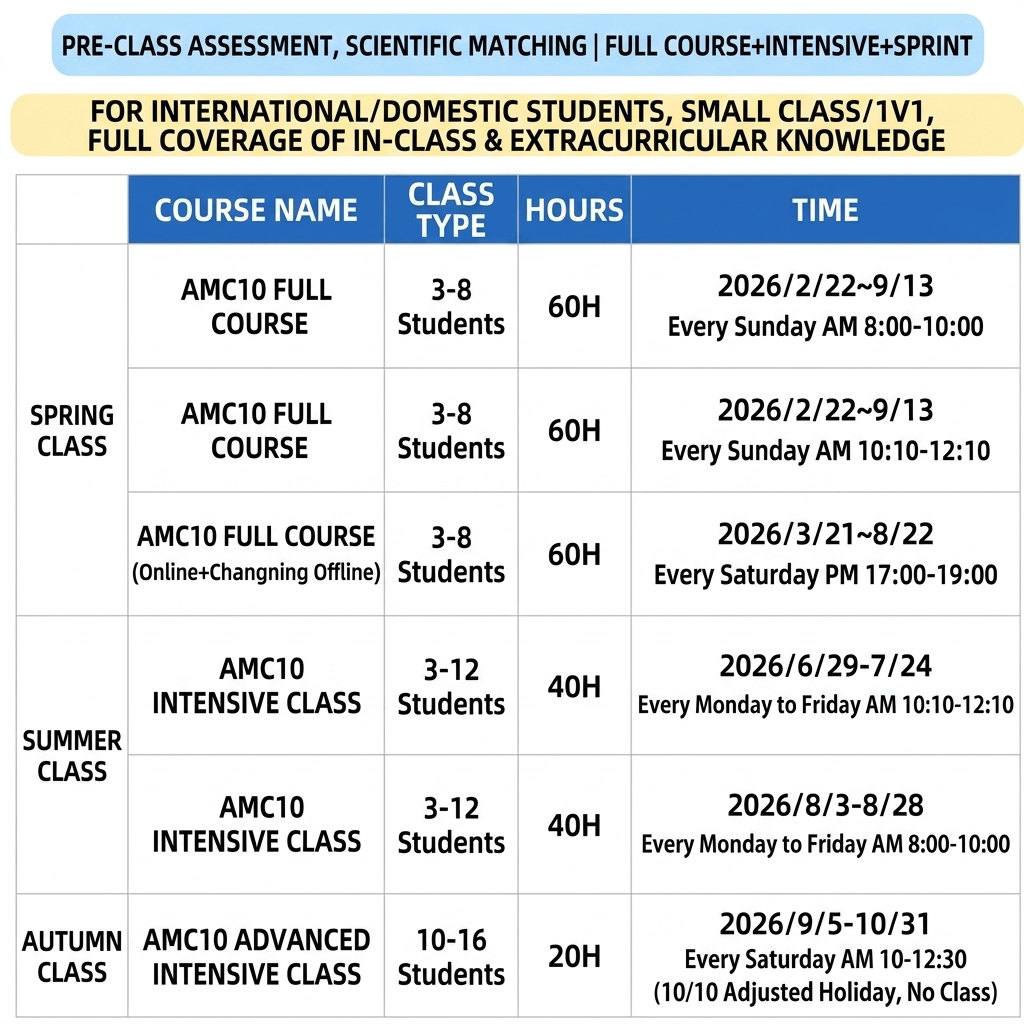
AMC10 Preparation Courses

Our instructors are graduates from top global universities. With precise curriculum planning and comprehensive learning tracking, we ensure your score improvement and award-winning success!

Class Type Hours Class Size Start Date
Winter Break Class 30H 3–8 students Consult teacher for details
Systematic Course 20H 1v1 / 3–8 students Consult teacher for details
Problem-Solving Class 20H 1v1 / 3–8 students Consult teacher for details

推荐

AMC10 vs AMC12 Comprehensive Comparison: Choosing the Wrong Path Wastes Your Efforts!

Many parents mistakenly believe: "AMC12 is just AMC10 with two more years of content, slightly more difficult."

But the truth is quite the opposite—AMC10 and AMC12 have fundamental differences in knowledge systems, difficulty structures, advancement logic, and strategic value. Choosing the wrong competition not only wastes preparation time but may also undermine a student's confidence. This article will thoroughly clarify, from five dimensions—knowledge points, difficulty, value, cutoff scores, and participation strategy—which competition your child should take: AMC10 or AMC12?

推荐

I. Core Knowledge Point Comparison: More Than Just "Two More Years" – It's a Different Track

Topic Area AMC10 AMC12
Algebra Linear/quadratic equations, inequalities, function basics Advanced inequalities (Cauchy, AM-GM), higher-degree equations, function composition and inverses
Geometry Plane geometry, similarity, circle basics Solid geometry, analytic geometry, complex plane geometry, trigonometric identities
Number Theory Factors and multiples, congruences, modular arithmetic basics Euler's theorem, Fermat's little theorem, higher-degree congruences, Chinese remainder theorem
Combinatorics Addition/multiplication principle, basic probability Generating functions, recurrence relations, advanced expectation, conditional probability
Additional Core Topics ❌ Not tested ✅ Trigonometry ✅ Logarithms and exponential functions ✅ Complex numbers and complex plane

Key Difference: AMC10 stops at "elementary mathematics," while AMC12 enters the complete high school mathematics system and paves the way for AIME/USA(J)MO.

II. Difficulty Comparison: Which Is More "Competitive"?

On the surface: AMC12 > AMC10
The final problems of AMC12 (Questions 21–25) often involve pre-college content, such as complex number rotations, nested trigonometric identities, and advanced recurrences, earning it the title "genius filter."

Actual advancement difficulty: AMC10 > AMC12

Competition 2025 AIME Cutoff Score Characteristics of Participants
AMC10 Version A: 105 / Version B: 99 Many 8th–9th grade "trial" students lower the average, but top competitors are extremely strong, pushing the cutoff higher.
AMC12 Version A: 96 / Version B: 100.5 Primarily 11th–12th graders with complete knowledge, but with higher tolerance for errors (perfect score 150, 96 points ≈ 16 correct answers + leaving some blank).

The truth: AMC10 is a "high-score rat race"—the top 1% threshold is extremely high; AMC12 is a "standard-based selection"—as long as you have full knowledge coverage, steady preparation makes it easier to advance to AIME.

III. Value Comparison: Real Worth from an Admissions Perspective

Target University/Major Recommended Path Reason
Top 30 US universities (non-elite STEM) AMC10 top 1% or AMC12 top 5% Both serve as proof of mathematical ability.
Ivy League / MIT / Caltech / Stanford Must take AMC12 + High AIME score AMC12 scores are directly linked to USA(J)MO selection and are a "hard currency" for top STEM schools.
Quantitative majors like CS/Engineering/Physics/Economics Prioritize AMC12 Advanced math tools (trigonometry, complex numbers, logarithms) are foundational for these fields, and AMC12 better demonstrates underlying ability.

推荐

IV. How to Choose Scientifically? A Guide for Three Typical Scenarios

Scenario 1: The child is still building a foundation (Grades 8–10, new to competitions)

Recommendation: AMC10
Reason: Fewer knowledge gaps, avoids frustration from "not having learned trigonometry/complex numbers"; focus on training stability in the first 20 questions, build confidence; the goal is not to win awards but to build a framework for competition thinking.
Note for parents: At this stage, focus on "experience + accumulation," not on scores.

Scenario 2: The child is stuck at an AMC10 bottleneck (consistently solving 12–16 questions, struggling to advance)

Recommendation: Switch to AMC12
Reason: The last 5 questions of AMC10 require exceptional talent and extensive time to master; whereas the first 20 questions of AMC12 are more "routine" for high school students with complete knowledge; with the same ability, it's easier to qualify for AIME with AMC12 (96 points vs. 105 points).

Scenario 3: The goal is a clear AIME score (applying to Ivy League/strong STEM programs)

Recommendation: Prepare directly for AMC12
Reason: AMC12 is the only path to USA(J)MO; even 10th graders who have already studied trigonometry, logarithms, and complex numbers can certainly challenge AMC12; admissions officers value a trajectory of continuous advancement (e.g., 9th grade AMC10 → 10th grade AMC12 → 11th grade AIME 10+).

AMC10 Preparation Courses

Our instructors are graduates from top global universities. With precise curriculum planning and comprehensive learning tracking, we ensure your score improvement and award-winning success!

Class Type Hours Class Size Start Date
Winter Break Class 30H 3–8 students Consult teacher for details
Systematic Course 20H 1v1 / 3–8 students Consult teacher for details
Problem-Solving Class 20H 1v1 / 3–8 students Consult teacher for details

推荐

Online Customer Service
Contact Customer Service