
How Hard Is the AMC10? Why Can't You Sprint for It? 4 Test-Day Tips

Many parents think: "AMC10 is too hard; my child is just an average student and not suitable for the competition."

But the truth is—although AMC10 is challenging, it is by no means "only for prodigies." With the right approach and a scientific plan, even beginners starting from scratch can achieve excellent results through systematic training and even advance to the AIME!

This article will comprehensively break down the real difficulty of the AMC10, common misconceptions, preparation rhythm, and test-day strategies, helping you break the "just making up the numbers" spell and achieve the leap from "dare not take it" to "steady award winner."

推荐

I. How Hard Is the AMC10? Knowing the Exact Level Helps You Prepare Scientifically

Difficulty benchmark (Chinese system): Middle School Math League (Preliminary) < AMC10 < High School Math League (Part I)
Target audience: 8th to 10th graders
Breadth of knowledge: Covers all middle school content + some core high school modules (e.g., quadratic functions, trigonometry, sequences, basic number theory, etc.)
Depth of thinking: Emphasizes multi-topic integration, logical reasoning, and model building—far beyond the requirements of the high school entrance exam.

II. Why Can't You Sprint for the AMC10? Three Real Obstacles

Myth 1: "Just a few practice tests and I'll get an award."

Reality 1: Too many topics—school learning is far from enough!
High-frequency AMC10 topics not covered in school include:

Inclusion–Exclusion Principle

Permutations and combinations (addition/multiplication principle, binding/insertion methods)

Congruence and modular arithmetic

Similarity in geometry, power of a point theorem, coordinate method

Recursive sequences, comprehensive application of Vieta's theorem

These topics are concentrated in problems 16–25 and are key to scoring higher!

Recommendation: If your child has not systematically studied the above, at least 3–6 months of targeted gap-filling are needed.

Myth 2: Treating AMC10 as "AMC8, Level Up"

Reality 2: The difficulty jumps by a wide margin!

Dimension AMC8 AMC10
Questions / Time 25 questions / 40 minutes 25 questions / 75 minutes
Average time per question 1.6 minutes 3 minutes
Difficulty of last few questions Middle school extension Approaching AIME level
Depth of knowledge Elementary school + grade 7 Grades 8–10 + competition thinking

Truth: Problems 21–25 of the AMC10 are almost a "cliff" for average students and require long-term training to overcome.

Myth 3: Underestimating the intensity of competition

Reality 3: The average score is only 57 points; 90% of test-takers are "just making up the numbers"!
Maximum score: 150 points
Global average: about 57 points
AIME qualification threshold (2025): 105+ points
This means you need to score nearly 50 points higher than 90% of test-takers worldwide!

推荐

III. AMC10 Difficulty Distribution (25 questions = 3 battlefields)

Question Range Difficulty Goal Strategy Skills Required
1–10 Basic (≈ final problems of high school entrance exam) Must get all correct! Accurate calculation + careful reading
11–20 Intermediate (competition entry level) At most 2 wrong Multi-topic integration + problem-pattern recognition
21–25 Hard (AIME preparation) Aim for 2–3 correct Advanced thinking + creative problem-solving

Award-winning formula: First 10 questions (30 points) + Middle 10 questions (40 points) + Last 5 questions (30 points) = 100+ points → Advance to AIME.

IV. Scientific 3‑Phase Preparation Plan (Suitable for All Students)

1. Foundation Building Phase (March–July)

Goal: Fill knowledge gaps, build a competition-thinking framework.
Actions:
- Work on 2013–2018 past papers (focus on questions 1–20)
- Focus on: algebraic identity transformations, geometric auxiliary lines, basic number theory
- 2 sets per week, analyze mistakes, build a "knowledge–question type" map

2. Strengthening Phase (September–October)

Goal: Increase speed + overcome intermediate problems.
Actions:
- Work on 2019–2023 past papers (full set under timed conditions)
- Targeted training: permutations and combinations, congruences, geometric optimization
- Simulate test-day pace: first 10 questions ≤ 15 minutes, questions 11–20 ≤ 35 minutes

3. Sprint Phase (before November exam)

Goal: Fill gaps + solidify strategy.
Actions:
- Work on the most recent 2024–2025 past papers
- Review your mistake notebook, memorize high-frequency formulas (e.g., Pythagorean triples, difference of squares, combinatorial identities)
- Solidify test-taking habits: circle keywords, skip stuck questions, leave blanks strategically

推荐

V. 4 Test-Day Tips (Lifesavers!)

1. Golden time allocation

Questions 1–10: ≤ 15 minutes (aim for all correct)

Questions 11–20: ≤ 35 minutes (minimize mistakes)

Questions 21–25: ≤ 20 minutes (grab 2 correct)

Last 5 minutes: check answer sheet + verify calculations

2. Learn to abandon strategically

AMC10 scoring rule:
Correct: +6 points
Omitted: +1.5 points
Incorrect: 0 points
Strategy: If unsure, it is better to leave the answer blank!
Example: 16 correct answers + 9 blank answers → 16×6 + 9×1.5 = 109.5 points → solid AIME qualification!

3. Use elimination to improve guess rate

Use:

Parity (e.g., the answer must be even)

Range estimation (e.g., side length cannot exceed 100)

Unit / dimension checks

Special value substitution (test with x = 0, 1, 2)

This quickly eliminates 2–3 options, raising the guess probability from 25% to 50%!

4. Mindset management: allow yourself "not to know"

When stuck, tell yourself: "This problem is meant to filter out people anyway; skipping it is normal."
Prioritizing guaranteed points from problems you know is always smarter than obsessing over a single tough question.

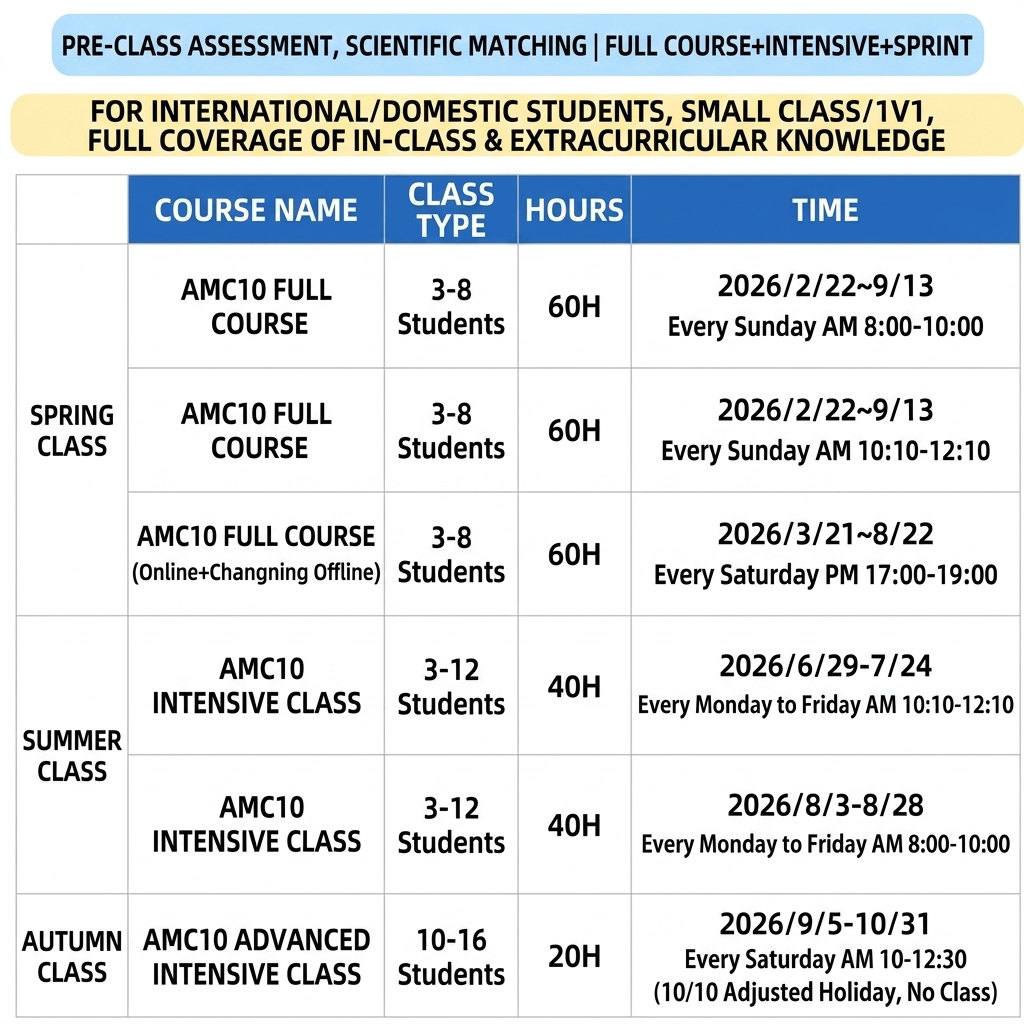
AMC10 Preparation Courses

Our instructors are graduates from top global universities. With precise curriculum planning and comprehensive learning tracking, we ensure your score improvement and award-winning success!

Class Type Hours Class Size Start Date
Winter Break Class 30H 3–8 students Consult teacher for details
Systematic Course 20H 1v1 / 3–8 students Consult teacher for details
Problem-Solving Class 20H 1v1 / 3–8 students Consult teacher for details

推荐

What Are the Advantages for Middle School Students Preparing for AMC10? How to Scientifically Set AMC10 Award Goals?

Many parents and students mistakenly believe: "AMC10 is a high school competition, it's too early for middle school students" or "Students in the domestic track don't need to take international competitions."

But the truth is quite the opposite—middle school is the golden window for preparing for AMC10! Especially for students transitioning from the domestic track to an international one, AMC10 is not only proof of mathematical ability but also a "key" that unlocks barriers to academic advancement.

This article will comprehensively analyze, from three dimensions—academic improvement, educational value, and award pathways—why middle school students (especially those in grades 8–9) are now in the best position to start preparing for AMC10.

推荐

I. Dual Improvement in Grades and Thinking: Competition ≠ Detached from Curriculum, It's an "Advanced Upgrade"

Highly Overlapping Knowledge: Preparing for the competition is also reviewing
The four core modules of AMC10 (Algebra, Geometry, Number Theory, Combinatorics) almost fully cover the key content of middle school mathematics:

Algebra: Equations, Inequalities, Functions, Sequences → Corresponds to high school entrance exam (Zhongkao) problem-solving questions

Geometry: Triangle congruence/similarity, properties of circles, Pythagorean theorem → Core of Zhongkao geometry

Number Theory: Factors and multiples, congruence, divisibility → Expands on the "Integers" chapter

Combinatorics: Counting principles, probability → Connects to high school elective content

Key Differences:
In-school problem: "Find the solution to this equation."
AMC10 problem: "Under certain conditions, how many integer solutions does this equation have?"
It's not beyond the syllabus; it's about depth + flexibility upgrade.

Cognitive Skills Nurtured Reflect Back on In-School Learning

Through AMC10 training, students will learn to:

Break down complex problem statements and quickly identify core concepts;

Build a knowledge network instead of memorizing formulas in isolation;

Improve time-constrained problem-solving skills to confidently tackle challenging Zhongkao problems;

Develop a habit of summarizing patterns, enhancing overall scientific literacy.

II. Maximizing Academic Advancement Value: A "Game-Changer" for Students Transitioning from Domestic Track

For students planning to transfer from middle school to international high school (such as IB, A-Level, AP programs), AMC10 offers irreplaceable strategic value:

Advantage 1: Solid Foundation, Low Preparation Cost

Domestic track students have strong calculation skills and a solid foundation, far exceeding their peers in pure international programs;
They only need to supplement competition thinking and problem-solving patterns (like the Inclusion–Exclusion Principle, permutations and combinations), no need to start from scratch;
With 3–6 months of systematic training, they can reach the AIME qualification level.

Advantage 2: Breaking Stereotypes, Highlighting STEM Strengths

International high school admissions officers often have two major concerns about domestic track students:

"They only know how to drill problems and lack logical thinking"

"They rely on teachers and have weak independent learning skills"

An AMC10 Top 5% or AIME qualification certificate directly proves that you possess the mathematical reasoning skills required for an international curriculum and that you can independently tackle challenging problems, adapting to the inquiry-based learning of IB/A-Level.

Advantage 3: Filling the Background Gap, Boosting Application Competitiveness

Compared to transfer applicants who only have "in-school grades + IELTS/TOEFL," those with AMC10 awards will:

Receive priority attention in resume screening;

Showcase growth mindset and resilience through their competition preparation experience during interviews;

Be more likely to earn scholarships or admission to top-tier classes.

推荐

III. How Can Middle School Students Scientifically Set AMC10 Award Goals?

Goal Level Required Correct Answers Accuracy Preparation Focus
Qualify for AIME ≥17 questions ≈68% Secure points on Q1–20, grab 1–2 on Q21–25
Top 5% (Honor Roll) ≥20 questions ≈80% ≤1 wrong in medium-difficulty Q11–20, 2 correct in Q21–25
Top 1% (DHR) ≥22 questions ≈88% ≤3 minutes per question on Q1–15, efficiently tackle Q16–25

Pacing Suggestions (75 minutes)

Questions 1–15: ≤40 minutes (<3 minutes per question, aim for all correct)

Questions 16–20: ≤22 minutes (aim for minimal mistakes)

Questions 21–25: ≤13 minutes (grab 2 questions, leave the rest blank wisely)

Scoring Strategy Reminder:

17 correct answers + 8 blank answers = 17×6 + 8×1.5 = 114 points → Far exceeding the AIME threshold!

IV. Actionable Advice for Parents of Middle School Students

Don't wait to "finish learning high school knowledge" before starting. 80% of AMC10 content is already covered in middle school; what's missing is just the training in mathematical thinking.

Prioritize AMC10 to validate abilities, not AMC8. If your child consistently scores 90+ in school math, AMC8 is no longer challenging; AMC10 is better at unleashing their potential.

Incorporate AMC10 into academic planning. 8th grade: first attempt, target Credit/Distinction; 9th grade: aim for AIME qualification, build a highlight for applications; 10th grade: if not qualified, shift to AMC12 as a safety net.

AMC10 Preparation Courses

Our instructors are graduates from top global universities. With precise curriculum planning and comprehensive learning tracking, we ensure your score improvement and award-winning success!

Class Type Hours Class Size Start Date
Winter Break Class 30H 3–8 students Consult teacher for details
Systematic Course 20H 1v1 / 3–8 students Consult teacher for details
Problem-Solving Class 20H 1v1 / 3–8 students Consult teacher for details

推荐

Online Customer Service
Contact Customer Service