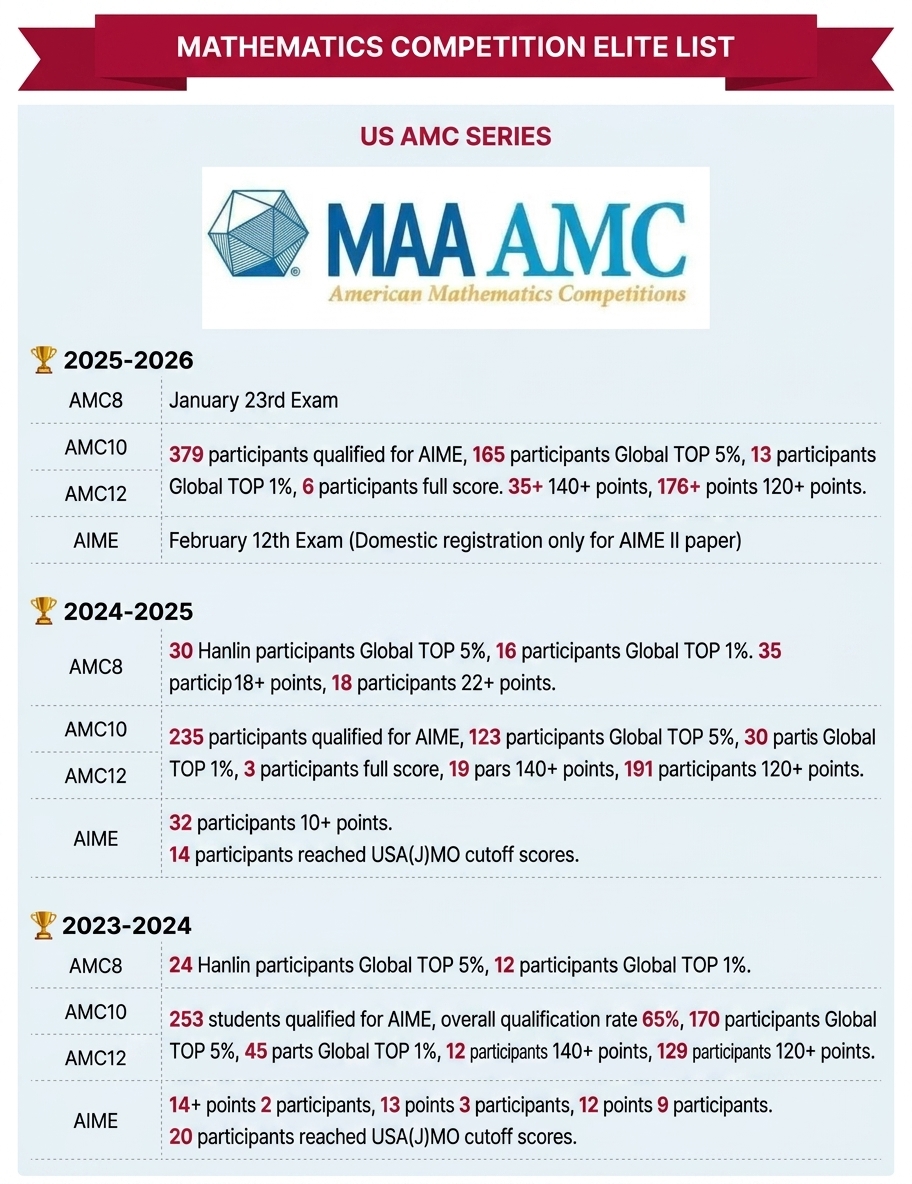

As one of the most influential secondary school mathematics competitions globally, the competitive landscape of the AMC10 has undergone a fundamental transformation over the past three years. It has evolved from a mass-participation event into an "elite battleground" where top students compete. Below is a comprehensive analysis based on official data from 2023 to 2025.
I. Core Trends: Soaring Cutoff Scores and Intensifying Elitism
1. Significantly Higher Qualification Threshold
AIME Cutoff (Top 2.5%): Taking AMC10A as an example, the cutoff skyrocketed from 94.5 in 2024 to 105 in 2025—a surge of 10.5 points in a single year, marking a five-year high.
Distinguished Honor Roll (DHR, Top 1%): In 2025, the AMC10A DHR cutoff reached a staggering 136.5, approaching a perfect score (150), indicating white-hot competition at the top percentile.
2. Decline in Participants, Increase in Prestige
Despite rising cutoffs, global participation has declined by 15%–25%. This indicates a mass exodus of casual participants, leaving primarily focused, well-prepared elite students. The AMC10 is transitioning from a "mass-participation" contest to an "elite-concentrated" competition.

II. Question Types & Content: Geometry on the Rise, Knowledge Integration Becomes Mainstream
1. Significant Changes in Topic Distribution
Geometry's Strong Rise: Its share has increased significantly by about 8%, making it the absolute core of the exam. In the 2025 A卷, there were up to 5 high-difficulty core geometry questions, focusing on advanced topics like the Power of a Point Theorem, Cyclic Quadrilaterals, and Triangle Similarity.
Algebra's Relative Contraction: The number of traditional function and equation problems has decreased, with greater emphasis placed on cross-disciplinary applications of algebra with other modules.
The "Disappearance" and Return of Number Theory: Although the 2025 A卷 did not feature standalone number theory problems, number theory concepts (such as congruences and divisibility) have been deeply integrated into algebra and combinatorics questions.
2. Comprehensive Upgrade of Skill Requirements
Increased Difficulty of the First 15 Questions: Previously considered "gimme" points, these early questions now generally require multi-step reasoning, demanding greater foundational mastery and mental agility.
Last 10 Questions Emphasize Thinking Over Calculation: The purely computational complexity of the final five questions (21-25) has decreased, but the requirements for innovative solutions, logical modeling, and cross-disciplinary associative ability have increased.
3. Unprecedented Level of Knowledge Integration
In the 2025 exam, cross-cutting questions combining algebra & number theory, and geometry & combinatorics, accounted for 30% of the paper, far exceeding the 22% seen in 2024. This means rote memorization of single modules is no longer sufficient; students must possess the ability to comprehensively utilize all four major modules (Algebra, Geometry, Number Theory, Combinatorics).
III. AMC10 Core Topics and Key Preparation Challenges
Although the AMC10 does not involve advanced topics like trigonometry or complex numbers, its depth and breadth of exploration of middle and early high school mathematics far surpass standard school curricula.
Core Topics of the Four Modules:
Comprehensive Algebra: Relationship between roots and coefficients of quadratic equations (Vieta's formulas), Polynomial Remainder Theorem, absolute value inequalities, recursive sequence general terms.
Advanced Geometry: Flexible application of triangle congruence/similarity, Power of a Point Theorem, proof and application of cyclic quadrilaterals.
Essentials of Number Theory: Distribution of primes, solving congruence equations, digit and base conversion, and clever applications of Fermat's Little Theorem and the Chinese Remainder Theorem.
Combinatorics & Probability: Comprehensive application of addition/multiplication principles, Inclusion-Exclusion Principle, and permutations/combinations, with particular emphasis on modeling ability in real-world scenarios (e.g., logistics, information security).
Key Challenge: Questions increasingly emphasize the "practical application value of mathematics"—for example, using the Inclusion-Exclusion Principle to solve logistics resource allocation problems, or using congruence equations to design information security keys. This requires students not only to "solve the problem correctly" but also to "understand the problem," connecting abstract mathematics to the real world.
IV. How Can Beginners Plan Scientifically? Stage-by-Stage Preparation Advice
The answer is yes: complete beginners can absolutely challenge the AMC10 through systematic study, but strategies should be tailored according to grade level.
Grades 7-8: Foundation Building & Exploration Period
Option 1 (No accelerated learning): Systematically study Pre-AMC10 or fully master AMC8 knowledge points as a bridging step.
Option 2 (With accelerated learning): If grades are excellent and foundations are solid, begin direct systematic AMC10 study.
Goal: Adapt to the AMC10 exam rhythm, aim for Honor Roll (Top 5%) to build confidence for future Sprint.
Grades 9-10: Golden Sprint Period
This is the optimal window for AMC10 preparation. Students' mathematical thinking matures, and focus should be on:
Topic Emphasis: Systematically tackle high-frequency难点 like congruences in number theory and permutations/combinations in combinatorics.
Real Exam Practice: Improve speed and accuracy through extensive problem-solving, especially focusing on breaking through the final five questions (21-25).
Goal Orientation: If aiming for top US universities or elite international schools, set AIME qualification or even DHR as the ultimate goal, with systematic, high-intensity long-term preparation.
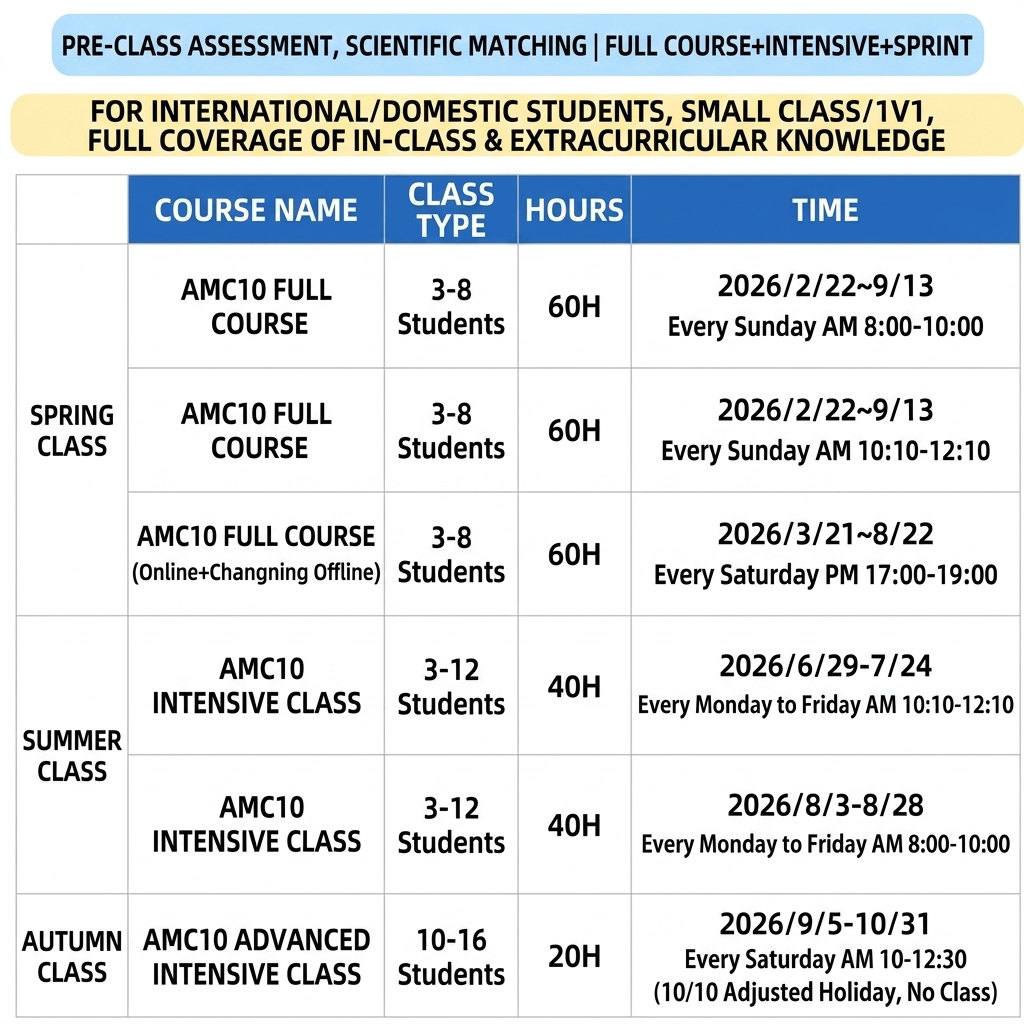
AMC10 Preparation Courses
Our instructors are graduates of top global universities. With precise curriculum planning and full learning support, we escort you to score improvement and awards!
| Class Type | Hours | Class Size | Start Date |
| Four-Module Short-Term Class | Varies by module | 3-8 students | Consult teacher |
| Systematic Course | 20H | 1v1 / 3-8 students | Consult teacher |
| Problem-Solving Class | 20H | 1v1 / 3-8 students | Consult teacher |