The AMC10 holds two exams each year — the A and B versions — which are completely equivalent in terms of college admission recognition, award value, and AIME qualification cutoffs. However, there are significant differences in question style and distribution. Understanding these differences and choosing accordingly is the key to maximizing your chances of advancing.

I. Core Comparison: AMC10 A vs B
| Dimension | A (AMC10A) | B (AMC10B) |
|---|---|---|
| Overall Difficulty | No significant difference; the official organizers ensure both versions are balanced in difficulty. | |
| Question Style | More conventional: classic question types, strong patterns, heavier computational load. Focuses on fundamental arithmetic skills and attention to detail. | More flexible: novel questions, many clever solution approaches, weaker patterns. Emphasizes logical thinking, reverse problem-solving, and interdisciplinary application of knowledge. |
| Topic Distribution | Geometry questions come with sufficient diagrams; plane geometry accounts for a larger proportion. Fewer difficult number theory and combinatorics problems; lower entry barrier. | Increased proportion of geometry without diagrams, solid geometry, and analytic geometry. More difficult number theory and combinatorial counting problems; difficulty may spike abruptly in mid-range questions (11–20). |
| Test Date | Early November | Mid-November (one week after A) |
II. How to Choose Between A and B?
A is more suitable if:
First-time participant or with limited competition experience.
Solid grasp of fundamentals, but slower to adapt to novel question types.
Goal is to perform steadily and secure the scores you are capable of achieving.
B is more suitable if:
Rich competition experience (e.g., has participated in AMC8, MathCounts, etc.).
Quick thinker, good at handling unconventional problems and cross-module comprehensive questions.
Able to stay calm under pressure, good at finding "clever solutions."
Optimal strategy: Sign up for both A and B! The two exams are only one week apart, with highly overlapping preparation content. Use A as a "practice exam" to quickly identify and fill knowledge gaps, then make a second push in B. This is the most effective way to significantly boost your chance of qualifying for AIME.
III. Preparation Guide for Different Student Levels
The knowledge scope of AMC10 is roughly equivalent to mathematics at or below the first year of Chinese high school (Grade 10), but its requirements for depth, breadth, and flexible application far exceed the standard school curriculum. Based on years of tutoring experience, the following recommendations are made for students with different backgrounds:
1. Students starting from scratch (Recommended preparation time: 3–4 months)
Core task: Fill the knowledge gap from AMC8 to AMC10. Systematically build foundational skills across the four major areas (Algebra, Geometry, Number Theory, Combinatorics).
Recommended path: Enroll in a systematic, long-term AMC10 foundation course to comprehensively cover all test topics and avoid knowledge blind spots.
Goal: Qualify for AIME and aim for the top 5% globally (Honor Roll).
2. Students with prior competition background (Recommended to start preparation 4–6 months in advance)
Core task: Connect and deepen the four major modules, focusing on high-frequency test points and common error-prone areas.
Key action: Create and continuously update an error log. Use error analysis to precisely identify weak areas.
Recommended path: Attend a four-module intensive class, focusing on improving accuracy on questions 11–20 — a critical range that distinguishes average from outstanding performers.
Goal: Aim for the top 1% globally (Distinguished Honor Roll) or secure a top 5% position.
3. Students with solid foundation / prior test-taking experience (Specialized Sprint Phase)
Core task: Break through bottlenecks, improve problem-solving efficiency and stress tolerance.
Key actions:
Build a mathematical English vocabulary bank to ensure quick and accurate comprehension of English problem statements.
Conduct strict timed mock exams to simulate real test pressure.
Recommended path: Participate in an intensive sprint course before the exam, where experienced instructors provide targeted strategies and thinking models for solving the most challenging problems (21–25).
Goal: Perform consistently, secure AIME qualification, and aim for a perfect score.
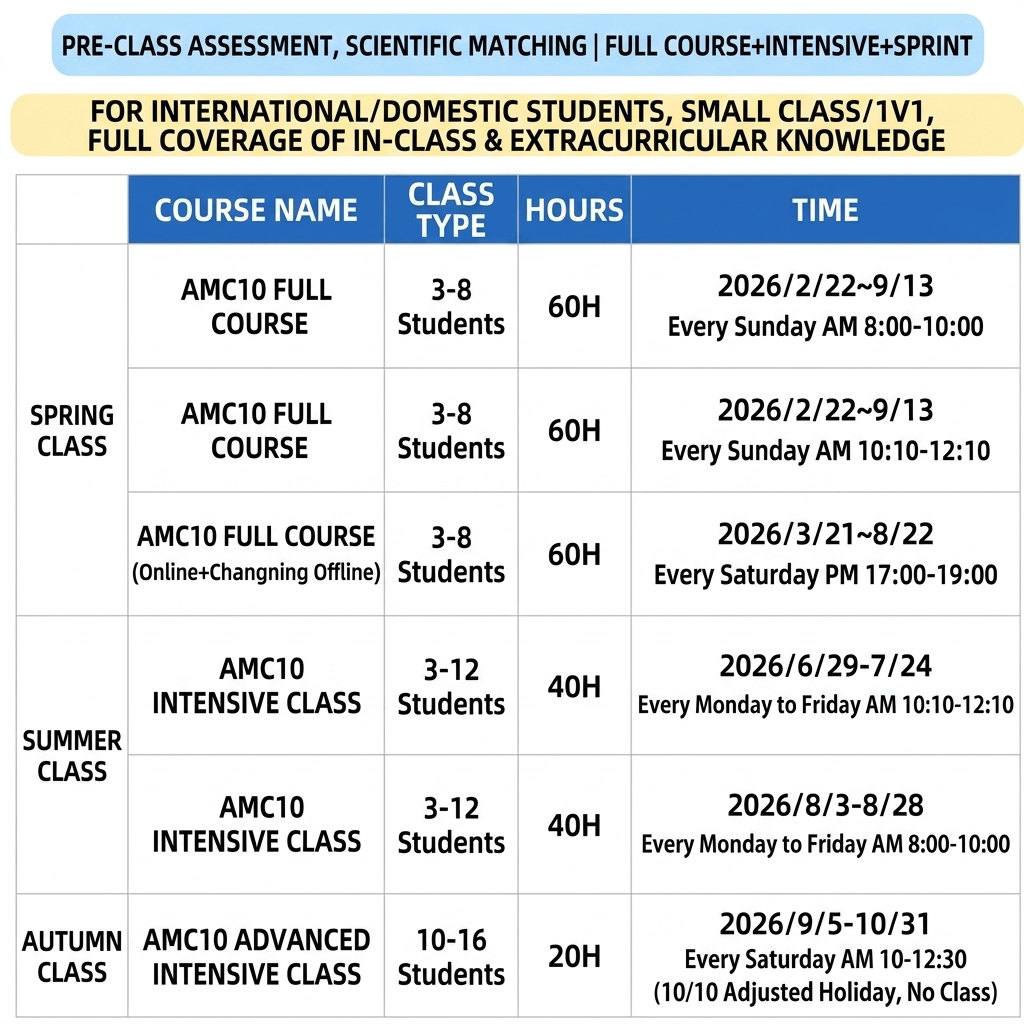
AMC10 Preparation Courses
Our instructors are graduates of top global universities. With precise curriculum planning and full learning support, we escort you to score improvement and awards!
| Class Type | Hours | Class Size | Start Date |
|---|---|---|---|
| Four-Module Short-Term Class | Varies by module | 3-8 students | Consult teacher |
| Systematic Course | 20 hours | 1v1 / 3-8 students | Consult teacher |
| Problem-Solving Class | 20 hours | 3-8 students | Consult teacher |