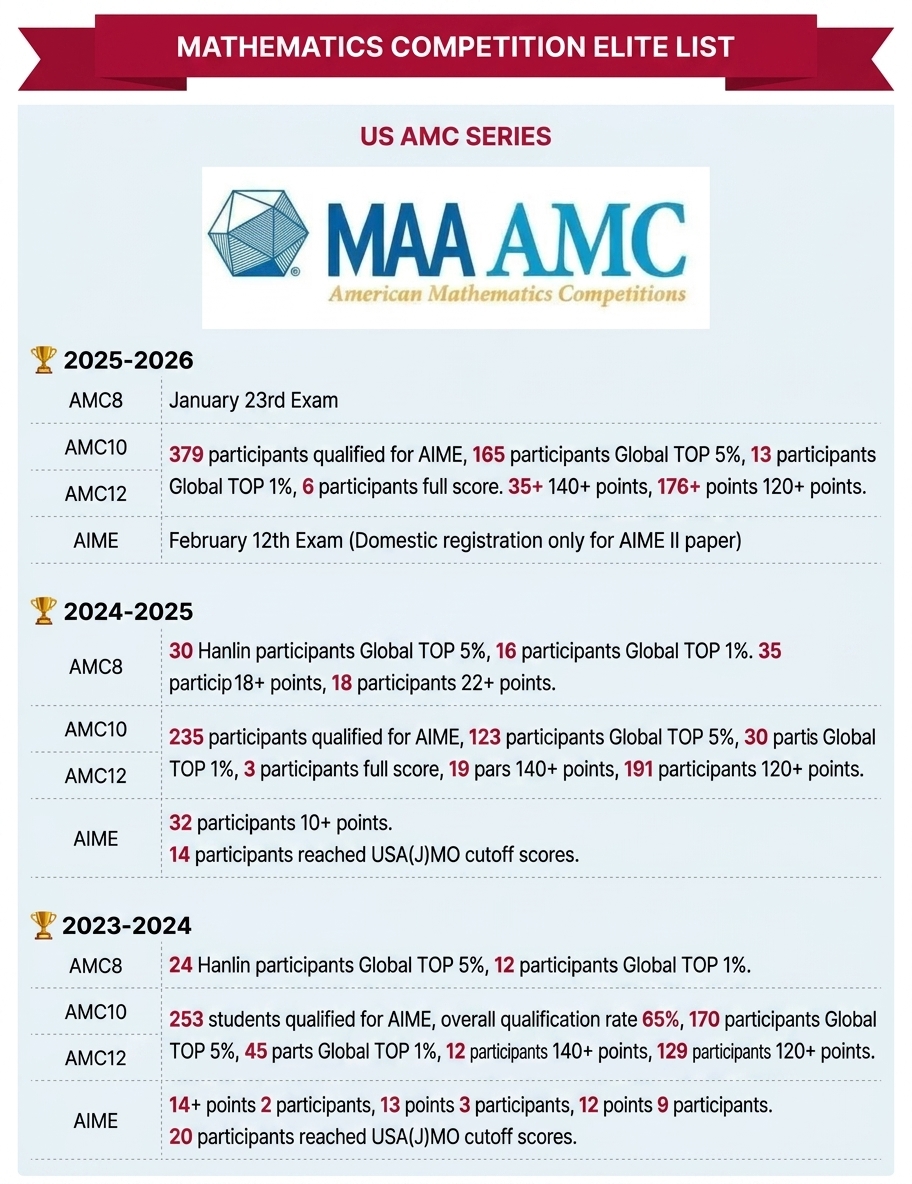

The AMC10 is a mathematics competition designed by the Mathematical Association of America (MAA) for students in grade 10 and below, aiming to assess their mathematical thinking and problem-solving abilities. Its knowledge coverage is broad, with a clear hierarchy of difficulty, requiring examinees to solve problems efficiently within a limited time. The following is an analysis of the difficulty and preparation strategies for the four major modules: Algebra, Geometry, Number Theory, and Combinatorics.

I. Algebra Module (35%-40% of the test)
1. Basic Level (Easy Scoring)
Solving quadratic equations and discriminant analysis
Properties of linear/quadratic function graphs
Simple sequences (arithmetic/geometric)
Percentages and ratio calculations
2. Intermediate Level (Key to Improving Scores)
Absolute value and fractional inequalities
Recurrence relations in sequences
Polynomial factorization (grouping/cross multiplication)
Basic operations with complex numbers
3. Advanced Level (Core for High Scores)
Relationship between polynomial roots and coefficients (advanced Vieta's formulas)
Function iteration and composition
Inequality scaling techniques
Comprehensive application of parametric equations
Preparation Strategies
Basic level: Must achieve perfect scores on all basic questions.
Intermediate level: Master problem-solving templates through extensive practice.
Advanced level: Prioritize accuracy on the first 20 questions; tackle advanced questions based on time availability.
II. Geometry Module (25%-30% of the test)
1. Basic Level (Easy Scoring)
Perimeter and area calculations for triangles and quadrilaterals
Pythagorean theorem
Fundamental properties of similar triangles
Surface area and volume of solid geometry
2. Intermediate Level (Key to Improving Scores)
Properties of circles (inscribed angles, tangents, chord-tangent angles)
Introduction to the five centers of a triangle
Geometric transformations (translation/symmetry)
Coordinate geometry calculations
3. Advanced Level (Core for High Scores)
Comprehensive application of the power of a point theorem
Cross-sections and spatial angle calculations in solid geometry
Geometric construction (auxiliary line techniques)
Advanced trigonometry (sum and difference formulas)
Preparation Strategies
Memorize geometric models: Such as cyclic quadrilateral and similarity models, to improve recognition and application skills.
Practice auxiliary line construction: Master techniques through extensive practice.
Focus on spatial imagination and logical deduction: Cultivate spatial reasoning and logical thinking.
III. Number Theory Module (20%-25% of the test)
1. Basic Level (Easy Scoring)
Divisibility, factors, and multiples
Prime numbers and composite numbers
Greatest common divisor / least common multiple
Base conversion (decimal to binary/hexadecimal)
2. Intermediate Level (Key to Improving Scores)
Fundamental applications of modular arithmetic
Introduction to Fermat's Little Theorem
Digit properties of numbers
Formula for the number of factors
3. Advanced Level (Core for High Scores)
Solving indefinite equations (Diophantine equations)
Comprehensive Euler's theorem
Number theory constructions and proofs
Complex base conversion operations
Preparation Strategies
Focused breakthrough: Number theory is rarely covered in the domestic curriculum, requiring dedicated study and practice.
Prioritize basic and intermediate questions: These are relatively easy to score and should be reviewed thoroughly.
Advanced questions for AIME aspirants: Students aiming for AIME should delve deeper into challenging number theory problems.
IV. Combinatorics Module (10%-15% of the test)
1. Basic Level (Easy Scoring)
Basic counting (addition/multiplication principles)
Simple probability calculations
Basic set operations
2. Intermediate Level (Key to Improving Scores)
Permutation and combination problems with constraints (e.g., adjacent/non-adjacent)
Recursive counting
Fundamentals of the inclusion–exclusion principle
Advanced classical probability
3. Advanced Level (Core for High Scores)
Complex applications of the inclusion–exclusion principle
Combinatorial constructions and extremal problems
Expected value in probability
Competition-level combinatorial techniques (e.g., advanced pigeonhole principle)
Preparation Strategies
Secure basic level points: Ensure accuracy on all basic questions.
Summarize patterns for intermediate level: Identify common solution patterns through extensive practice.
Flexibility in advanced level: Given time constraints, it may be advisable to skip some advanced questions.
V. AMC10 Preparation Tips
1. Basic and intermediate questions account for over 80%
Mastering the first 20 questions is key to securing a high score; strive for the highest possible accuracy on these questions.
The core of advancing to AIME is to ensure all intermediate-level questions are correct: performance on these questions directly impacts qualification for AIME.
2. Number theory and combinatorics are key differentiators
Number theory, in particular, is a "signature difficulty" of the AMC10: it is rarely covered in the domestic curriculum and requires targeted reinforcement. Combinatorics questions are highly flexible, so summarizing question patterns is essential.
3. Overall preparation strategy
Systematically learn core concepts: Ensure a solid foundation in all four major modules.
Practice 1000+ basic questions and maintain an error log: Consolidate fundamentals and analyze mistakes.
Intensive past paper training: Familiarize yourself with question types to improve speed and accuracy.
Sprint mock exams: Conduct full-length mock exams weekly to optimize time allocation and pacing.
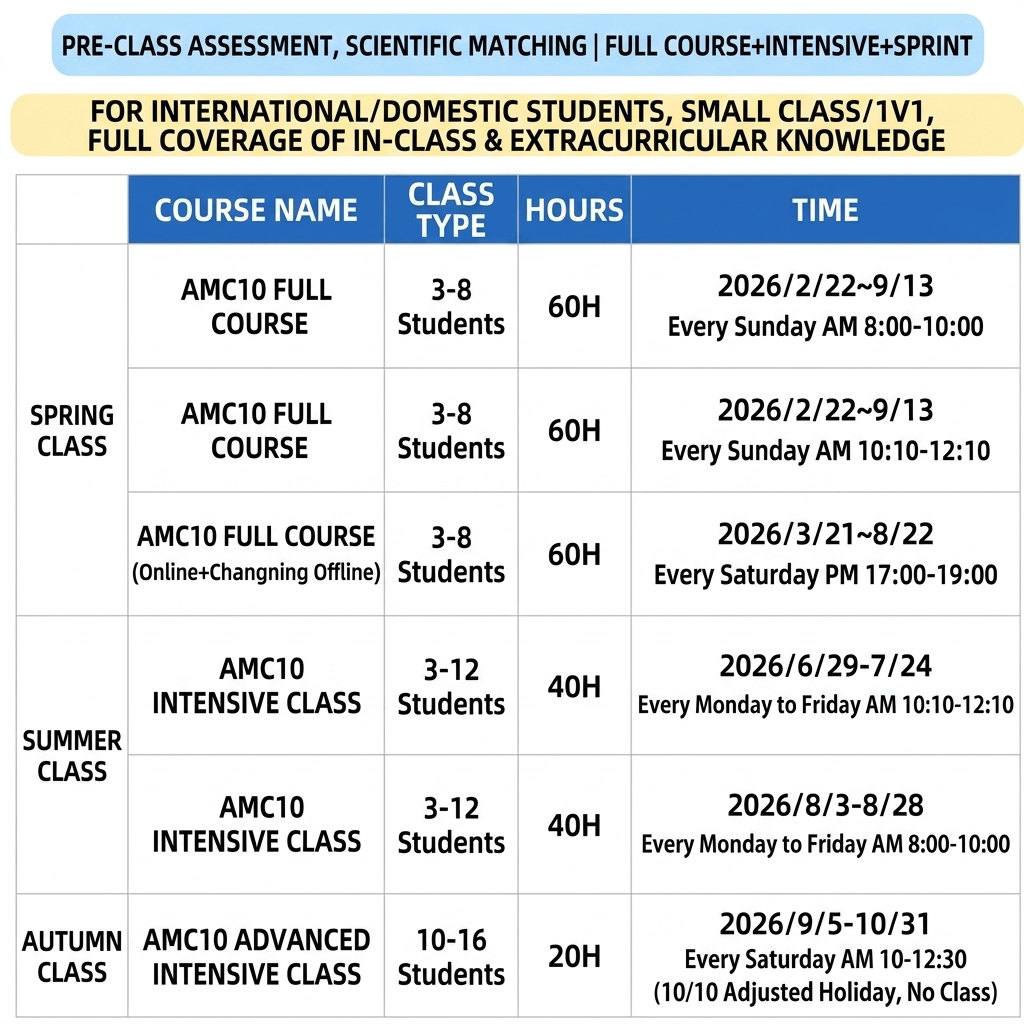
AMC10 Preparation Courses
Our instructors are graduates from top global universities. With precise curriculum planning and comprehensive learning tracking, we ensure your score improvement and award-winning success!
| Class Type | Hours | Class Size | Start Date |
|---|---|---|---|
| Winter Break Class | 30H | 3–8 students | Consult teacher for details |
| Systematic Course | 20H | 1v1 / 3–8 students | Consult teacher for details |
| Problem-Solving Class | 20H | 1v1 / 3–8 students | Consult teacher for details |