
As one of the most influential high school math competitions globally, the AMC 10 is known for its broad coverage, strong gradient, and deep thinking requirements. To secure a high score within the 75-minute time limit, you must accurately master the distribution of high-frequency topics and develop a personalized preparation timeline based on your foundation and target score.

I. Detailed Explanation of High-Frequency AMC 10 Topics (by Module)
The AMC 10 consists of 25 questions with a stepwise difficulty increase: Questions 1–10: Basic Questions (curriculum extensions), Questions 11–20: Intermediate Questions (requiring technique and synthesis), Questions 21–25: Difficult Questions (competition-level thinking, often testing number theory/combinatorics). The following are the seven core modules and their key test points, based on an analysis of past five years' past papers:
1. Comprehensive Algebra
Core content: Quadratic functions, equations and inequalities, sequences, polynomials, multiplication formulas, and identity transformations.
High-frequency difficulties: Polynomial divisibility problems; simplification of symmetric expressions; substitution methods; constructing equations.
Advice: At least 6–8 questions in the first 15 are from algebra—key to securing your score!
2. Functions and Coordinate Geometry
Core content: Properties of linear/quadratic function graphs; equations of circles; coordinate transformations; area calculation of polygons.
Problem-solving tools: Shoelace formula (quickly calculates the area of any polygon); Pick's theorem (area of lattice polygon A = I + B/2 - 1).
Note: Function questions are often combined with geometry and appear in the 16–22 question range.
3. Comprehensive Plane Geometry
Core content: Triangles, quadrilaterals and polygons, trigonometric functions.
Area methods: Partition-complement method, equal-area transformation, common side theorem.
Key skills: Drawing auxiliary lines (e.g., altitudes, midpoints, constructing similar shapes); recognizing hidden conditions (e.g., "isosceles triangle," "right angle").
Tip: Geometry questions often appear in the 10–20 range and are key for differentiating scores in the middle segment.
4. Circles and Solid Geometry
Core content: Circle properties: inscribed angles, chord-tangent angles, perpendicular chord theorem, intersecting chords theorem; Solid geometry: Volume and surface area of rectangular prisms, prisms, cylinders, cones; Euler's formula (V - E + F = 2, occasionally seen in challenging problems).
Difficulties: Spatial visualization ability (especially for solid net diagrams); multiple points concyclic on a circle; angle transformation.
Trend: In recent years, circle problems have placed greater emphasis on comprehensive application, often combining trigonometry and algebra.
5. Combinatorics
Core content: Addition principle and multiplication principle; permutations (ordered) vs. combinations (unordered); special models: path counting, coloring problems, round-robin tournament systems.
Common errors: Double counting or omissions; considering order or not (e.g., "select 3 people to form a team" vs. "select 3 people to sit in a row").
Techniques: Drawing tree diagrams, case analysis, reverse exclusion (inclusion–exclusion principle).
6. Probability and Statistics
Core content: Classical probability (equally likely events); geometric probability (ratio of length/area/volume); conditional probability ("given that… find…" type problems); expected value (occasionally seen in recent years).
High-frequency scenarios: Rolling dice, drawing cards, random walks, game outcomes.
Key point: Conditional probability is a frequent guest in difficult problems (e.g., 2023 AMC 10B Question 24).
7. Number Theory
Core content: Divisibility, congruences, digit problems, parity, floor function [x], defined new operations.
Typical position: Appears frequently in questions 21–25, key to distinguishing the top 1%!
Difficulty: Requires flexible problem transformation (e.g., converting "last two digits are the same" to a congruence modulo 100 problem).
II. How Long Does It Take to Prepare for the AMC 10? – Planning Based on Foundation and Target Score
|
Student Type
|
Math Foundation Characteristics
|
Recommended Preparation Cycle
|
Core Tasks
|
|---|---|---|---|
|
Weak Foundation
|
No systematic junior high competition training; high school algebra/geometry not completed
|
6–12 months
|
1. Supplement core junior high competition topics (number theory/combinatorics)
2. Complete high school compulsory 1–2 3. Begin AMC 10 topic-specific training |
|
Average Foundation
|
Completed high school curriculum; some competition exposure
|
3–6 months
|
1. Strengthen the four major AMC 10 modules
2. Categorized practice with past papers (focus on questions 1–20) 3. Build problem-solving templates |
|
Solid Foundation
|
Award in AMC 8/junior high league competition; comprehensive high school knowledge
|
1–3 months
|
1. Focus on difficult questions 21–25
2. Summarize high-frequency techniques (e.g., symmetry, extreme principle) 3. Timed mock exams to maintain proficiency |
Preparation Depth Based on Target Score
|
Target
|
Score Range
|
Required Ability
|
Recommended Cycle
|
|---|---|---|---|
|
Experience Participation
|
70–90 points
|
Master the first 15 basic questions
|
1–3 months
|
|
Top 25% (AIME Threshold)
|
95–110 points
|
Stably complete the first 20 questions, some of questions 21–23
|
3–6 months
|
|
Top 5% (Honor Roll)
|
≥120 points
|
Comprehensive mastery of all modules, ability to solve questions 24–25
|
6–12 months
|
|
Top 1% (Distinguished Honor Roll)
|
≥135 points
|
Competition-level thinking, high speed and accuracy
|
8–12+ months of long-term accumulation
|
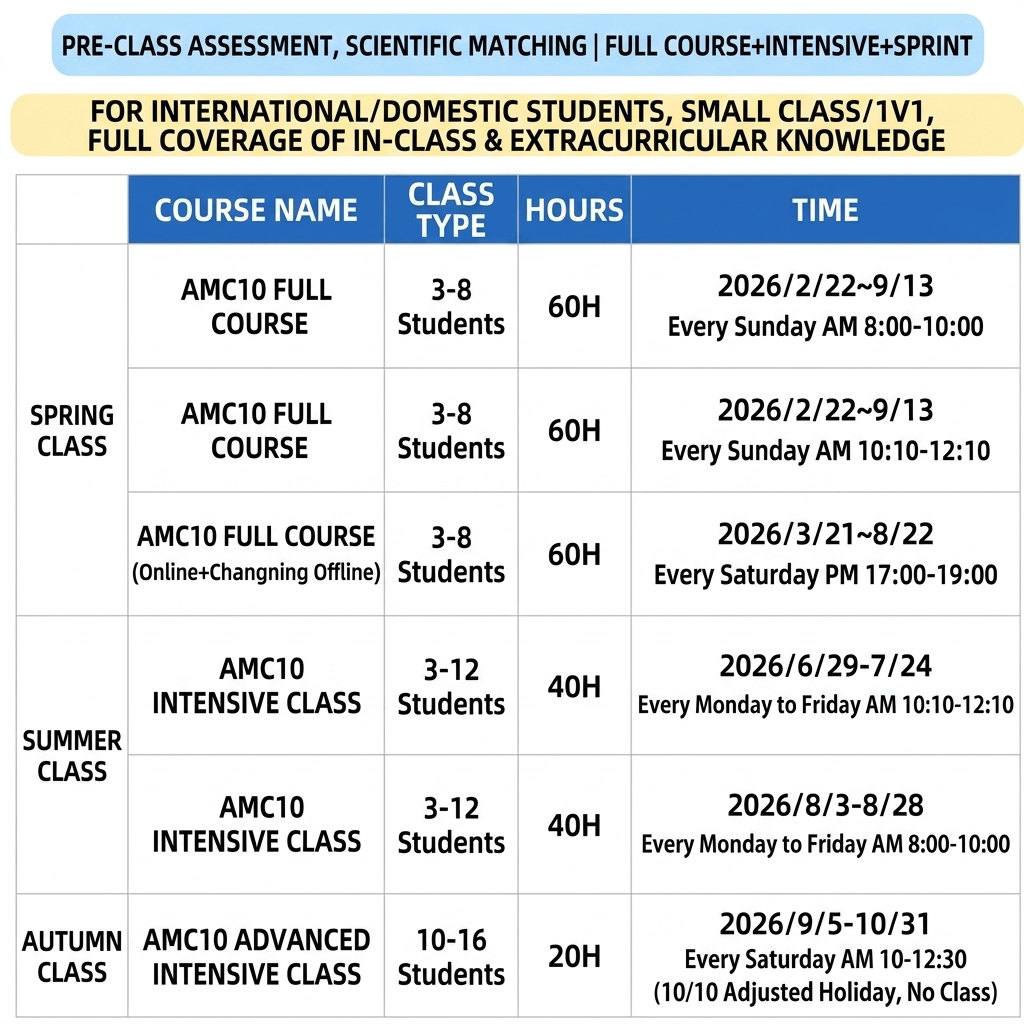
For more information about AMC 10/12 competition courses, please contact us.
AMC10 Preparation Courses
Our instructors are graduates from top global universities. With precise curriculum planning and comprehensive learning tracking, we ensure your score improvement and award-winning success!
| Class Type | Hours | Class Size | Start Date |
|---|---|---|---|
| Winter Break Class | 30H | 3–8 students | Consult teacher for details |
| Systematic Course | 20H | 1v1 / 3–8 students | Consult teacher for details |
| Problem-Solving Class | 20H | 1v1 / 3–8 students | Consult teacher for details |