
What Are the Main Differences Between AMC10 Version A and Version B? How Long Does an Average Student Need to Prepare for AMC10 to Win an Award? AMC10 Module-Specific Breakthrough Tips & Answering Strategies!

The AMC10 Math Competition not only assesses students' breadth of mathematical knowledge but also tests their problem-solving speed and depth of thinking. Through scientific planning and systematic preparation, even average students can achieve excellent results in this high-level competition.

I. Main Differences Between AMC10 Version A and Version B

1. Different Exam Dates

Version A: November 6, 2025 (Thursday) 17:00-18:15 (75 minutes)

Version B: November 14, 2025 (Friday) 17:00-18:15 (75 minutes)

Typically, the AMC10 Version A exam is held about one week earlier than Version B.

2. Slight Differences in Knowledge Point Proportions

Although both versions cover roughly the same knowledge points—Algebra, Geometry, Combinatorics, and Number Theory—their emphases differ. Version A focuses more on mathematical applications and computational problem-solving, while Version B places greater emphasis on a balanced assessment across various mathematical areas.

3. Different Cutoff Scores

The cutoff scores for advancing to AIME do not differ much between Version A and Version B. However, for the top 1% cutoff, there may be significant fluctuations between the two versions.

推荐

II. How to Choose Between Version A and Version B?

Take Both Versions: If time permits, it is recommended that students take both the A and B versions. This not only increases the chances of winning an award but also allows you to better prepare for the second exam using the experience gained from the first.

Can Only Take One Exam: It is recommended to register for Version B. This way, after Version A is completed, you can use the actual past paper to familiarize yourself with the question types, thereby increasing your chances of achieving a high score on Version B.

III. How Long Does an Average Student Need to Prepare for AMC10 to Win an Award?

Based on different foundational levels, average students can refer to the following timeline to prepare for AMC10 and gradually improve to reach their award goals.

January to May (Foundation Period)

For students with no prior experience or a weaker foundation, this is a critical period to systematically master the core knowledge points of AMC10. Lower-grade students, in particular, need to supplement and solidify their foundational knowledge.

Goal: Solve over 1,000 foundational problems and establish a mistake notebook.

June to August (Intensive Period)

After mastering the basics, you need to flexibly apply this knowledge to solve complex problems. Achieve this by working through a large number of problems, promptly organizing mistakes, and repeatedly tackling weak areas.

Goal: Work through past papers from 2018 to 2025, summarize problem-solving models, and conquer intermediate-level questions.

September to November (Sprint Period)

This is the final sprint phase. Focus on breaking through key and difficult points, reviewing and organizing knowledge, and repeatedly training on mistakes. Additionally, do not neglect mock exams and time management training.

Goal: Conduct 1-2 full mock exams per week and optimize time allocation.

推荐

IV. Preparation Tips

Foundation Period: Systematically learn the four major modules, solve over 1,000 foundational problems, and establish a mistake notebook.

Intensive Period: Work through recent years' past papers, summarize problem-solving models, and conquer intermediate-level questions.

Sprint Period: In the two weeks before the exam, review mistakes, focus on techniques for the final challenging questions, and adjust your answering pace.

V. Competition Module-Specific Breakthrough Tips

Algebra: Master polynomial transformations, Vieta's formulas, mean inequalities, etc. Improve speed in calculation and symbolic derivation.

Geometry: Deeply understand the Power of a Point theorem, similar triangles, solid geometry sections and volume calculations, etc. Practice constructing auxiliary lines.

Number Theory: Strengthen understanding of modular arithmetic and congruences. Master factorization and recursive thinking. Avoid missing cases when using casework.

Combinatorics: Proficiently use the Inclusion–Exclusion Principle and probability modeling. Use extremal principles and recursion to solve complex counting problems.

推荐

VI. Answering Strategies

Easy First, Hard Later: Don't dwell on difficult questions; ensure you score points on easy and intermediate-level questions.

Organize Scratch Paper by Sections: Keep steps clear for easy review. For geometry problems, draw diagrams to aid thinking. For number theory problems, first try small numbers to find patterns.

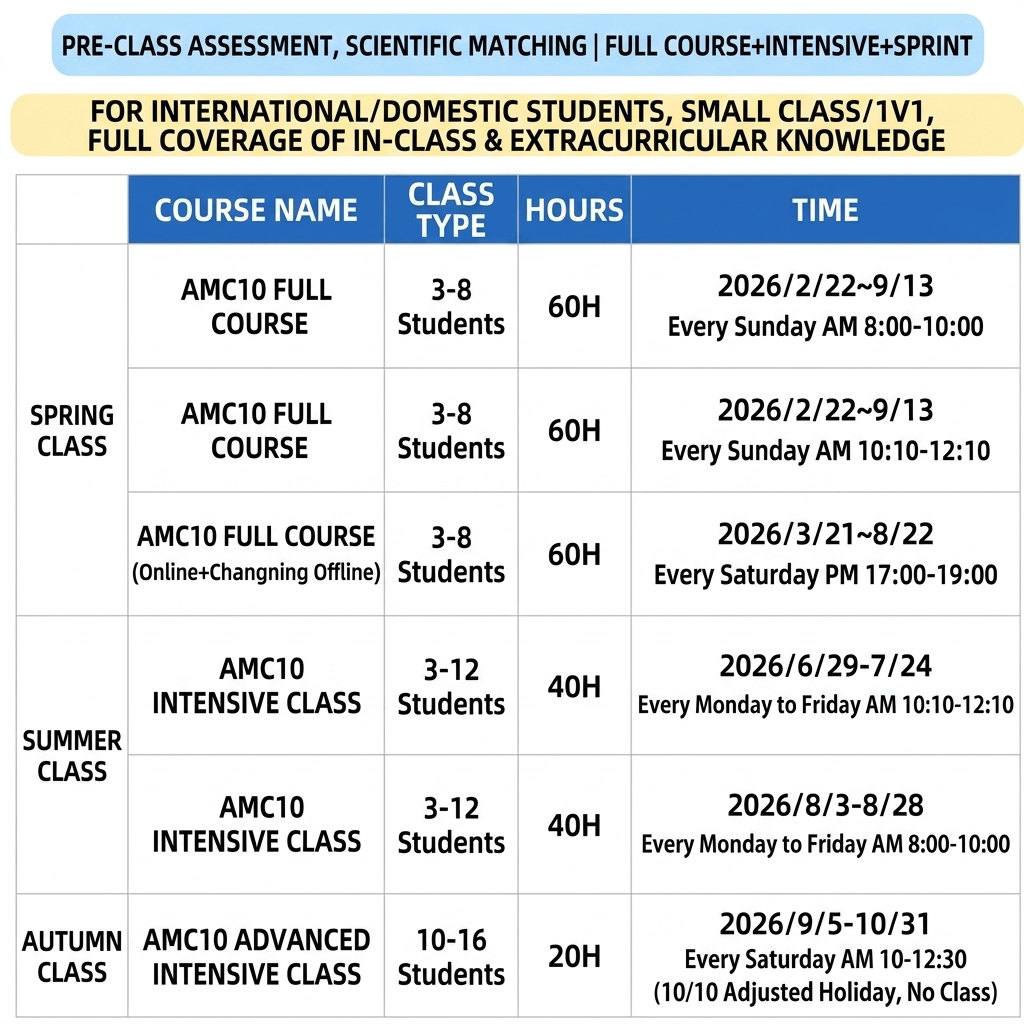
AMC10 Tutoring Courses

Our instructors are graduates of top universities worldwide, providing precise curriculum planning and full-course learning tracking to ensure you improve and win awards!

Class Type
Hours
Class Size
Start Date
Winter Break Class
30H
3–8 students
Consult teacher for details
Systematic Course
20H
1v1 / 3–8 student class
Consult teacher for details
Problem-Solving Class
20H
1v1 / 3–8 student class
Consult teacher for details

For more information about AMC10/12 competition courses, please contact us.
推荐

One Article Clarifies the Difficulty Distribution of the Four Major Knowledge Modules in the AMC10 Math Competition!

The AMC10, a math competition designed by the Mathematical Association of America (MAA) for students in grade 10 and below, aims to assess students' mathematical thinking and problem-solving abilities. Its knowledge coverage is broad, with clear layers of difficulty, requiring test-takers to solve problems efficiently within a limited time. The following is an analysis of the difficulty of the four major modules—Algebra, Geometry, Number Theory, and Combinatorics—along with preparation strategies.

推荐

I. Algebra Module (35%-40%)

1. Basic Level Topics (Easy Points)

Solving quadratic equations and discriminant analysis

Properties of linear/quadratic function graphs

Simple sequences (arithmetic/geometric)

Percent and ratio calculations

2. Intermediate Level Topics (Key to Improving Scores)

Absolute value and fractional inequalities

Recursive formulas for sequences

Polynomial factorization (grouping/cross multiplication)

Basic operations with complex numbers

3. Hard Level Topics (Core for High Scores)

Relationship between polynomial roots and coefficients (advanced Vieta's formulas)

Function iteration and composition

Scaling techniques for inequalities

Comprehensive application of parametric equations

Preparation Strategies

Must get full marks on basic questions: Ensure all basic questions are answered correctly.

Proficiently master problem-solving templates for intermediate questions: Through extensive practice, master problem-solving approaches for common question types.

Selectively tackle hard questions: Prioritize the accuracy of the first 20 questions; hard questions can be managed based on time constraints.

II. Geometry Module (25%-30%)

1. Basic Level Topics (Easy Points)

Perimeter and area calculations of triangles and quadrilaterals

Pythagorean theorem

Basic properties of similar triangles

Surface area and volume of solid geometry

2. Intermediate Level Topics (Key to Improving Scores)

Properties of circles (inscribed angles, tangents, chord-tangent angles)

Introduction to the five centers of a triangle

Geometric transformations (translation/reflection)

Coordinate geometry calculations

3. Hard Level Topics (Core for High Scores)

Comprehensive application of the power of a point theorem

Cross-sections and spatial angle calculations in solid geometry

Geometric constructions (auxiliary line techniques)

Advanced trigonometry (sum and difference formulas)

Preparation Strategies

Memorize geometric models: Such as cyclic quadrilateral models, similarity models, to improve recognition and application ability.

Practice drawing auxiliary lines for intermediate questions: Master the skill of constructing auxiliary lines through extensive practice.

Focus on spatial imagination and logical deduction for hard questions: Cultivate spatial visualization and logical reasoning skills.

推荐

III. Number Theory Module (20%-25%)

1. Basic Level Topics (Easy Points)

Divisibility, factors, and multiples

Prime and composite numbers

Greatest Common Divisor (GCD) and Least Common Multiple (LCM)

Base conversion (decimal to binary/hexadecimal)

2. Intermediate Level Topics (Key to Improving Scores)

Basic applications of congruence theorems: Understand the concept of congruence and its basic properties.

Introduction to Fermat's Little Theorem: Master the basic form and applications of Fermat's Little Theorem.

Digit characteristics: Understand the digit characteristics of numbers and their applications.

Formula for the number of factors: Proficiently use the formula to calculate the number of factors.

3. Hard Level Topics (Core for High Scores)

Solving indefinite equations (Diophantine equations)

Comprehensive applications of Euler's theorem

Number theory constructions and proofs

Complex operations in base conversion

Preparation Strategies

Requires specialized breakthrough due to limited exposure in class: Since number theory content is rarely covered in domestic curricula, dedicated study and practice are needed.

Basic and intermediate questions offer high cost-performance, prioritize mastering them: Basic and intermediate number theory questions are relatively easy to score and should be a review focus.

Hard questions are suitable for students targeting AIME to delve deeper: Students aiming for AIME need to intensively study number theory hard questions.

IV. Combinatorics Module (10%-15%)

1. Basic Level Topics (Easy Points)

Basic counting (addition/multiplication principles)

Simple probability calculations

Basic set operations

2. Intermediate Level Topics (Key to Improving Scores)

Permutation and combination problems with constraints (e.g., adjacent/not adjacent)

Recursive counting

Basic Inclusion–Exclusion Principle

Advanced classical probability

3. Hard Level Topics (Core for High Scores)

Complex applications of the Inclusion–Exclusion Principle

Combinatorial constructions and extremal problems

Expected value in probability

Competition-style combinatorial techniques (e.g., advanced pigeonhole principle)

Preparation Strategies

Ensure points on basic questions: Ensure all basic questions are answered correctly.

Summarize question patterns for intermediate questions: Through extensive practice, summarize problem-solving patterns for common question types.

Hard questions are flexible; consider skipping them if time is limited: For hard questions, decide based on time and actual circumstances.

推荐

V. AMC10 Math Competition Preparation Tips

1. Basic and intermediate questions account for over 80%; mastering the first 20 questions secures a high score: The first 20 questions are key to achieving a high score; ensure the highest possible accuracy. The core to advancing to AIME is getting all intermediate questions correct; the score on intermediate questions directly affects qualification.

2. Number Theory and Combinatorics are key modules for distinguishing performance: Especially number theory, as a "characteristic difficulty" of the AMC10. Since number theory content is rarely covered in domestic curricula, targeted reinforcement is needed. Combinatorics problems are highly flexible; summarize question patterns through extensive practice.

3. Overall Preparation Strategy

Systematically study the core knowledge points of the four major modules.

Solve over 1000 basic problems and maintain an error notebook.

Reinforce with past papers to become familiar with question types and improve speed and accuracy.

Conduct full mock exams weekly to optimize time allocation and adjust answering pace.

AMC10 Tutoring Courses

Our instructors are graduates of top universities worldwide, providing precise curriculum planning and full-course learning tracking to ensure you improve and win awards!

Class Type
Hours
Class Size
Start Date
Winter Break Class
30H
3–8 students
Consult teacher for details
Systematic Course
20H
1v1 / 3–8 student class
Consult teacher for details
Problem-Solving Class
20H
1v1 / 3–8 student class
Consult teacher for details

For more information about AMC10/12 competition courses, please contact us

推荐

Online Customer Service
Contact Customer Service