
The AMC10 is an internationally authoritative math competition sponsored by the Mathematical Association of America (MAA) for students in grade 10 and below. In recent years, its popularity has soared—not only because it serves as a springboard to higher-level competitions (such as AIME, USAMO), but also because it has become a "hard currency" for applying to top global universities and entering domestic elite science classes. This article will systematically answer: ✅ What is AMC10? ✅ Why is it so highly regarded? ✅ Why is top 1% (DHR) so difficult to achieve? ✅ How should beginners prepare scientifically?

I. AMC10 Basic Information at a Glance
| Item | Details |
|---|---|
| Organizer | Mathematical Association of America (MAA) |
| Target Participants | Grade 10 and below, age ≤ 17.5 |
| Exam Date | November each year (A and B sessions, choose either or both) |
| Duration | 75 minutes |
| Question Type & Scoring | 25 multiple-choice questions Correct: +6 points | Omitted: +1.5 points | Wrong: 0 points Total: 150 points |
| Language | Bilingual Chinese-English test paper (extremely friendly to Chinese students) |
| Core Modules | Algebra, Geometry, Number Theory, Combinatorics (the four pillars; number theory/combinatorics have increased share in recent years) |
II. Why Do So Many People Participate? The Five Core Values of AMC10
1. The "Golden Key" to Ivy League & G5
Recent admission data shows: over 45% of Ivy League/Oxbridge engineering and science admits have AMC participation experience; MIT, Stanford, Cambridge, and others explicitly value AMC/AIME scores in the Common App; AMC10 top 1% (DHR) ≈ an international math proficiency certification, far surpassing ordinary high school grades.
2. A Screening Tool for Domestic Elite High School "Science Classes"
No.2 High School of East China Normal University, Shanghai High School, Fudan University High School: AMC10 score of 110+ can lead to direct interview; Qibao High School, Jianping High School, Nanyang Model High School: top 25% (approx. 100 points) get priority in independent enrollment, with some "score cut-off equals admission"; Guanghua Cambridge International School's entrance exam: Question 9 directly uses an original AMC10 problem; even World Foreign Language School tests up to AMC12 difficulty.
3. The "First Building Block" of the International Competition Pyramid
Top 2.5% (approx. 103–110 points) → qualifies for AIME; high AIME scores → USAMO → IMO national team; AMC10 is the starting point to IMO and a necessary path for most international competition participants.
4. Skill Enhancement: Highly Aligned with IB/AP/A-Level
The problems emphasize logical reasoning, modeling skills, and creative problem-solving; highly overlapping in content with IB Math AA/AI, AP Calculus, and A-Level Further Math; preparation can feed back into school grades, achieving a "competition + coursework" win-win.
5. Globally Recognized, Certificate Valid for Life
Officially issued by the MAA, widely recognized by global universities, summer schools, and research programs; a high score serves as a lifelong proof of academic ability.
III. Why Is Top 1% (DHR) So Hard?
1. Immense Time Pressure
75 minutes / 25 questions = average 3 minutes per question; the first 15 questions need to be completed within 30 minutes, leaving sufficient time for the last 10 questions (especially the challenging 21–25); beginners often fail to even look at the challenging questions due to slow reading, slow calculation, or indecision.
2. Intense Global Competition
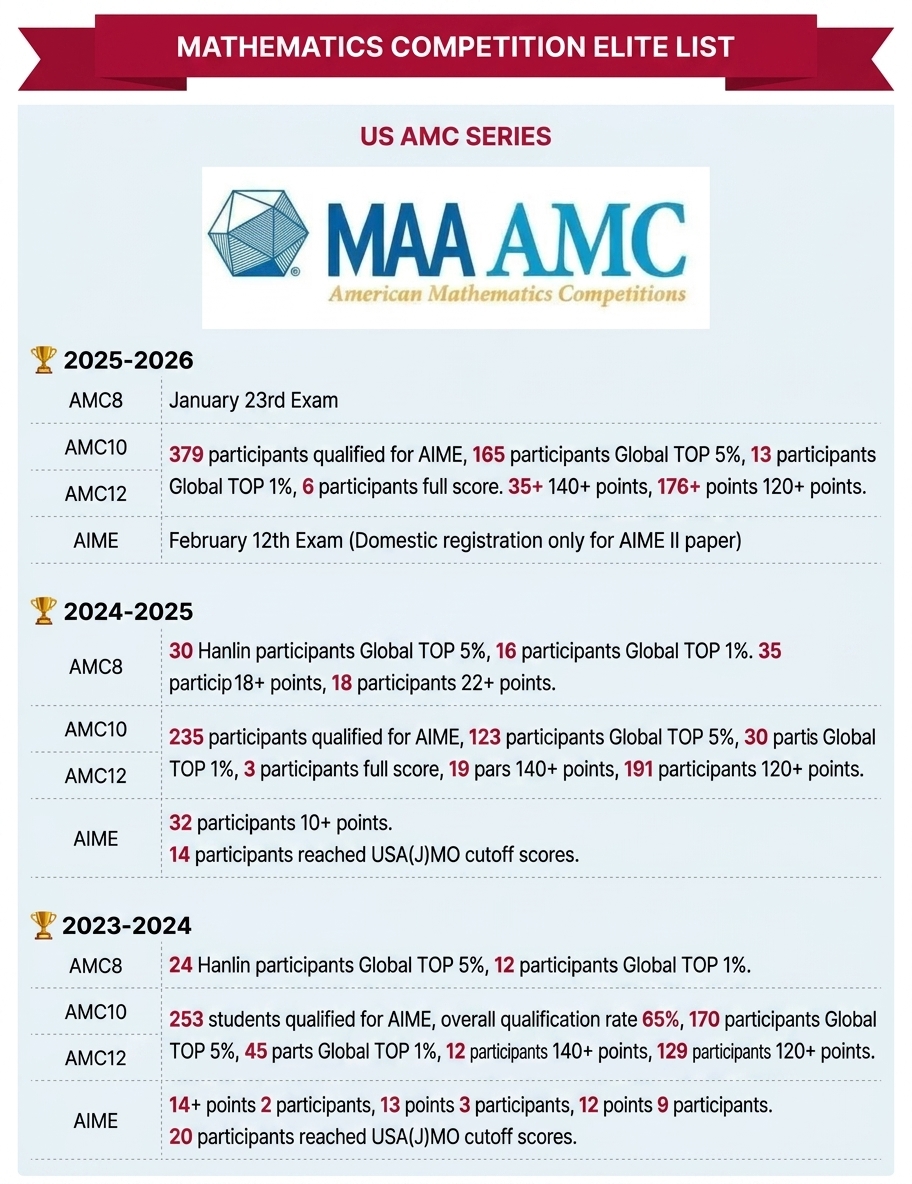
Over 30,000 participants globally each year, but only about 300 achieve top 1%; students from China, South Korea, India, and elsewhere are systematically trained—the era of taking the test unprepared is over; cutoff scores are rising: DHR has stabilized at 130+ points (out of 150) in recent years.
3. Dense Problem Traps
AMC10 is known for being "deceptively simple, but hiding pitfalls": unit confusion, ignoring boundary conditions, graphic misdirection (non-standard diagrams). Many students "feel they got it right, but the answer is wrong," fundamentally due to shallow understanding and imprecise thinking.
4. Extremely Low Margin for Error
130 points ≈ at most 1–2 mistakes; moreover, at least 3–4 of questions 21–25 must be correct (each worth 6 points, determining DHR qualification); this means not only must the foundation be solid, but advanced thinking must be exceptionally strong.
IV. Award Categories and Cutoff Score Reference (Recent Trends)
| Award | Requirement | Cutoff Score (Reference) |
|---|---|---|
| Perfect Score | 150 points | Very few |
| Distinguished Honor Roll (DHR) | Top 1% | ≥130 points |
| Honor Roll | Top 5% | ≥103–110 points |
| Achievement Roll | Grade 8 or below & ≥90 points | — |
Key Tip: AIME qualification threshold ≈ top 2.5% ≈ 103–110 points (adjusted slightly each year); DHR (top 1%) is the "hardcore indicator" truly valued by top universities.
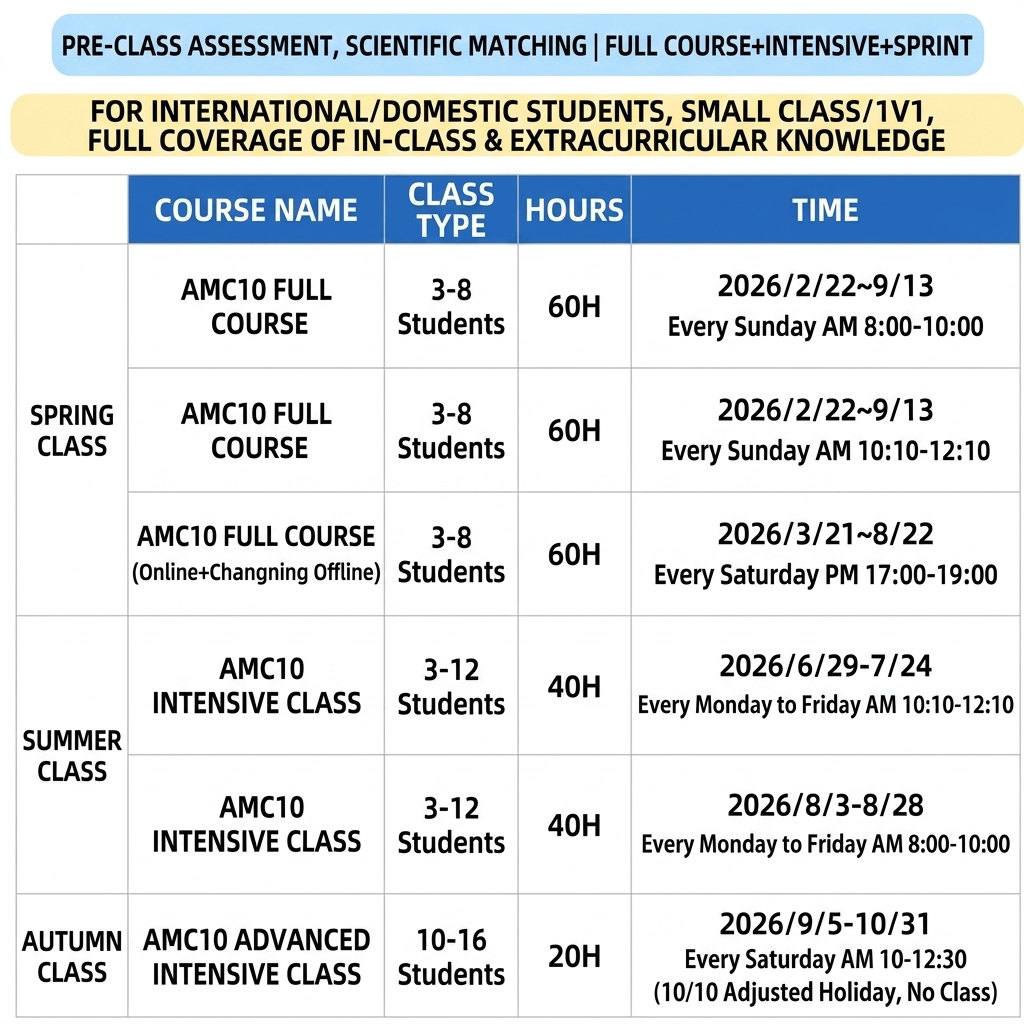
AMC10 Preparation Courses
Our instructors are graduates from top global universities. With precise curriculum planning and comprehensive learning tracking, we ensure your score improvement and award-winning success!
| Class Type | Hours | Class Size | Start Date |
|---|---|---|---|
| Winter Break Class | 30H | 3-8 students | Consult teacher for details |
| Systematic Course | 20H | 1v1 / 3-8 students | Consult teacher for details |
| Problem-Solving Class | 20H | 1v1 / 3-8 students | Consult teacher for details |
AMC 10 Tutoring Course
All instructors are graduates from top global universities. With tailored curriculum planning and full-process learning tracking, we provide comprehensive support to help students boost scores and win awards!