The AMC10 is an international mathematics competition organized by the Mathematical Association of America (MAA), open to students in grade 10 and below. Its examination content covers all mathematics knowledge points from middle school to the first year of high school, and raises higher requirements in certain areas (such as number theory and combinatorics). This article will analyze in detail the knowledge point distribution, difficulty levels, and preparation strategies for the AMC10, helping you scientifically plan your preparation path.

Comprehensive Organization of AMC10 Knowledge Points
1. Required Knowledge Points (Key Mastery)
Algebra
Algebraic calculation techniques: factorization, substitution method, expansion, etc.;
Linear functions and equations: linear equations systems, slope-intercept form;
Absolute value and floor functions: absolute value inequalities, floor operations;
Sequences: arithmetic sequences, geometric sequences and their applications;
Quadratic functions and equations: quadratic formula, Vieta's formulas, discriminant.
Geometry
Geometric transformations: translation, rotation, symmetry;
Geometric properties of circles: tangents, secants, arc length, inscribed angles;
Similar triangles: proportional relationships, similarity criteria;
Lines and circles: intersection, tangency, distance formula.
Number Theory
Congruence: modular arithmetic, congruence equations;
Divisibility: prime factorization, greatest common divisor (GCD), least common multiple (LCM);
Prime factorization: primality testing, fundamental theorem of arithmetic;
Base conversion: conversion between binary, decimal, and hexadecimal systems.
Combinatorics
Permutations and combinations: basic counting principles, permutation and combination formulas;
Probability fundamentals: classical probability, conditional probability;
Inclusion-exclusion principle: union, intersection, and complement in set operations;
Recurrence relations: Fibonacci sequence, dynamic programming concepts.
2. Distribution of Common Error Points (By Module)
Algebra
Application problem comprehension: pay attention to unit conversion and implicit conditions;
Solving absolute values: consider multiple solution cases;
Exponential and logarithmic calculations: special handling when the base is a fraction or negative.
Geometry
Finding equal angles in congruent/similar triangles: construct auxiliary lines, use properties of parallelograms;
Cutting and augmenting figures: partitioning and reorganizing complex figures;
Plane geometry spatial imagination skills: develop spatial sense, 3D geometry projections.
Counting
Distinguishing between permutations and combinations: avoid double counting, understand the meaning of combinations;
Application of recurrence relations: Fibonacci sequence, dynamic programming thinking.
Number Theory
Prime factorization: quickly determine primality;
Last digit problems: patterns of last digits, periodicity analysis.
Probability
Discrete probability: event independence, mutually exclusive events;
Geometric probability: area ratios, length ratios, volume ratios.
Distribution and Difficulty Levels of AMC10 Questions
1. Basic Questions (Questions 1-8)
Lower difficulty, covering basic knowledge points in algebra, geometry, and number theory;
Goal: Get all correct, ensuring accuracy and speed to save time for later difficult questions.
2. Relatively Easy Questions (Questions 9-13)
Slightly increased difficulty, mainly reflected in the trap designs in the problem statements;
Requires careful reading by students; this section is also conquerable by most students.
3. Medium Difficulty Questions (Questions 14-17)
This is the dividing line and the key to entering the top 1%;
For G8 and below students, answering 15 questions correctly is excellent; for G9+ students, focus on conquering this section, aiming for all correct.
4. Relatively Difficult Questions (Questions 18-23)
More challenging; besides basic techniques, introduces advanced concepts like linear functions, quadratic equations, probability and statistics;
Key focus area for those aiming for the top 5% and the AIME qualification line.
5. Difficult Questions (Questions 24-25)
The truly difficult area, requiring deep knowledge and high mental agility;
Only a very small number of students can solve them; students aiming for a perfect score can focus on breaking through these.
AMC10 Preparation Time Planning and Strategies
1. Foundation Consolidation Phase (Recommended 6-8 months in advance)
Goal: Systematically organize knowledge points from various AMC10 sections, expanding on the basis of school mathematics;
Method:
- Beginners and lower-grade students: Spend at least six months building a solid foundation;
- Review school knowledge: Ensure no significant weaknesses in the four major modules: Algebra, Geometry, Number Theory, Combinatorics;
- Supplement competition-specific content: such as congruence equations in number theory, recurrence relations in combinatorics, etc.
2. Practice Phase (3-4 months before the exam)
Goal: Improve problem-solving speed and accuracy through practice with past papers;
Method:
- Study past papers: Familiarize yourself with the application of each knowledge point in the exam;
- Connect knowledge sections: Train flexible problem-solving approaches;
- Accumulate mistakes: Conquer your own challenging problems.
3. Sprint Phase (1-2 months before the exam)
Goal: Simulate the real exam environment, optimize time allocation and test-taking strategies;
Method:
- Take timed mock exams: Simulate the real exam process, control time allocation;
- Strategy optimization: Adjust the order of attempting questions based on mock results, develop a "gain maximization" strategy;
- Psychological adjustment: Maintain a good mindset to avoid unnecessary errors due to nervousness.
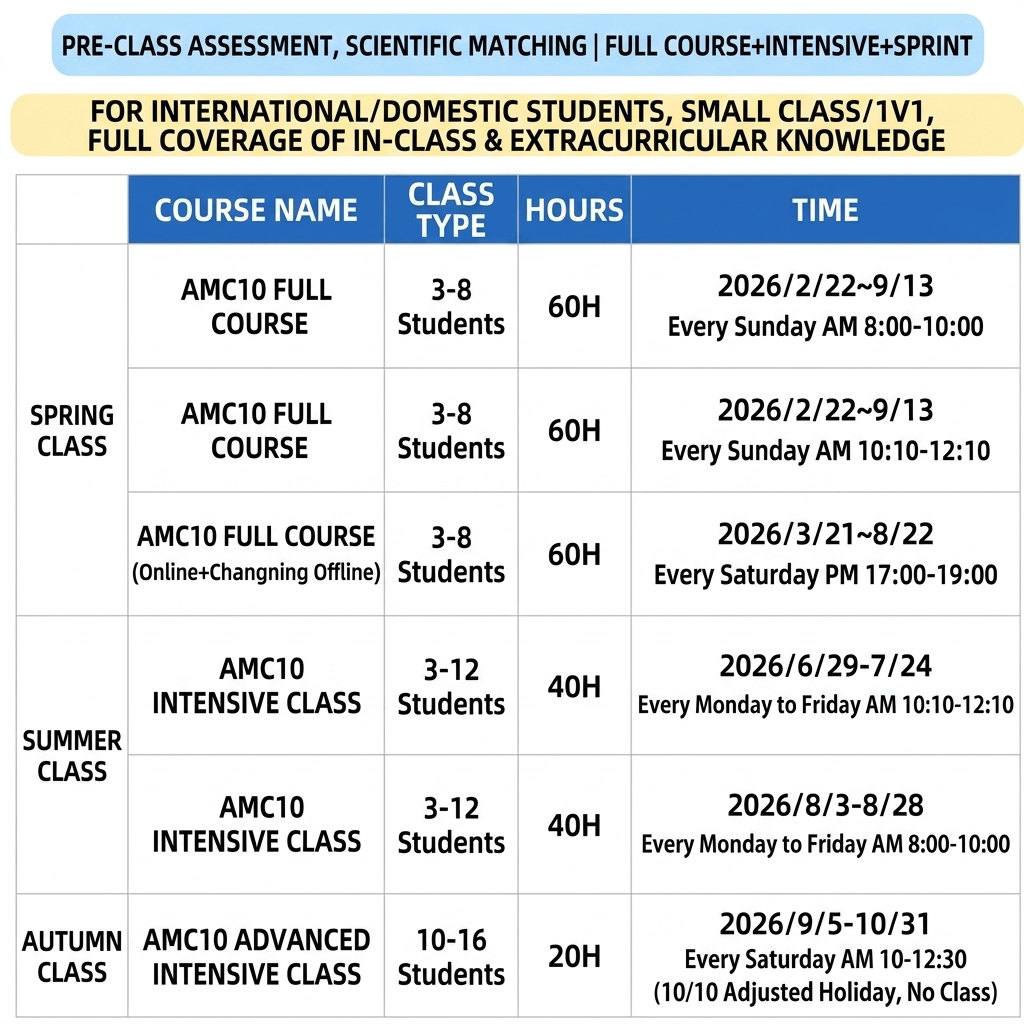
AMC 10 Tutoring Course
All instructors are graduates from top global universities. With tailored curriculum planning and full-process learning tracking, we provide comprehensive support to help students boost scores and win awards!