AMC 10 Resources: Books, Websites, and Tools for Preparation

Library study resources

Success on the AMC 10 requires more than just natural mathematical ability—it requires access to the right resources and the discipline to use them effectively. With countless books, websites, apps, and tools available, it can be overwhelming to know where to start. This comprehensive guide will walk you through the best resources for AMC 10 preparation, organized by type, difficulty level, and learning style.

推荐

The Importance of Quality Resources

Before diving into specific resources, it's important to understand why quality matters. The AMC 10 tests not just your knowledge of mathematical concepts, but also your ability to apply them creatively and efficiently. High-quality resources will:

Teach you problem-solving techniques, not just facts

Provide progressively challenging problems

Offer detailed solutions and explanations

Help you identify and improve weak areas

Simulate the actual test experience

Study materials and books

Essential Books for AMC 10 Preparation

The Art of Problem Solving Series

The Art of Problem Solving (AoPS) series is widely considered the gold standard for math competition preparation. Written by Richard Rusczyk, a former USA Mathematical Olympiad winner, these books are comprehensive, well-organized, and filled with challenging problems.

Art of Problem Solving, Vol. 1: The Basics

Best for: Beginners and intermediate students

Content:

Algebra: Linear equations, quadratics, polynomials, inequalities

Geometry: Triangles, circles, coordinate geometry, area and volume

Number Theory: Divisibility, primes, modular arithmetic

Combinatorics: Counting, probability, permutations and combinations

Why it's great: Clear explanations, progressive difficulty, hundreds of practice problems with solutions

Art of Problem Solving, Vol. 2: and Beyond

Best for: Advanced students aiming for top scores

Content: More advanced topics in algebra, geometry, number theory, and combinatorics

Why it's great: Bridges the gap between AMC 10 and AMC 12/AIME

Introduction to Algebra

Best for: Students who need to strengthen their algebra foundation

Content: Comprehensive coverage of algebra topics with competition-style problems

Introduction to Geometry

Best for: Students who need to strengthen their geometry foundation

Content: Detailed geometry coverage with emphasis on problem-solving

Introduction to Number Theory

Best for: Students new to number theory

Content: Fundamental number theory concepts with AMC-style problems

Introduction to Counting & Probability

Best for: Students new to combinatorics

Content: Counting principles, probability, and combinatorial techniques

Other Highly Recommended Books

Competition Math for Middle School by J. Batterson

Best for: Younger students or those new to competition math

Content: Accessible introduction to competition-style problems

Why it's great: Gentle introduction, builds confidence

The Art and Craft of Problem Solving by Paul Zeitz

Best for: Advanced students

Content: Problem-solving strategies and techniques

Why it's great: Focuses on problem-solving approach rather than specific topics

101 Problems in Algebra by Titu Andreescu and Zuming Feng

Best for: Students wanting focused algebra practice

Content: 101 carefully selected algebra problems with detailed solutions

102 Combinatorial Problems by Titu Andreescu and Zuming Feng

Best for: Students wanting focused combinatorics practice

Content: 102 combinatorics problems with detailed solutions

Geometry Revisited by H.S.M. Coxeter and S.L. Greitzer

Best for: Students wanting deep geometry understanding

Content: Advanced geometry topics and theorems

Why it's great: Classic text, beautiful mathematics

Problem-Solving Strategies by Arthur Engel

Best for: Advanced students preparing for olympiad-level competitions

Content: Comprehensive problem-solving strategies

Why it's great: Extremely thorough, covers many advanced techniques

Collection of math books

Online Resources and Websites

Art of Problem Solving Website (artofproblemsolving.com)

The AoPS website is an invaluable resource for AMC 10 preparation. It offers:

Alcumus: Free adaptive learning system with thousands of problems

Forums: Active community where students discuss problems and solutions

Past AMC 10 Problems: Complete archive of past tests with solutions

Wiki: Comprehensive mathematical reference

Online classes: Live and recorded courses (paid)

Best feature: The forums allow you to see multiple solution approaches to the same problem

MAA's Official Website (maa.org/math-competitions)

The Mathematical Association of America's website provides:

Official AMC 10 information and registration details

Past problems and solutions (some free, some for purchase)

Test dates and locations

Eligibility requirements

Best feature: Official source for all AMC 10 information

Khan Academy (khanacademy.org)

While not specifically designed for AMC 10, Khan Academy offers:

Free video lessons on all AMC 10 topics

Practice exercises with instant feedback

Progress tracking

Personalized learning recommendations

Best feature: Excellent for building foundational knowledge

Brilliant.org

Brilliant offers interactive courses in mathematics, including:

Competition math courses

Interactive problem-solving

Visual explanations

Progress tracking

Best feature: Interactive, engaging approach to learning

Note: Requires subscription for full access

YouTube Channels

Several YouTube channels offer excellent math competition preparation:

Numberphile

Content: Engaging videos on various mathematical topics

Best for: Building mathematical curiosity and intuition

3Blue1Brown

Content: Beautiful visual explanations of mathematical concepts

Best for: Understanding geometric and algebraic concepts visually

Michael Penn

Content: Problem-solving videos, including AMC and AIME problems

Best for: Learning problem-solving techniques

Art of Problem Solving

Content: Official AoPS channel with problem-solving videos

Best for: Learning AoPS approaches to problems

Online learning resources

推荐

Practice Tests and Problem Collections

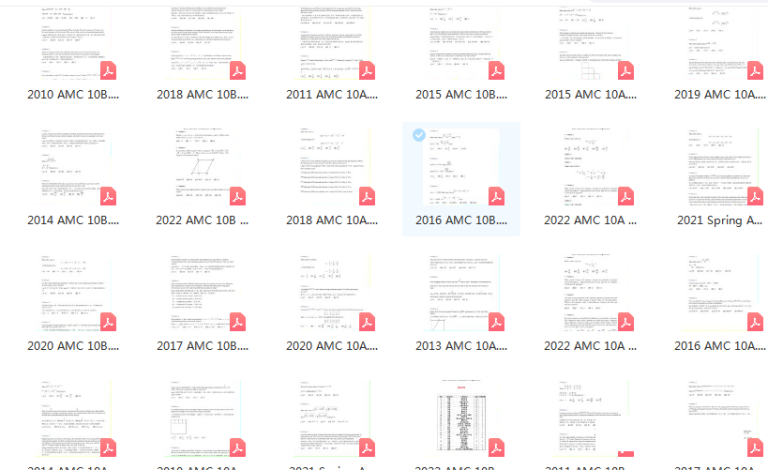
Past AMC 10 Tests

The most important resource for AMC 10 preparation is past AMC 10 tests. These are available from:

Art of Problem Solving website (free)

MAA website (some free, some for purchase)

Various math competition prep books

How to use them:

Start with older tests (2000-2010) when problems were generally easier

Progress to more recent tests (2011-present)

Take tests under timed conditions (75 minutes)

Review every problem, especially those you got wrong

Try to solve problems using multiple methods

AMC 10 Problem Collections

Several books compile AMC 10 problems by topic or year:

AMC 10 Practice Tests by Richard Rusczyk

Content: Full-length practice tests modeled after actual AMC 10

Best for: Simulating test conditions

The Art of Problem Solving's AMC 10 Preparation

Content: Curated problems from past AMC 10 tests, organized by topic

Best for: Focused practice on weak areas

Mobile Apps and Digital Tools

Math Apps

Photomath

Features: Scans and solves math problems, shows step-by-step solutions

Best for: Checking your work and understanding solution steps

Limitation: May not handle complex competition problems well

Wolfram Alpha

Features: Computational knowledge engine, solves complex problems

Best for: Verifying answers and exploring mathematical concepts

Note: Some features require Pro subscription

GeoGebra

Features: Dynamic geometry, algebra, and calculus tool

Best for: Visualizing geometry problems and exploring mathematical relationships

Note: Free and available on multiple platforms

Flashcard Apps

Anki

Features: Spaced repetition flashcard system

Best for: Memorizing formulas, theorems, and key concepts

Note: Free on most platforms

Quizlet

Features: Flashcards and study games

Best for: Quick review of concepts and formulas

Online Communities and Forums

Art of Problem Solving Forums

The AoPS forums are the most active math competition community online. Benefits include:

Discussion of problems and solutions

Multiple approaches to the same problem

Help from experienced students and mentors

Access to additional problems and resources

Best practice: Don't just read solutions—try to understand them and contribute your own ideas

Reddit Communities

Several Reddit communities discuss math competitions:

r/math: General mathematics discussion

r/learnmath: Help with learning mathematics

r/mathematics: Academic mathematics discussion

Discord Servers

Several Discord servers focus on math competitions:

Art of Problem Solving Discord server

Math competition study groups

Best for: Real-time discussion and collaboration

Digital learning resources

Creating a Personalized Resource Plan

Assess Your Current Level

Before diving into resources, take a diagnostic test to understand your current level:

Take a past AMC 10 test under timed conditions

Identify which topics are strong and which need work

Determine your comfortable difficulty level

Set Clear Goals

Define what you want to achieve:

Minimum goal: Qualify for AIME (typically 100+ points)

Stretch goal: Score in the top 5% (Honor Roll)

Ultimate goal: Score in the top 1% (Distinguished Honor Roll)

Choose Resources Based on Your Needs

If you're a beginner (scoring below 90):

Start with AoPS Vol. 1 or Competition Math for Middle School

Use Khan Academy to build foundational knowledge

Focus on understanding concepts before tackling hard problems

If you're intermediate (scoring 90-110):

Work through AoPS Vol. 1 thoroughly

Start doing past AMC 10 problems

Join AoPS forums for discussion

Consider AoPS online classes

If you're advanced (scoring 110+):

Move to AoPS Vol. 2 or specialized topic books

Do all past AMC 10 problems under timed conditions

Start working on AMC 12 problems

Consider AIME preparation resources

Organizing Your Study Materials

Physical Organization

Keep all books and notes in one dedicated space

Use notebooks or binders for each topic area

Create a "problem log" to track problems you've solved

Maintain an "error journal" to record and learn from mistakes

Digital Organization

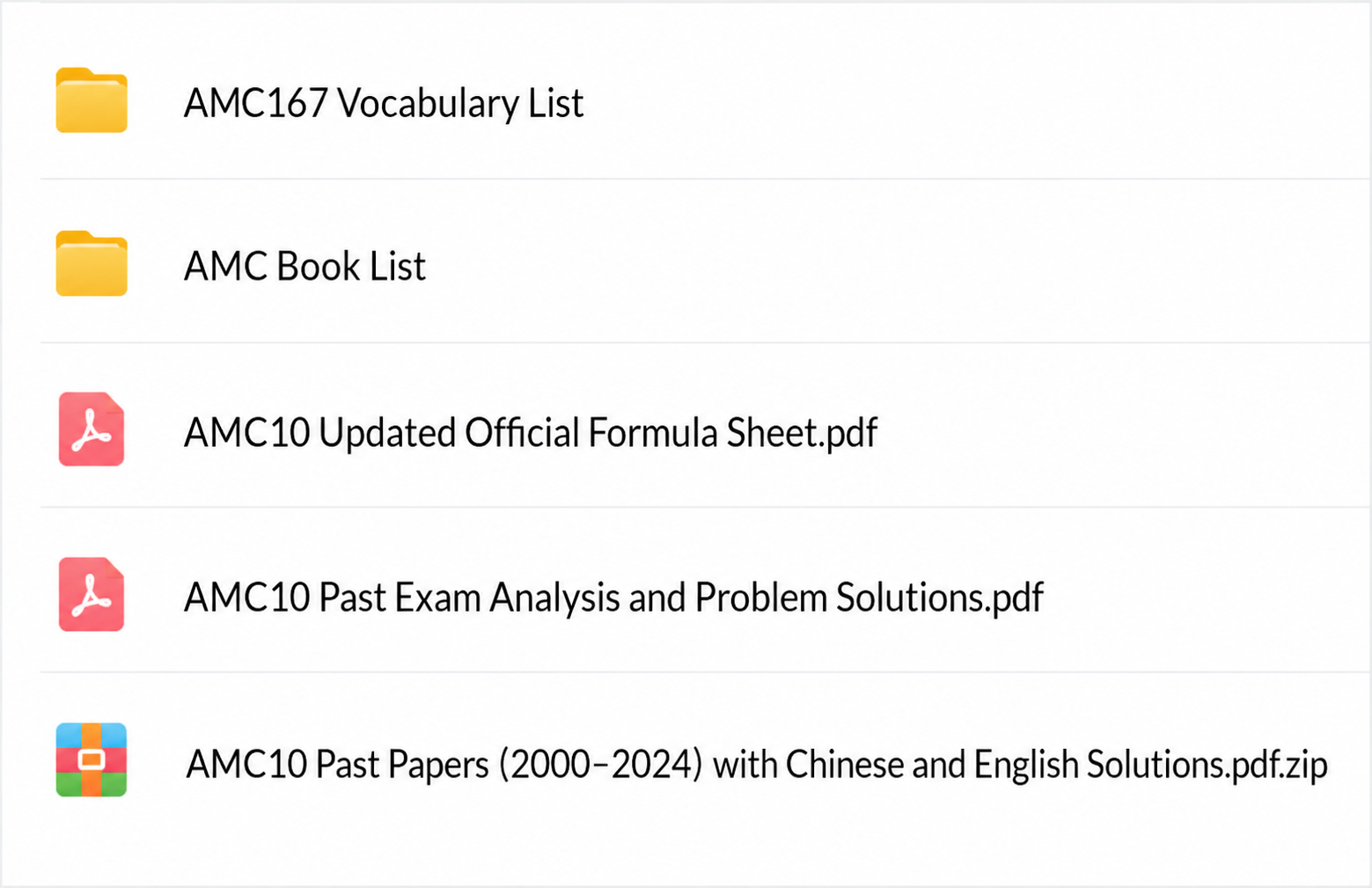
Create folders for different types of resources

Use cloud storage to access materials from anywhere

Bookmark important websites for quick access

Use note-taking apps (Notion, Evernote) to organize concepts and solutions

Making the Most of Your Resources

Active vs. Passive Learning

Passive learning (reading, watching videos) is necessary but not sufficient. You must also engage in active learning:

Solve problems yourself before looking at solutions

Explain solutions to others or out loud to yourself

Try multiple approaches to the same problem

Create your own problems based on concepts you've learned

Spaced Repetition

Don't try to learn everything at once. Use spaced repetition to retain information:

Review concepts regularly

Revisit problems you struggled with

Spiral back to topics periodically

Quality Over Quantity

It's better to deeply understand 10 problems than to superficially work through 100. Focus on:

Understanding why each step works

Identifying the key insight or technique

Learning how to apply the technique to other problems

Budget-Friendly Resource Options

Free Resources

Art of Problem Solving website (Alcumus, forums, wiki)

Khan Academy

YouTube channels (Numberphile, 3Blue1Brown, etc.)

MAA website (some free resources)

Library books

Past AMC 10 problems (available free online)

Low-Cost Resources

AoPS books (one-time purchase, can be resold)

Used books from online marketplaces

Library borrowing

Free trials of subscription services

Investment Resources

AoPS online courses (various price points)

Brilliant.org subscription

Private tutoring (if needed)

Math competition prep programs

Staying Motivated and Consistent

Set a Regular Study Schedule

Study at the same time each day

Start with 30 minutes and gradually increase

Be consistent—even short daily sessions are better than occasional long ones

Track Your Progress

Keep a log of problems solved

Record your scores on practice tests

Celebrate improvements, no matter how small

Find a Study Buddy or Group

Study with friends who are also preparing

Join a math club at school

Participate in online study groups

Conclusion

The right resources can make a significant difference in your AMC 10 preparation. The Art of Problem Solving series remains the gold standard for books, while the AoPS website provides an unparalleled online community and resource collection. Past AMC 10 tests are essential for practice, and online forums offer valuable discussion and learning opportunities.

Remember that resources are only as good as your engagement with them. Active problem-solving, careful review of solutions, and consistent practice are what will ultimately lead to success. Start with the resources that match your current level, gradually work your way up, and don't be afraid to ask for help when you need it.

With the right resources, the right approach, and the right mindset, you can achieve your goals on the AMC 10 and develop mathematical skills that will serve you well throughout your academic career and beyond.

For more information about AMC 10 preparation, visit the official Mathematical Association of America website at maa.org/math-competitions and explore the Art of Problem Solving community at artofproblemsolving.com.

推荐

Common Mistakes in AMC 10 and How to Avoid Them

Student thinking carefully about problems

The AMC 10 is a challenging competition that tests not just your mathematical knowledge, but also your attention to detail, time management, and problem-solving skills. Even the most prepared students can lose points due to common mistakes that could have been avoided. This comprehensive guide will walk you through the most frequent errors students make on the AMC 10 and provide practical strategies to help you avoid them.

Understanding the Cost of Mistakes

Before diving into specific mistakes, it's important to understand their impact on your score. The AMC 10 scoring system is:

Correct answer: 6 points

Blank answer: 1.5 points

Incorrect answer: 0 points

This means that a careless mistake doesn't just cost you the 6 points for that question—it costs you 7.5 points compared to a correct answer (6 points you didn't get plus 1.5 points you would have gotten for leaving it blank). With this scoring system, avoiding mistakes is just as important as solving problems correctly.

Reviewing and checking answers

Mistake Category 1: Misreading the Problem

The Mistake

One of the most common and costly mistakes is misreading the problem. This can happen in several ways:

Missing key words like "not," "except," or "always"

Misunderstanding what the problem is asking for

Overlooking important conditions or constraints

Confusing similar-looking numbers or variables

Real-World Example

Problem: "Which of the following is NOT a factor of 144?"

Common mistake: Students read too quickly and look for a factor instead of a non-factor, choosing the wrong answer.

How to Avoid It

Read the problem twice: Once to understand the context, once to identify what's being asked

Underline key words: Circle or underline words like "not," "always," "never," "at least," "at most"

Identify the question: Before solving, ask yourself: "What exactly am I looking for?"

Check conditions: Make sure you've noted all constraints (e.g., "positive integer," "less than 100")

Mistake Category 2: Careless Arithmetic Errors

The Mistake

Simple calculation mistakes are surprisingly common, even among top students. These include:

Addition or subtraction errors

Multiplication or division mistakes

Sign errors (positive vs. negative)

Fraction or decimal calculation errors

Transcription errors (writing down a number incorrectly)

Real-World Example

Problem: "If 3x + 7 = 22, what is x?"

Common mistake: Student correctly solves 3x = 15, but then writes x = 3 instead of x = 5 due to a division error.

How to Avoid It

Write out your work clearly: Don't try to do too much in your head

Check each step: After each calculation, quickly verify it makes sense

Use estimation: Does your answer seem reasonable? If you're calculating a probability and get 1.5, something's wrong

Re-calculate key steps: If you have time, redo important calculations a different way

Pay attention to signs: Be extra careful with negative numbers

Focus and concentration during study

Mistake Category 3: Answering the Wrong Question

The Mistake

This is related to misreading, but it's a distinct error: you solve a problem correctly, but it's not the problem that was asked. Common variations include:

Finding x when the problem asks for 2x

Finding the area when the problem asks for the perimeter

Finding one value when the problem asks for a sum or product of values

Stopping too early and not completing all parts of the solution

Real-World Example

Problem: "If x + y = 10 and x - y = 4, what is the value of xy?"

Common mistake: Student finds x = 7 and y = 3 correctly, then answers "7" instead of calculating xy = 21.

How to Avoid It

Re-read the question after solving: Make sure you're answering what was asked

Box your final answer: Physically write "Answer: ___" to force yourself to identify the final result

Check the units: If the problem asks for area, make sure you're giving area, not length

Verify completeness: Have you answered all parts of the question?

Mistake Category 4: Not Using All the Information

The Mistake

AMC 10 problems are carefully constructed so that every piece of information is necessary. Students sometimes overlook conditions or constraints, leading to incorrect answers.

Real-World Example

Problem: "A positive integer n has exactly 4 factors. If n is less than 20, how many values of n are possible?"

Common mistake: Student finds numbers with 4 factors but forgets the constraint that n must be less than 20, or forgets that n must be positive.

How to Avoid It

List all conditions: Write down every constraint or condition given in the problem

Check your answer against all conditions: Does your solution satisfy every requirement?

Look for implicit conditions: Sometimes conditions are implied (e.g., "integer" means whole numbers only)

Consider edge cases: Are there boundary conditions you need to check?

Mistake Category 5: Time Management Errors

The Mistake

Poor time management can cost you points even if you know how to solve every problem. Common time management errors include:

Spending too much time on one problem

Not attempting easy problems at the end of the test

Rushing through problems you could solve correctly with more time

Not leaving time to review your answers

Learning from mistakes

How to Avoid It

Use the three-pass approach:

First pass (15-20 minutes): Solve problems 1-10 and any other quick wins

Second pass (30-35 minutes): Work on problems 11-20

Third pass (20-25 minutes): Tackle problems 21-25 and review

Set time limits: If you're stuck on a problem for more than 3 minutes, move on

Mark problems to return to: Circle problems you want to revisit

Leave 5 minutes for review: Use this time to check calculations and ensure you've filled in the answer sheet correctly

Mistake Category 6: Filling in the Answer Sheet Incorrectly

The Mistake

This is a mechanical error that can cost you points even when you've solved problems correctly:

Filling in the wrong bubble on the answer sheet

Skipping a line and filling in answers in the wrong order

Not erasing completely when changing an answer

Running out of time and not transferring answers to the sheet

How to Avoid It

Fill in answers as you go: Don't wait until the end to transfer answers

Check problem numbers: Every few problems, verify that you're filling in the correct number

Erase completely: Make sure old marks are fully erased before filling in a new answer

Leave 5 minutes for verification: Use this time to check that your answer sheet matches your work

Use a pencil with a good eraser: Bring quality supplies to avoid mechanical issues

Mistake Category 7: Not Checking Your Work

The Mistake

Many students solve problems and move on without verifying their answers. This is a missed opportunity to catch errors.

How to Avoid It

Plug answers back in: For algebra problems, substitute your answer back into the original equation

Use a different method: If you solved a problem algebraically, try solving it geometrically (or vice versa) to verify

Check reasonableness: Does your answer make sense in the context of the problem?

Verify edge cases: If your answer is a specific number, check if nearby values also work (they shouldn't)

Mistake Category 8: Giving Up Too Early

The Mistake

Some students see a hard problem, assume they can't solve it, and move on without trying. This is especially common with problems 21-25.

How to Avoid It

Try small cases: For many hard problems, working with smaller numbers can reveal patterns

Draw a diagram: Visual representation can make complex problems more approachable

Write down what you know: Sometimes organizing information reveals solution paths

Make an educated guess: If you can eliminate even one answer choice, guessing becomes statistically favorable

Remember: all problems are worth the same: A correct answer on problem 25 is worth the same as a correct answer on problem 1

Preparing for exams

Mistake Category 9: Not Managing Test Anxiety

The Mistake

Test anxiety can cause you to make mistakes you wouldn't normally make. Symptoms include:

Rushing through problems

Blanking out on problems you know how to solve

Second-guessing correct answers

Panic when encountering difficult problems

How to Avoid It

Practice under timed conditions: Take full-length practice tests to build comfort with the format

Develop a pre-test routine: Establish a calming routine before the test (deep breathing, positive self-talk)

Focus on the process, not the outcome: Concentrate on solving each problem, not on your final score

Take deep breaths: If you feel panic rising, pause and take a few deep breaths

Remember: it's just one test: Your worth isn't determined by your AMC 10 score

Mistake Category 10: Not Learning from Past Mistakes

The Mistake

Many students make the same mistakes repeatedly because they don't analyze and learn from their errors.

How to Avoid It

Keep an error log: After each practice test, record what mistakes you made and why

Categorize your errors: Group mistakes by type (careless, conceptual, time management) to identify patterns

Create a "mistakes to avoid" list: Before each test, review your common errors

Review solutions thoroughly: Don't just check if you got the right answer—understand why your approach worked or didn't work

Teach others: Explaining your mistakes to someone else helps you internalize the lesson

Creating Your Personal Mistake-Prevention Plan

Before the Test

Review your error log: Remind yourself of your common mistakes

Prepare your supplies: Bring multiple sharp pencils, a good eraser, and a watch

Get adequate rest: Being tired increases careless errors

Eat well: Proper nutrition helps with focus and concentration

During the Test

Read each problem twice: Once for context, once for details

Underline key information: Mark important words and conditions

Write clearly: Organize your work so you can follow it later

Check each answer: Before moving on, verify your solution makes sense

Monitor your time: Stay aware of the clock and adjust your pace accordingly

After the Test

Record your mistakes: Update your error log with any new errors

Analyze patterns: Are you making the same types of mistakes repeatedly?

Adjust your preparation: Focus your study on areas where you're making errors

Celebrate improvements: Acknowledge when you've successfully avoided a past mistake

Common Mistakes by Problem Type

Algebra Problems

Mistake: Sign errors when moving terms across the equals sign

Prevention: Double-check each step, especially when dealing with negatives

Mistake: Forgetting to check for extraneous solutions

Prevention: Always plug solutions back into the original equation

Geometry Problems

Mistake: Not drawing a diagram (or drawing it incorrectly)

Prevention: Always draw a diagram, even for "simple" problems

Mistake: Confusing similar-looking shapes or angles

Prevention: Label everything clearly in your diagram

Mistake: Using the wrong formula (e.g., area instead of perimeter)

Prevention: Write down what you're solving for before starting

Number Theory Problems

Mistake: Forgetting that 1 is not a prime number

Prevention: Remember: 2 is the smallest prime

Mistake: Miscounting factors or multiples

Prevention: List them out systematically, don't try to count in your head

Mistake: Confusing "divides" with "is divisible by"

Prevention: Read carefully: "a divides b" means b/a is an integer, not a/b

Combinatorics and Probability Problems

Mistake: Overcounting or undercounting in combinatorics problems

Prevention: Use systematic counting methods, check for overlap

Mistake: Confusing permutations and combinations

Prevention: Ask: "Does order matter?" If yes, it's a permutation

Mistake: Not ensuring probabilities sum to 1

Prevention: Check that all possible outcomes are accounted for

The Psychology of Mistake Prevention

Developing a Growth Mindset

Understand that mistakes are not failures—they're opportunities to learn. Every mistake you make and correct makes you stronger. Adopt the mindset that you're constantly improving, and view errors as valuable feedback.

Building Confidence Through Preparation

The more prepared you are, the less likely you are to make careless errors. Thorough preparation builds confidence, which reduces anxiety and helps you stay focused during the test.

Practicing Mindfulness

Stay present during the test. Don't worry about previous problems or future ones. Focus entirely on the problem in front of you. This mindfulness reduces errors and improves performance.

Conclusion

Avoiding common mistakes on the AMC 10 is just as important as knowing how to solve problems. By understanding the types of errors students typically make and implementing strategies to prevent them, you can significantly improve your score.

Remember that mistake prevention is a skill that develops over time. Start by focusing on one or two categories of mistakes, then gradually work on others. Keep an error log, review it regularly, and adjust your approach as needed.

With careful preparation, mindful test-taking, and a commitment to learning from your errors, you can minimize mistakes and achieve your best possible score on the AMC 10. Good luck!

For more AMC 10 preparation resources, visit the official Mathematical Association of America website at maa.org/math-competitions.

Online Customer Service
Contact Customer Service