On the track of international math competitions, the AMC10 has always been a highly valuable watershed. Many students who excel in school math often feel a sense of frustration, like "having strength but nowhere to use it," when they first encounter AMC10 past papers. So, what exactly makes AMC10 past papers difficult? Is it the depth of the formulas, or the volume of questions? To successfully break through in the 2026 season, we must peel back the surface of the past papers, identify the core pain points, and strike them with precision.
I. In-depth Review: The "Three Mountains" of AMC10 Past Papers
Through a longitudinal analysis of AMC10 past papers from the past 10 years, we find that the difficulty is mainly reflected in the following three dimensions:
1. The "Obscurity" and "Span" of Knowledge Points
Although AMC10 does not test calculus, its depth of examination of Number Theory and Combinatorics far exceeds that of most countries' standard curricula.
Difficulty Highlight: Congruence equations, place value principles, complex inclusion-exclusion principles, and the stars and bars method frequently appear in the past papers, which are often considered "electives" or even "blanks" in regular textbooks. For students who have not been systematically exposed to competitive mathematics, these questions can seem like an alien language.
2. The "Variability" and "Subtlety" of Logical Paths
What AMC10 past papers are most known for (and most headache-inducing) is that they rarely test the direct application of formulas.
Difficulty Highlight: A seemingly simple geometry problem might require you to solve it using algebraic equations; a seemingly purely algebraic problem can often be solved in seconds using a coordinate system. This cross-module logical transfer ability requires students to have a deep intuition for mathematical models.
3. The "Extreme Game" of Time Pressure
Handling 25 questions in 75 minutes — factoring in time for filling in answer sheets and checking, the average time per question is only about 2.5 minutes.
Difficulty Highlight: This high-pressure environment can lead to "technique deformation." Many students spend too much time on medium-difficulty questions like 15-20, leaving them without even enough time to read questions 21-25. The difficulty of the past papers largely stems from the conflict between speed and accuracy.

II. Targeted Overcoming: The "Breakthrough" Path for High Achievers
Faced with the above difficulties, a blind brute-force approach to problem-solving will only yield half the result with twice the effort. What you need is a set of "point-to-point" targeted solutions.
1. Build a "Competition-Level" Knowledge System
Strategy: Don't just focus on textbooks; strengthen your knowledge directionally.
Action: Focus on conquering the Number Theory module (Remainder Theorem, relationships between GCD and LCM) and the Combinatorics module (conditional probability, recursive sequence counting). Summer is the golden period for strengthening these "obscure" test points. When you encounter these test points in the first 15 questions of the past papers, aim to react as instinctively as you would to basic arithmetic.
2. Master "Non-Standard" Problem-Solving Techniques
There are many "dimensionality reduction" techniques in the past papers that must be practiced during preparation.
Strategy: Practice methods such as the special value method, substitution method, elimination method, and dimensional analysis.
Action: When working on past papers, if you haven't found a rigorous derivation path within 2 minutes, immediately try simplification through special cases. The AMC10 is a multiple-choice exam — "getting the points" is always more important than "having a perfect proof process."
3. Train "Modular" Thinking
Strategy: When you see the context of a problem, quickly identify the mathematical model behind it.
Action: Review and categorize past papers. For example, gather all past problems involving circles together and observe whether they test similar triangles, the power of a point theorem, or tangent properties. When you can see through the "visual shell" of a problem at a glance and directly reach the underlying algebraic or geometric model, your problem-solving speed will see a qualitative leap.
4. Implement "Gradient-Based" Timed Training
Strategy: Train your decision-making ability under pressure.
Action: Divide the past paper practice into three phases:
Questions 1-15: Practice "instant kills" — aim for zero mistakes within 35 minutes.
Questions 16-20: Practice "steady performance" — these 5 questions determine whether you can securely win the top 5% globally (Honor Roll).
Questions 21-25: Practice "selective engagement" — learn how to choose the 1-2 most solvable problems among them to tackle in the final 15 minutes.
III. Preparation Advice for the 2026 Season
Value Concise Error Analysis: Don't just copy the wrong problem. Write next to it: "Why didn't I think in this direction?" Correcting your thought process is much more important than correcting calculation errors.
Make Good Use of Past Paper Data: The styles of AMC10A and AMC10B are slightly different; it is recommended to practice both. The past papers from the past 5 years are the most valuable — be sure to set aside 3 sets for full simulations.
Mindset Building: The AMC10 scoring mechanism is "+1.5 points for leaving a question blank, 0 points for a wrong answer." Learning to leave questions blank is also a strategy for overcoming the difficulty of the past papers.
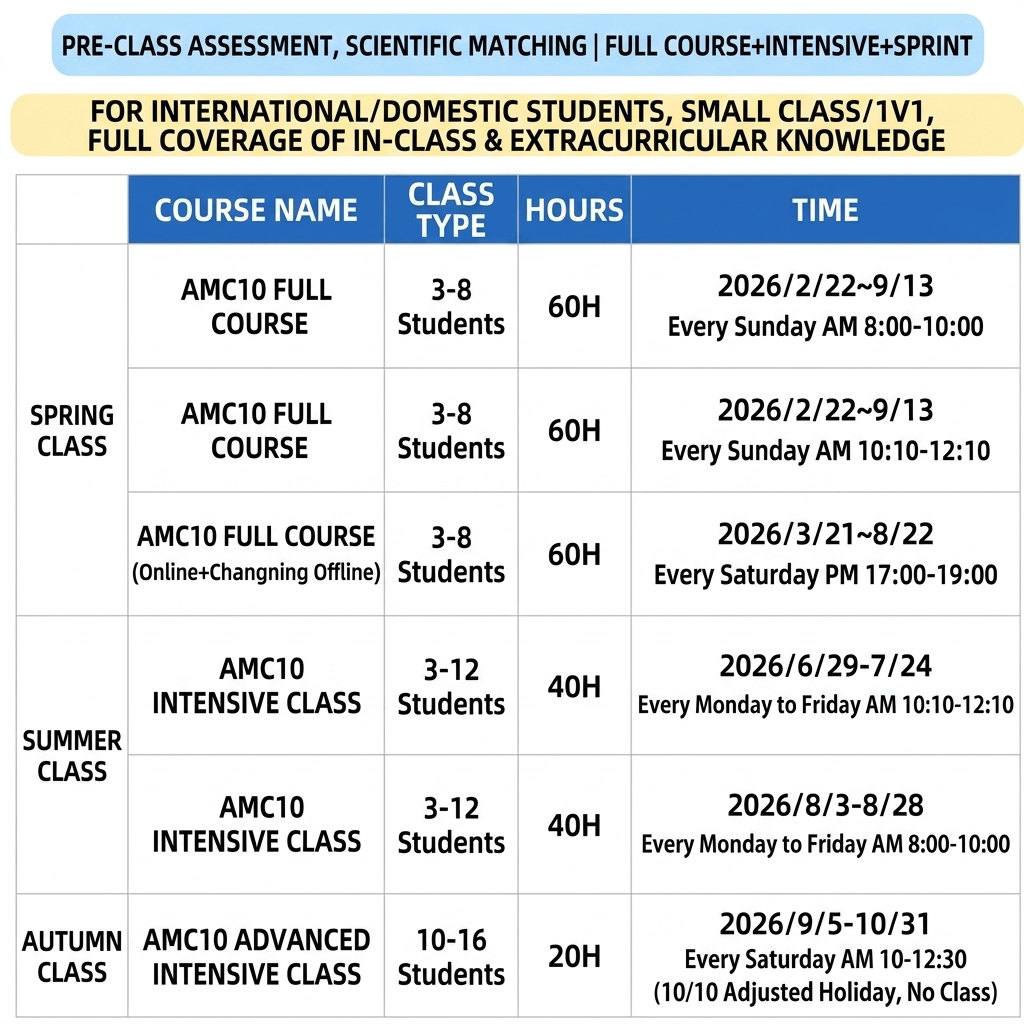
AMC10 Preparation Courses
Our instructors are graduates of top global universities. With precise curriculum planning and full learning progress tracking, we escort you to score improvement and awards!
| Class Type | Hours | Class Size | Start Date |
|---|---|---|---|
| Four-Module Short-Term Class | Varies by module | 3-8 students | Consult teacher |
| Systematic Course | 20h | 1v1 / 3-8 students | Consult teacher |
| Problem-Solving Class | 20h | 1v1 / 3-8 students | Consult teacher |