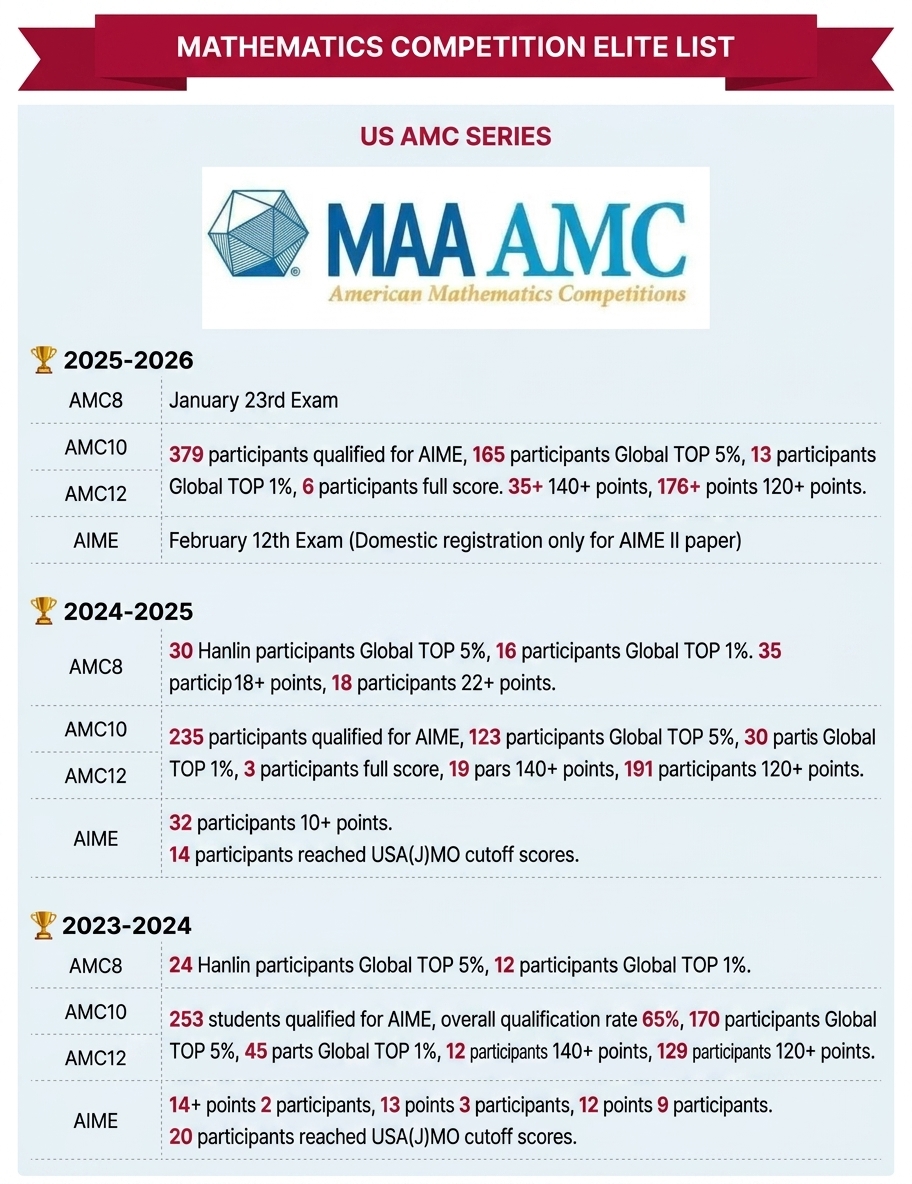

As a globally recognized mathematics competition, AMC10 is not only a "hard currency" for applying to top schools but also a necessary path to AIME (American Invitational Mathematics Examination). With the 2026 season approaching, how to effectively prepare during the summer, the "golden period for advancement," has become a topic of great concern for parents and students. To stand out in AMC10, we must first understand: Where exactly lie the difficulties of this "gateway"?

I. In-Depth Analysis: AMC10 Key Points and Challenges
The AMC10 syllabus covers core middle and high school mathematics content except calculus, but its difficulty does not lie in the depth of formulas, but in the flexibility of logic.
1. Number Theory & Counting
This is the area most easily overlooked in the regular domestic mathematics curriculum but accounts for a very high proportion in AMC10.
Difficulty: Includes congruence equations, place value principles, divisors and multiples, as well as complex classification discussions in permutations and combinations (such as stars and bars, inclusion-exclusion principle). These problems often do not have fixed templates and require strong logical rigor. Missing one case can lead to a complete failure.
2. The "Algebraization" Trend in Geometry
Difficulty: AMC10 geometry problems no longer merely test simple proofs of congruence or similarity. Instead, they increasingly involve the Power of a Point Theorem, Ptolemy's Theorem, and comprehensive problems requiring the use of analytic geometry (coordinate system establishment) or trigonometric identities to assist in solving.
3. "Speed and Accuracy" Under Time Constraint
Difficulty: 25 questions to be solved in 75 minutes. Average time per question is only 3 minutes.
Core: The real difficulty lies in how, under extreme pressure, to quickly find the "optimal solution" among 2-3 problem-solving paths while ensuring that the basic points from the first 15 questions are secured.
II. Summer Preparation: Tailored Strategies for Different Grades
Summer is the only period for immersive, topic-focused preparation. The focus should be completely different for students in different grades.
1. 8th Grade and Below (Interest Stimulation and Foundation Building)
For these "younger participants" who have spare learning capacity, the goal of the summer is to transcend the boundaries of the regular curriculum.
Preparation Focus: Complete the basics of 9th and 10th grade algebra (e.g., polynomials, sequences) in advance.
Summer Actions: Focus on the bridging knowledge points from AMC8 to AMC10, especially coordinate systems and simple probability. Practice the first 10 questions of AMC10 from the past 5 years to build confidence and develop "language intuition" for math competition problems.
2. 9th Grade (Systematic Modeling and Targeted Breakthrough)
This group is the core force aiming for the global top 5% (Honor Roll). Summer is crucial for building a knowledge system.
Preparation Focus: Fill knowledge gaps. Most 9th graders have serious weaknesses in number theory and combinatorics.
Summer Actions: Adopt the "topic-focused attack method": practice only geometry for one week, only number theory for another. Organize your own "problem-solving techniques manual," recording advanced uses of high-frequency tools such as Vieta's theorem and inclusion-exclusion principle. The goal is to independently solve questions 16-20 from past exams.
3. 10th Grade (Final Sprint and Strategy Refinement)
This is the last year to participate in AMC10, with the goal typically being the global top 1% (Distinguished Honor Roll) or securely obtaining AIME qualification.
Preparation Focus: Speed training and tackling difficult problems (questions 21-25).
Summer Actions: Full mock exams: Conduct at least 2 strictly timed mock exams per week to practice the "letting go" strategy — learn to give up difficult problems that show no solution approach within 5 minutes, ensuring basic points are not lost. Deep review: Focus on the last 5 questions. Even if you cannot solve them, repeatedly study the official solutions and learn how to "earn points" through techniques like elimination, substitution, or special value methods.
III. Three Summer Suggestions for All Participants
Avoid "Mindless Practicing": In summer, do not just focus on the quantity of problems, but pursue "multiple solution methods for one problem." Every time you get a problem wrong, ask yourself: Is it because the knowledge point is not mastered, or the logical path chosen was wrong?
Make Good Use of LaTeX or a Notebook: The error log you organize in summer will be your most valuable review material before the November exam.
Maintain Logical Agility: Practice 3-5 medium-difficulty problems every day to prevent your brain from "rusting" during the long holiday.
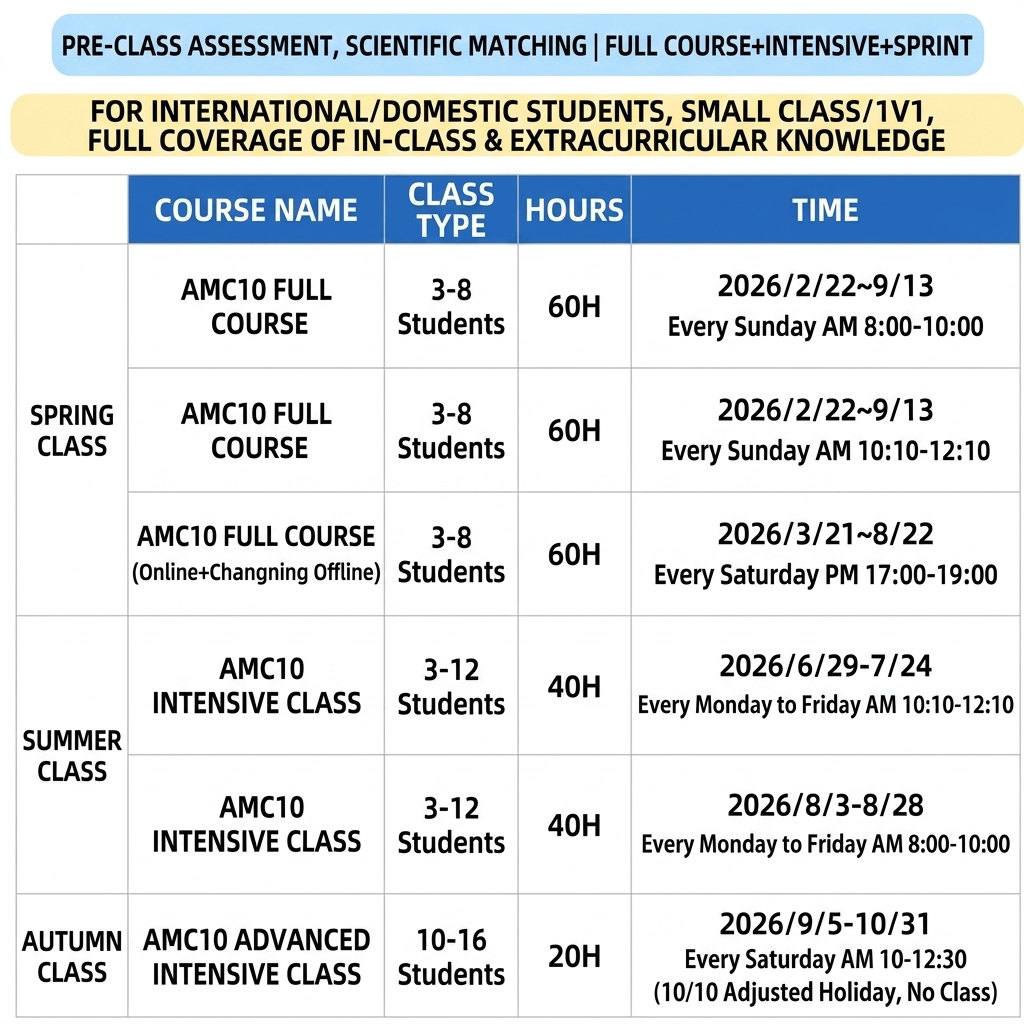
AMC10 Preparation Courses
Our instructors are graduates of top global universities. With precise curriculum planning and full learning progress tracking, we escort you to score improvement and awards!
| Class Type | Hours | Class Size | Start Date |
|---|---|---|---|
| Four-Module Short-Term Class | Varies by module | 3-8 students | Consult teacher |
| Systematic Course | 20H | 1v1 / 3-8 students | Consult teacher |
| Problem-Solving Class | 20H | 1v1 / 3-8 students | Consult teacher |