As an extremely influential global youth math competition, AMC10 has become the "golden ticket" for countless middle school students to prove their mathematical prowess and open the doors to top-tier universities. However, among the vast army of annual test-takers, many well-prepared students end up failing due to falling into the "trap of effort." To succeed in breaking through in the 2026 season, you not only need intense practice but also a clear and strategic mind. This article will deconstruct the "fatal" mistakes in exam preparation and clarify the core requirements for achieving a high score.

I. Pitfall Guide: Avoid These Preparation Mistakes!
1. Falling into "Drill and Kill," Neglecting Model Summarization
Misconception: Many students believe that simply solving nearly 20 years' worth of past exam papers will guarantee a high score.
Truth: AMC10 problem backgrounds are extremely flexible; rote memorization of question types is no longer sufficient. The competition tests underlying mathematical logic. If you only solve problems without summarizing, you'll still get stuck when encountering problems with modified contexts. High-scoring students cultivate the habit of, after solving a problem, reviewing the underlying mathematical model (e.g., Does this Number Theory problem test Congruence or Prime Factorization? Can this Combinatorics problem be solved with the Stars and Bars method?).
2. Blindly Pursuing the "Hardest Problems," Ignoring Accuracy on Fundamental Questions
Misconception: Many students invest 80% of their preparation energy on the final questions 21-25.
Truth: This "putting the cart before the horse" approach is extremely dangerous. AMC10 is a time-constrained game. Questions 1-15 constitute the foundational score. If you lose points due to carelessness while chasing speed, even solving the later hard problems correctly won't make up for the loss. Remember: The point value of the first 15 questions is the same as the last 5, but the difficulty is worlds apart.
3. Relying Solely on In-Class Thinking, Underestimating "Number Theory" & "Combinatorics"
Misconception: Believing that good grades in school math (such as AP Precalc or national middle/high school math) suffice for the AMC10.
Truth: The AMC10 syllabus places a heavy emphasis on Number Theory and Counting & Probability, which are often underrepresented in many school curricula. Without targeted reinforcement, losing points in these sections can be devastating.
4. Neglecting "Test-Taking Strategy," Habitually Grinding on Stuck Problems
Misconception: Persistently grinding on a problem you don't know how to solve, or randomly guessing when completely lost.
Truth: The AMC10 scoring rule is: "1.5 points for an unanswered question, 0 points for a wrong answer." Leaving a question blank is more advantageous than guessing. Students lacking a macro view often waste 10 minutes on a single mid-level problem, leaving no time to even look at later questions worth scoring.
II. Aiming for High Scores: What Requirements Must You Meet?
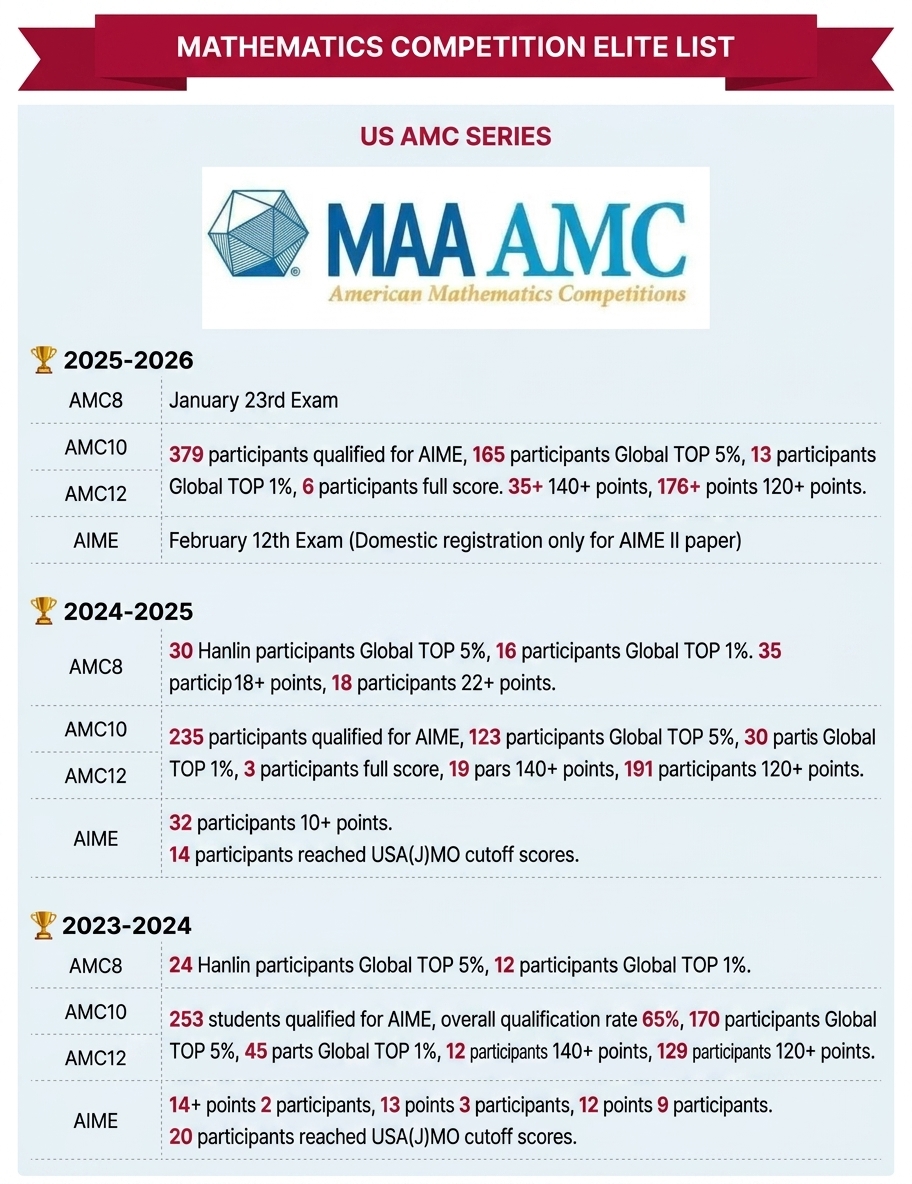
To achieve a top 5% (Honor Roll) or even top 1% (DHR) globally, and to secure a position in the AIME, you need the following core competencies:
1. "Extreme Balance" Between Speed and Accuracy
Requirement: Solve 25 problems in 75 minutes. You must complete the first 15 problems within 40 minutes with a "zero error rate."
Goal: For foundational problems, develop muscle memory, averaging no more than 2 minutes per problem.
2. A Complete Knowledge Map
Algebra: Proficiently apply Vieta's formulas, complex factoring, and advanced transformations of arithmetic and geometric sequences.
Geometry: Master Ptolemy's theorem, the Power of a Point theorem, and nested models of similar triangles.
Number Theory: Flexibly handle congruence equations, the relationship between GCD and LCM, and place value principles.
Combinatorics: Deeply understand the Inclusion-Exclusion Principle, the Stars and Bars method, and complex conditional probability calculations.
3. Flexible "Game Theory" Thinking
Requirement: Be able to quickly assess whether a problem is worth solving based on remaining time.
High Score Benchmarks:
Aiming for AIME qualification (Top 5%): Typically requires solving about 18 problems correctly, leaving the rest blank.
Aiming for Top 1% (DHR): The goal is typically to solve 21-23 problems correctly.
III. 2026 Season Preparation Recommendations
Now - June: Phase 1 - Targeted Review and Reinforcement – Focus on filling knowledge gaps, especially in Number Theory and Probability.
July - September: Phase 2 - Topic-Focused Intensive Training – Improve flexibility in solving medium-difficulty problems (Questions 16-20).
Starting October: Phase 3 - Timed Full-Length Mock Exams – Conduct strictly timed mock exams weekly. Train your instincts to calmly decide "to solve or to skip" under pressure.
Use an Error Log: Categorize all your mistakes by topic. Success in AMC10 lies not in how many new problems you solve, but in not repeating past mistakes.
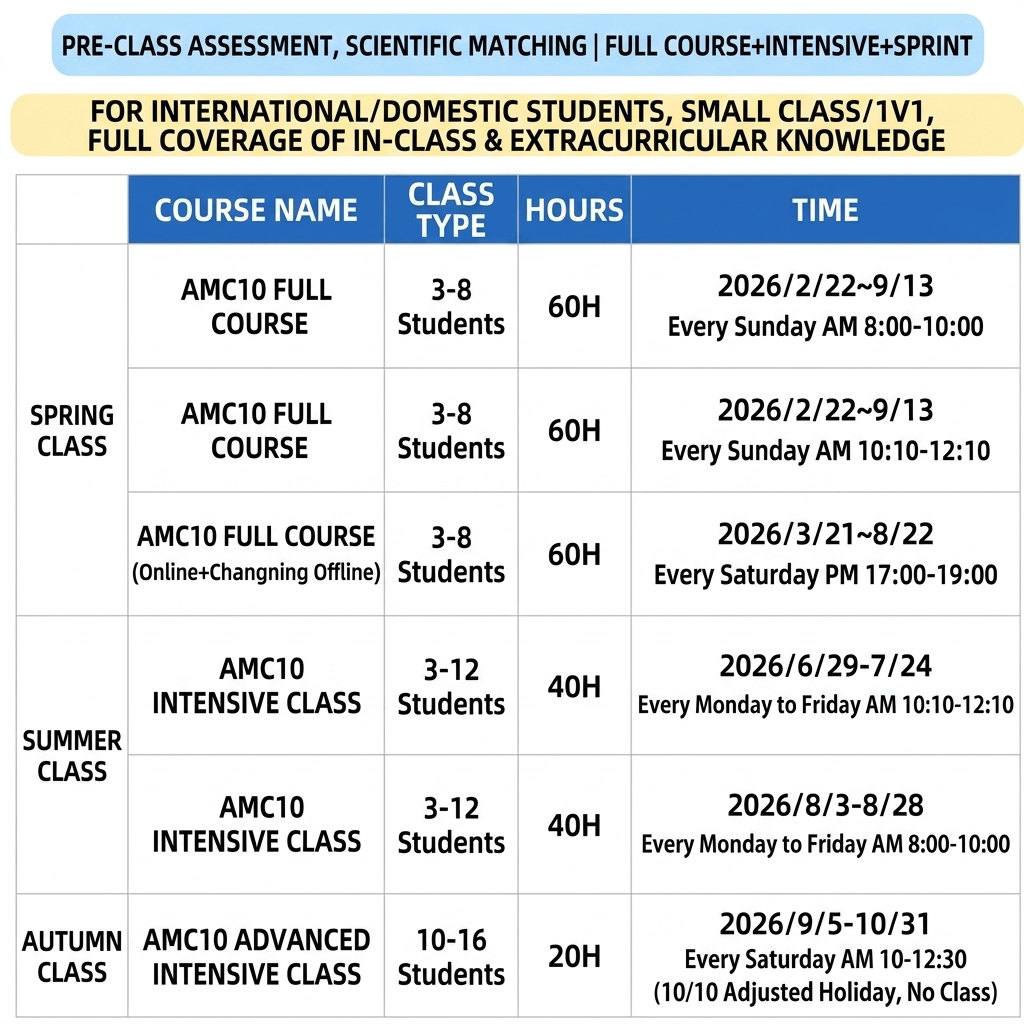
AMC10 Preparation Courses
Our instructors are graduates of top global universities. With precise curriculum planning and full learning progress tracking, we escort you to score improvement and awards!
| Class Type | Hours | Class Size | Start Date |
|---|---|---|---|
| Four-Module Short-Term Class | Varies by module | 3-8 students | Consult teacher |
| Systematic Course | 20H | 1v1 / 3-8 students | Consult teacher |
| Problem-Solving Class | 20H | 1v1 / 3-8 students | Consult teacher |