
Why is the AMC 10 Competition So Valuable? How to Efficiently Use Past Papers for AMC 10 Preparation?

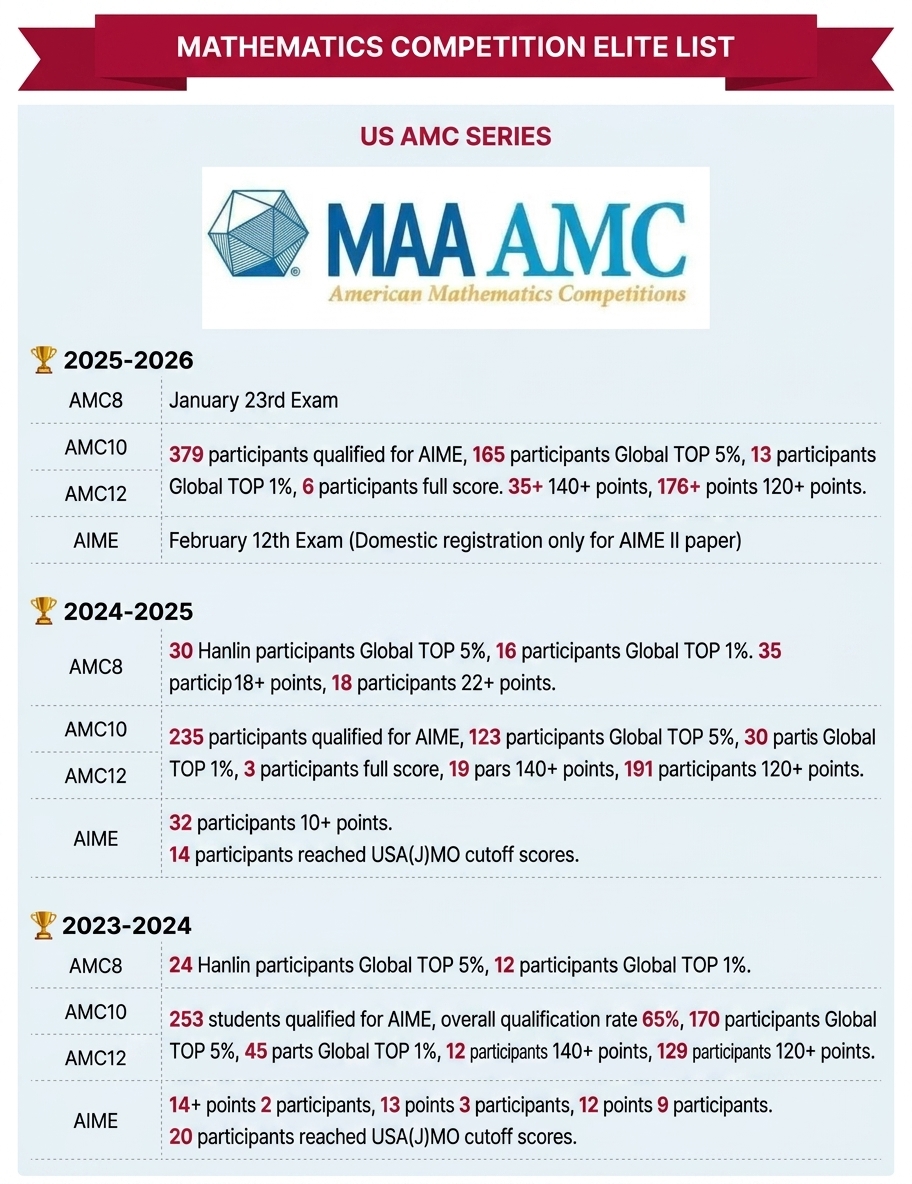
The AMC 10 has long surpassed the scope of "a math exam" and has become an important global benchmark for measuring the mathematical potential and academic rigor of middle school students. Its value is reflected in three major dimensions: international admissions, domestic selection, and skill development, and it continues to grow year by year.

推荐

I. Three Core Dimensions of AMC 10 Value

1. Official Recognition by Top Global Universities

MIT, Stanford, Caltech, Carnegie Mellon, etc., have dedicated fields for entering AMC/AIME scores in their undergraduate application systems. Admissions officers view scoring in the top 2.5% of AMC 10 (approximately 120+ points) or achieving AIME qualification as:

Hard evidence of mathematical talent

Demonstration of independent learning and stress management abilities

Predictive indicator for success in advanced STEM courses

2. High Regard from UK G5 Universities

Oxford, Cambridge, Imperial College London, when admitting students to majors in Mathematics, Computer Science, Engineering, etc.:

Use AMC 10/12 scores as strong supporting evidence for the Personal Statement (PS)

High-scoring students are often asked about their competition problem-solving approaches in interviews, showcasing their depth of logic

3. A Tool for "Snatching Up" Students by Top Domestic Middle Schools and Universities

Elite schools such as RDFZ, Shanghai High School, Shenzhen Middle School, and No.1 Middle School Affiliated to CCNU:

Use high AMC 10 scores (e.g., ≥120) as a basis for waiving written exams, adding interview bonus points, or giving priority admission in selections for Technology Talents, Qiuzhen (Yau) Science Classes, and the Strong Base Program

Some international departments list AMC 10 Honor Roll as a criterion for scholarship assessment

II. Three Key Reminders for AMC 10 Preparation

1. Calculation Ability is the Foundation

Calculators are not allowed in the AMC 10; all calculations must be done by hand. Common point-loss areas include: sign errors, mistakes in simplifying fractions, and carelessness with squares and square roots. It is recommended to do 10 speed calculation problems daily (such as factoring and simplifying radicals) to improve accuracy and speed.

2. Methods > Quantity of Problems Solved

The last 5 questions (21–25) are rarely solved by "routine" methods; they require flexible use of:

Constructive methods (e.g., constructing counterexamples, auxiliary functions)

Case analysis (especially in combinatorics and number theory)

Reverse thinking (backtracking from answer choices, testing extreme cases)

Avoid blind problem-solving: focus on summarizing "general solutions for a class of problems."

3. Seek Professional Guidance Reasonably

Self-study can easily lead to "knowledge blind spots" or "inefficient repetition." A good coach can help by:

Organizing the unique problem-solving models of AMC 10 (e.g., "simplifying with symmetry," "reducing dimensions with modular arithmetic")

Pinpointing weak modules

Simulating the real exam rhythm and pressure

推荐

III. Efficient Past Paper Practice Strategies for AMC 10

Version A vs. Version B: How to Choose?

Version
Characteristics
Suitable For
Version A
• Emphasizes application of foundational knowledge
• More "straightforward" questions
• Slightly larger calculation load
Average foundation, first-time participants
Version B
• More flexible and abstract
• Some questions require deep reasoning
• Stronger leaps in thinking
Aiming for high scores, those with competition experience

Suggestion: Start with Version A for a baseline assessment, then use Version B to challenge your thinking limits.

Four-Step Scientific Practice Method

Step 1: Full Mock Exam (Start in Winter Break)

Choose past papers from the last 5 years (e.g., 2021–2025), strictly timed to 75 minutes. Purpose: Understand the true difficulty, expose knowledge gaps, and develop a personalized plan.

Step 2: Module-Specific Intensive Practice

Categorize past papers into seven modules for targeted training:

Algebra → Focus on polynomials, function graphs

Geometry → Strengthen auxiliary lines, area methods

Number Theory → Break through congruences, factor analysis

Combinatorics → Master addition/multiplication principles, path counting

Step 3: Summarize Question Patterns

Statistics on high-frequency topics from the last 10 years:

Module
High-Frequency Question Types
Algebra
Extrema of quadratic functions, integer solutions of equations
Geometry
Similar triangles, power of a point theorem
Number Theory
Prime factorization, last digits
Combinatorics
Coloring problems, recurrence relations

Organize solution templates: e.g., "Combinatorics → Step-by-step analysis → Enumerate boundaries → Verify."

Step 4: Closed-Loop Mistake Management

Create a digital or paper mistake notebook, recording:

Cause of error (calculation? reasoning? misreading?)

Correct solution + key techniques

Links to similar problems

Re-do the mistake questions weekly. Remove them from the notebook only after two consecutive correct attempts, ensuring thorough mastery.

For more information about AMC 10/12 competition courses, please contact us.

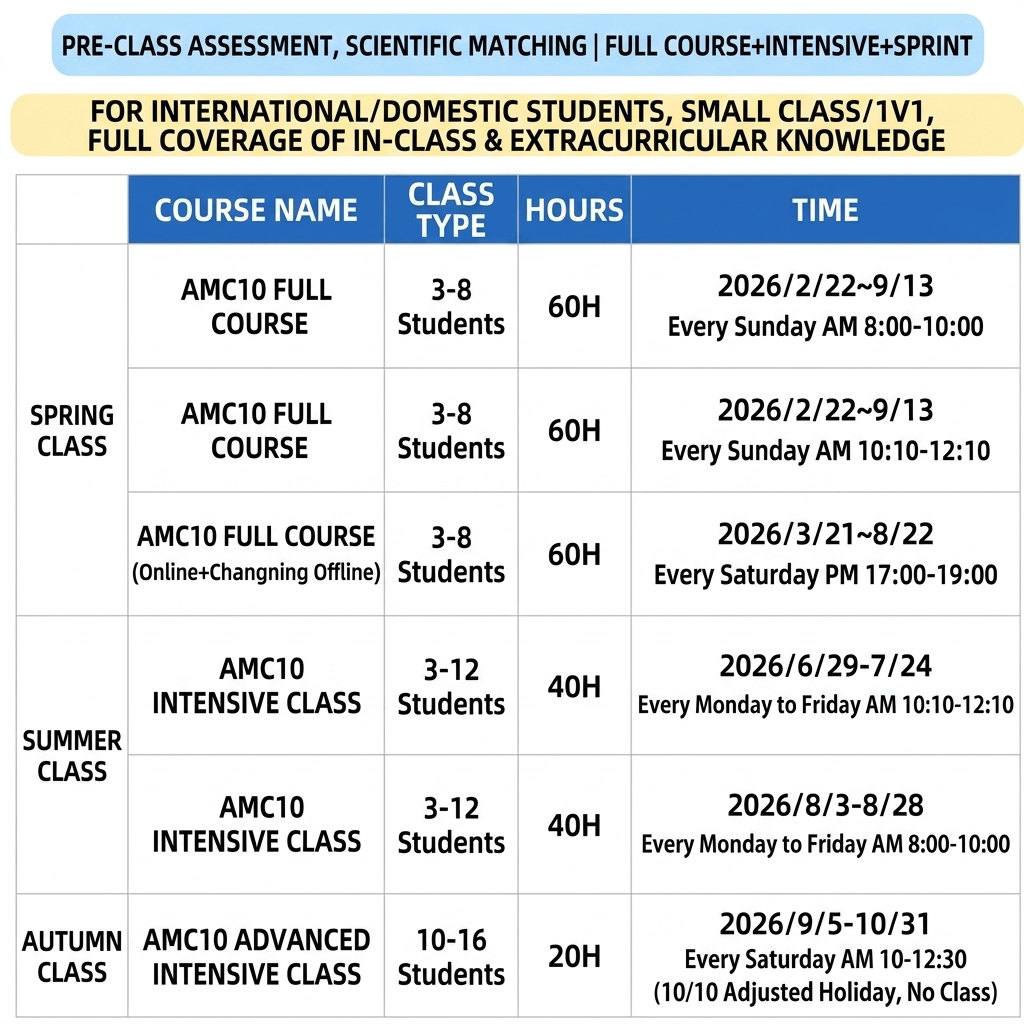
AMC10 Preparation Courses

Our instructors are graduates from top global universities. With precise curriculum planning and comprehensive learning tracking, we ensure your score improvement and award-winning success!

Class Type Hours Class Size Start Date
Winter Break Class 30H 3–8 students Consult teacher for details
Systematic Course 20H 1v1 / 3–8 students Consult teacher for details
Problem-Solving Class 20H 1v1 / 3–8 students Consult teacher for details

推荐

A Panoramic Map of High-Frequency AMC 10 Math Competition Topics! How Long Do Students with Different Award Goals and Foundations Need to Prepare for the AMC 10?

As one of the most influential high school math competitions globally, the AMC 10 is known for its broad coverage, strong gradient, and deep thinking requirements. To secure a high score within the 75-minute time limit, you must accurately master the distribution of high-frequency topics and develop a personalized preparation timeline based on your foundation and target score.

推荐

I. Detailed Explanation of High-Frequency AMC 10 Topics (by Module)

The AMC 10 consists of 25 questions with a stepwise difficulty increase: Questions 1–10: Basic Questions (curriculum extensions), Questions 11–20: Intermediate Questions (requiring technique and synthesis), Questions 21–25: Difficult Questions (competition-level thinking, often testing number theory/combinatorics). The following are the seven core modules and their key test points, based on an analysis of past five years' past papers:

1. Comprehensive Algebra
Core content: Quadratic functions, equations and inequalities, sequences, polynomials, multiplication formulas, and identity transformations.
High-frequency difficulties: Polynomial divisibility problems; simplification of symmetric expressions; substitution methods; constructing equations.
Advice: At least 6–8 questions in the first 15 are from algebra—key to securing your score!

2. Functions and Coordinate Geometry
Core content: Properties of linear/quadratic function graphs; equations of circles; coordinate transformations; area calculation of polygons.
Problem-solving tools: Shoelace formula (quickly calculates the area of any polygon); Pick's theorem (area of lattice polygon A = I + B/2 - 1).
Note: Function questions are often combined with geometry and appear in the 16–22 question range.

3. Comprehensive Plane Geometry
Core content: Triangles, quadrilaterals and polygons, trigonometric functions.
Area methods: Partition-complement method, equal-area transformation, common side theorem.
Key skills: Drawing auxiliary lines (e.g., altitudes, midpoints, constructing similar shapes); recognizing hidden conditions (e.g., "isosceles triangle," "right angle").
Tip: Geometry questions often appear in the 10–20 range and are key for differentiating scores in the middle segment.

4. Circles and Solid Geometry
Core content: Circle properties: inscribed angles, chord-tangent angles, perpendicular chord theorem, intersecting chords theorem; Solid geometry: Volume and surface area of rectangular prisms, prisms, cylinders, cones; Euler's formula (V - E + F = 2, occasionally seen in challenging problems).
Difficulties: Spatial visualization ability (especially for solid net diagrams); multiple points concyclic on a circle; angle transformation.
Trend: In recent years, circle problems have placed greater emphasis on comprehensive application, often combining trigonometry and algebra.

5. Combinatorics
Core content: Addition principle and multiplication principle; permutations (ordered) vs. combinations (unordered); special models: path counting, coloring problems, round-robin tournament systems.
Common errors: Double counting or omissions; considering order or not (e.g., "select 3 people to form a team" vs. "select 3 people to sit in a row").
Techniques: Drawing tree diagrams, case analysis, reverse exclusion (inclusion–exclusion principle).

6. Probability and Statistics
Core content: Classical probability (equally likely events); geometric probability (ratio of length/area/volume); conditional probability ("given that… find…" type problems); expected value (occasionally seen in recent years).
High-frequency scenarios: Rolling dice, drawing cards, random walks, game outcomes.
Key point: Conditional probability is a frequent guest in difficult problems (e.g., 2023 AMC 10B Question 24).

7. Number Theory
Core content: Divisibility, congruences, digit problems, parity, floor function [x], defined new operations.
Typical position: Appears frequently in questions 21–25, key to distinguishing the top 1%!
Difficulty: Requires flexible problem transformation (e.g., converting "last two digits are the same" to a congruence modulo 100 problem).

推荐

II. How Long Does It Take to Prepare for the AMC 10? – Planning Based on Foundation and Target Score

Student Type
Math Foundation Characteristics
Recommended Preparation Cycle
Core Tasks
Weak Foundation
No systematic junior high competition training; high school algebra/geometry not completed
6–12 months
1. Supplement core junior high competition topics (number theory/combinatorics)
2. Complete high school compulsory 1–2
3. Begin AMC 10 topic-specific training
Average Foundation
Completed high school curriculum; some competition exposure
3–6 months
1. Strengthen the four major AMC 10 modules
2. Categorized practice with past papers (focus on questions 1–20)
3. Build problem-solving templates
Solid Foundation
Award in AMC 8/junior high league competition; comprehensive high school knowledge
1–3 months
1. Focus on difficult questions 21–25
2. Summarize high-frequency techniques (e.g., symmetry, extreme principle)
3. Timed mock exams to maintain proficiency

Preparation Depth Based on Target Score

Target
Score Range
Required Ability
Recommended Cycle
Experience Participation
70–90 points
Master the first 15 basic questions
1–3 months
Top 25% (AIME Threshold)
95–110 points
Stably complete the first 20 questions, some of questions 21–23
3–6 months
Top 5% (Honor Roll)
≥120 points
Comprehensive mastery of all modules, ability to solve questions 24–25
6–12 months
Top 1% (Distinguished Honor Roll)
≥135 points
Competition-level thinking, high speed and accuracy
8–12+ months of long-term accumulation

For more information about AMC 10/12 competition courses, please contact us.

AMC10 Preparation Courses

Our instructors are graduates from top global universities. With precise curriculum planning and comprehensive learning tracking, we ensure your score improvement and award-winning success!

Class Type Hours Class Size Start Date
Winter Break Class 30H 3–8 students Consult teacher for details
Systematic Course 20H 1v1 / 3–8 students Consult teacher for details
Problem-Solving Class 20H 1v1 / 3–8 students Consult teacher for details

推荐

Online Customer Service
Contact Customer Service