
What AMC 10 Score Is Useful for College Applications? The Importance of AMC 10 for International Students? How to Choose Between Versions A and B?

The AMC 10, one of the world's most influential youth math competitions, is not only a key benchmark for assessing students' mathematical abilities but also a crucial factor in applying to top universities, international schools, and securing scholarships. So, what scores are needed to stand out for different goals? The following will provide a detailed analysis from multiple perspectives.

推荐

I. AMC 10 Score Requirements for Different Award Goals

1. Applying to U.S. Top 30 Universities

Suggested Score: 120+ points. Top institutions like MIT and Stanford prefer students with AMC 10 scores of 135 or higher. Scoring in the top 2.5% (approximately 120+ points) or achieving AIME qualification is considered a significant academic achievement that can greatly enhance application competitiveness.

2. Planning to Apply for Mathematics/Computer Science Majors

Suggested Score: 130+ points. Mathematics and computer science majors are highly competitive; high scores better demonstrate students' logical thinking and problem-solving abilities. DHR (Distinguished Honor Roll, top 1% globally) typically requires 130+ points, proving both academic strength and the ability to handle complex problems.

3. Applying for Scholarships

Suggested Score: 140+ points. A high score (e.g., 140+) is a significant criterion for receiving full or merit-based scholarships. A score at this level indicates that the student possesses top-tier mathematical literacy and innovation skills, enabling them to stand out globally.

4. Applying to International Schools

Suggested Score: 110+ points. Many international schools (e.g., Beijing Keystone Academy) explicitly state that IBDP applicants with AMC 10 scores ≥ 110 can be exempted from math placement tests and directly enter advanced courses. Entrance exams for schools like Shanghai Guanghua Cambridge and Shenghua Zizhu often include original AMC 10 questions; thus, preparing for AMC 10 helps students become familiar with the style of these admission tests.

II. The Importance of AMC 10 for International Students

1. Alignment with International School Entrance Exams

High Consistency: The question types and difficulty levels of the AMC 10 are highly consistent with the entrance exams of international schools. Examples: Question 9 on the 2023 entrance exam of Shanghai Guanghua Cambridge was exactly the same as Question 19 on the 2023 AMC 10B; 50% of the math questions in Shenghua Zizhu's spring admissions test were original AMC 10 competition problems.

2. Assisting with IB/AL/AP Exam Preparation

High Content Overlap: The knowledge points tested in AMC 10 heavily overlap with the math sections of mainstream international curricula such as IB, AP, and A-Level. Students in grades 6-9 can build a solid foundation by preparing for AMC 10 in advance, clearing obstacles for future in-depth learning. Grade 10 students can use AMC 10 to sharpen their mathematical logic and problem-solving skills, supporting their progress in international coursework.

3. Boosting Applications to Top U.S. and U.K. Universities

Widely Recognized: Prestigious universities such as MIT, Stanford, and Columbia University have dedicated fields for entering AMC 10 scores in their application systems. A top 1% (DHR) score can help students stand out among a sea of applicants and increase their chances of admission.

推荐

III. AMC 10 Version A vs. Version B: How to Choose?

1. Overview

Versions A and B: The questions are different, and the exams are held about a week apart. However, the overall difficulty is similar, and the knowledge scope is the same, with only slight differences in focus and style. Score cutoffs are calculated independently, so choosing either version will not put you at a disadvantage in terms of ranking.

2. Specific Differences

Version
Characteristics
Suitable For
Version A
• More "stable," suitable for students with a solid foundation
• Basic questions are more direct; cutoffs are typically lower
Students aiming to securely qualify for AIME, or those who want a high score without taking too many risks
Version B
• More "flexible," demands higher creative thinking
• Contains more innovative question types in number theory and combinatorics
Students aiming for a very high score or DHR (top 5% globally), with prior competition experience and flexible thinking

3. Version Selection Strategies

Securely Qualifying for AIME: Prioritize Version A, or take both versions A and B. Version A's basic questions are more direct, and the cutoffs are typically lower, making it more favorable for students with a solid foundation. Taking both versions allows you to use your highest score as your final result, significantly increasing your chances of qualification.

Aiming for a Very High Score or DHR: Prioritize Version B. Version B has greater score differentiation; its innovative questions in number theory and combinatorics better showcase strengths, making it easier to stand out in the high-score range.

Transitioning to AMC 12 or Long-Term Preparation: Take Version A for AMC 10 and Version B for AMC 12. If you have a solid foundation, you can use the one-week gap between the two versions to consolidate your AMC 10 basics with Version A, then challenge AMC 12 difficulty. This allows you to secure a strong AMC 10 score while also getting an early taste of higher-level competition pacing.

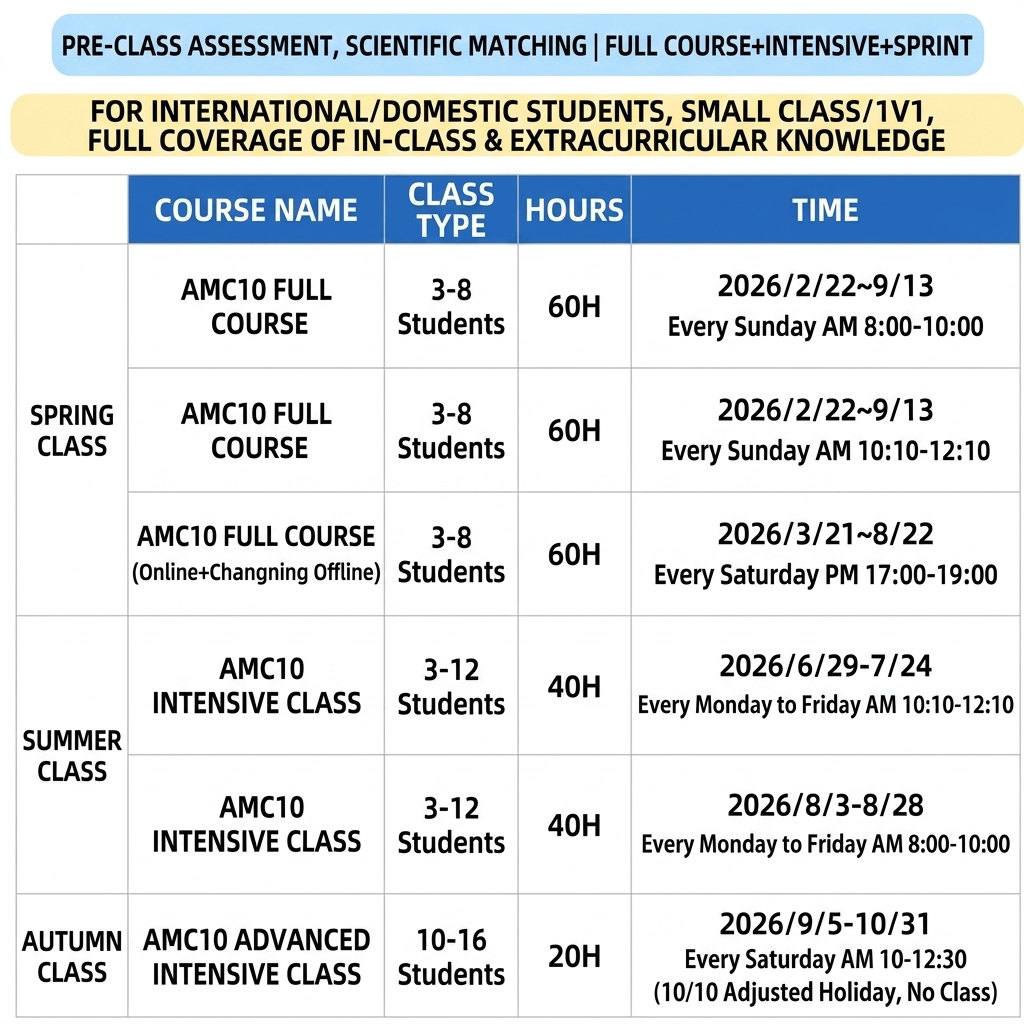
AMC10 Preparation Courses

Our instructors are graduates from top global universities. With precise curriculum planning and comprehensive learning tracking, we ensure your score improvement and award-winning success!

Class Type Hours Class Size Start Date
Winter Break Class 30H 3–8 students Consult teacher for details
Systematic Course 20H 1v1 / 3–8 students Consult teacher for details
Problem-Solving Class 20H 1v1 / 3–8 students Consult teacher for details

推荐

What Are the Main Differences Between AMC10 Version A and Version B? How Long Does an Average Student Need to Prepare for AMC10 to Win an Award? AMC10 Module-Specific Breakthrough Tips & Answering Strategies!

The AMC10 Math Competition not only assesses students' breadth of mathematical knowledge but also tests their problem-solving speed and depth of thinking. Through scientific planning and systematic preparation, even average students can achieve excellent results in this high-level competition.

I. Main Differences Between AMC10 Version A and Version B

1. Different Exam Dates

Version A: November 6, 2025 (Thursday) 17:00-18:15 (75 minutes)

Version B: November 14, 2025 (Friday) 17:00-18:15 (75 minutes)

Typically, the AMC10 Version A exam is held about one week earlier than Version B.

2. Slight Differences in Knowledge Point Proportions

Although both versions cover roughly the same knowledge points—Algebra, Geometry, Combinatorics, and Number Theory—their emphases differ. Version A focuses more on mathematical applications and computational problem-solving, while Version B places greater emphasis on a balanced assessment across various mathematical areas.

3. Different Cutoff Scores

The cutoff scores for advancing to AIME do not differ much between Version A and Version B. However, for the top 1% cutoff, there may be significant fluctuations between the two versions.

推荐

II. How to Choose Between Version A and Version B?

Take Both Versions: If time permits, it is recommended that students take both the A and B versions. This not only increases the chances of winning an award but also allows you to better prepare for the second exam using the experience gained from the first.

Can Only Take One Exam: It is recommended to register for Version B. This way, after Version A is completed, you can use the actual past paper to familiarize yourself with the question types, thereby increasing your chances of achieving a high score on Version B.

III. How Long Does an Average Student Need to Prepare for AMC10 to Win an Award?

Based on different foundational levels, average students can refer to the following timeline to prepare for AMC10 and gradually improve to reach their award goals.

January to May (Foundation Period)

For students with no prior experience or a weaker foundation, this is a critical period to systematically master the core knowledge points of AMC10. Lower-grade students, in particular, need to supplement and solidify their foundational knowledge.

Goal: Solve over 1,000 foundational problems and establish a mistake notebook.

June to August (Intensive Period)

After mastering the basics, you need to flexibly apply this knowledge to solve complex problems. Achieve this by working through a large number of problems, promptly organizing mistakes, and repeatedly tackling weak areas.

Goal: Work through past papers from 2018 to 2025, summarize problem-solving models, and conquer intermediate-level questions.

September to November (Sprint Period)

This is the final sprint phase. Focus on breaking through key and difficult points, reviewing and organizing knowledge, and repeatedly training on mistakes. Additionally, do not neglect mock exams and time management training.

Goal: Conduct 1-2 full mock exams per week and optimize time allocation.

推荐

IV. Preparation Tips

Foundation Period: Systematically learn the four major modules, solve over 1,000 foundational problems, and establish a mistake notebook.

Intensive Period: Work through recent years' past papers, summarize problem-solving models, and conquer intermediate-level questions.

Sprint Period: In the two weeks before the exam, review mistakes, focus on techniques for the final challenging questions, and adjust your answering pace.

V. Competition Module-Specific Breakthrough Tips

Algebra: Master polynomial transformations, Vieta's formulas, mean inequalities, etc. Improve speed in calculation and symbolic derivation.

Geometry: Deeply understand the Power of a Point theorem, similar triangles, solid geometry sections and volume calculations, etc. Practice constructing auxiliary lines.

Number Theory: Strengthen understanding of modular arithmetic and congruences. Master factorization and recursive thinking. Avoid missing cases when using casework.

Combinatorics: Proficiently use the Inclusion–Exclusion Principle and probability modeling. Use extremal principles and recursion to solve complex counting problems.

推荐

VI. Answering Strategies

Easy First, Hard Later: Don't dwell on difficult questions; ensure you score points on easy and intermediate-level questions.

Organize Scratch Paper by Sections: Keep steps clear for easy review. For geometry problems, draw diagrams to aid thinking. For number theory problems, first try small numbers to find patterns.

AMC10 Tutoring Courses

Our instructors are graduates of top universities worldwide, providing precise curriculum planning and full-course learning tracking to ensure you improve and win awards!

Class Type
Hours
Class Size
Start Date
Winter Break Class
30H
3–8 students
Consult teacher for details
Systematic Course
20H
1v1 / 3–8 student class
Consult teacher for details
Problem-Solving Class
20H
1v1 / 3–8 student class
Consult teacher for details

For more information about AMC10/12 competition courses, please contact us.

推荐

Online Customer Service
Contact Customer Service